Australia Desktop-as-a-Service (DaaS) Market (2026-2032) Outlook | Value, Revenue, Analysis, Growth, Trends, Forecast, Industry, Share, Size & Companies
Market Forecast By Type (On-premises, Cloud), By Application (Small Enterprises, Medium Enterprises, Large Enterprises) And Competitive Landscape
| Product Code: ETC068094 | Publication Date: Jun 2021 | Updated Date: Jun 2026 | Product Type: Report | |
| Publisher: 6Wresearch | Author: Ravi Bhandari | No. of Pages: 70 | No. of Figures: 35 | No. of Tables: 5 |
Australia Desktop-as-a-Service (DaaS) Market Size, Share & Growth Rate
The Australia Desktop-as-a-Service (DaaS) Market was estimated at USD 105 Million in 2025 and is projected to reach USD 122 Million by 2032, growing at a CAGR of 2.2% from 2026 to 2032. This steady growth trajectory is primarily fueled by the increasing adoption of cloud computing solutions across a diverse range of industries. As businesses in Australia embrace remote work and the need for flexible IT solutions, DaaS has emerged as a critical tool to enable secure and efficient access to desktop environments and applications.
Australia Desktop-as-a-Service (DaaS) Market Growth Rate Analysis (2021-2032)
The Australian Desktop-as-a-Service (DaaS) market has shown notable resilience after contracting by 0.8% in 2021, primarily due to pandemic-related uncertainties. The landscape shifted in 2022, with growth resuming at 5.6%, driven by increased remote working and the ongoing digitalization of businesses. In 2023, the market continues to expand at 4.4%, supported by heightened consumer demand for flexible IT solutions and significant investments in infrastructure. Growth is expected to moderate to 2.4% in 2024, reflecting market saturation and a shift in focus toward energy-efficient technologies. Nonetheless, as businesses increasingly prioritize cloud-based solutions, the market is projected to achieve stable growth rates of around 2% to 3% through 2032.
Australia Desktop-as-a-Service (DaaS) Market Year-wise Growth Rate and Key Drivers
This graph highlights how the Australia Desktop-as-a-Service (DaaS) Market has steadily grown over the past five years, supported by major growth factors.
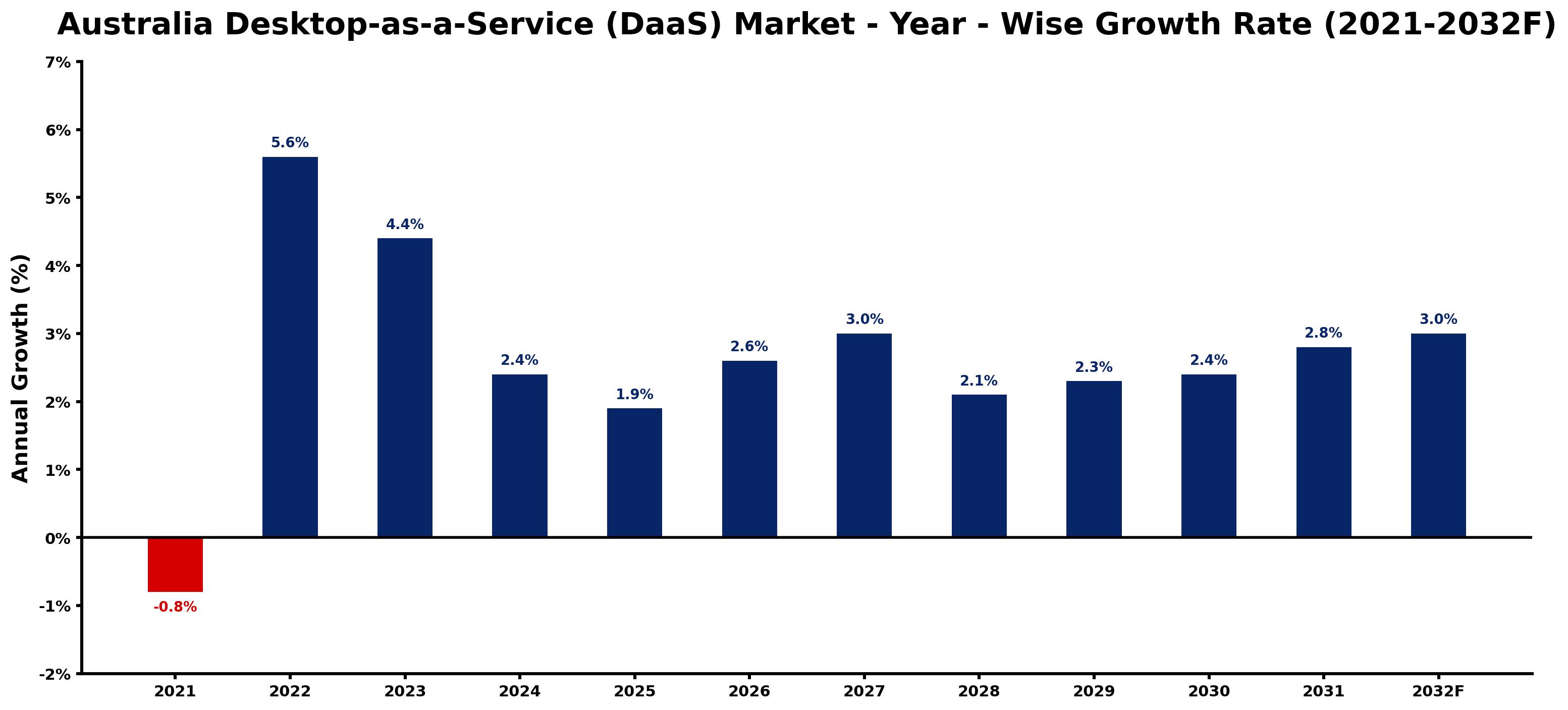
The table below presents the year‑wise growth rates along with the key drivers influencing the market
| Year | Growth Rate | Major Drivers |
| 2021 | -0.8% | Government infrastructure modernization initiatives |
| 2022 | 5.6% | Growing renewable energy integration projects |
| 2023 | 4.4% | Rising electricity demand across industries |
| 2024 | 2.4% | Increasing industrial automation investments |
| 2025 | 1.9% | Rapid growth in telecom and data center sectors |
| 2026 | 2.6% | Government infrastructure modernization initiatives |
| 2027 | 3.0% | Growing renewable energy integration projects |
| 2028 | 2.1% | Rising electricity demand across industries |
| 2029 | 2.3% | Increasing industrial automation investments |
| 2030 | 2.4% | Expansion of manufacturing activities |
| 2031 | 2.8% | Increasing industrial automation investments |
| 2032 | 3.0% | Increasing adoption of advanced technologies |
Note - Market size estimations and growth projections presented in this report are based on 6Wresearch’s advanced forecasting approach, validated with industry datasets as of June 2026.
Australia Desktop-as-a-Service (DaaS) Market Synopsis
A surge in remote work practices has significantly heightened demand for Desktop-as-a-Service (DaaS) in Australia. Companies are keen to leverage this technology to ensure their workforce remains productive, regardless of location. DaaS solutions not only simplify desktop management but also enhance data security and compliance, making them an attractive choice for organizations transitioning to a cloud-first approach.
Furthermore, Australian businesses are increasingly recognizing the value of scalable IT infrastructure that DaaS provides. With tailored packages designed to meet specific business needs, organizations can integrate these solutions seamlessly into their existing IT systems while also benefiting from cost-effective pricing structures that eliminate the need for heavy upfront investments in hardware.
Australia Desktop-as-a-Service (DaaS) Market Key Takeaways
- Growing remote work trends are propelling demand for DaaS solutions across various sectors.
- Enhanced security features are becoming a key selling point as organizations prioritize data protection.
- The need for scalable and flexible IT infrastructure continues to drive DaaS market growth.
- Collaborations between DaaS providers and other IT vendors are fostering innovation and competitiveness.
- Government initiatives are increasingly supporting the adoption of DaaS solutions, particularly in the public sector.
Evaluation of Restraints in Australia Desktop-as-a-Service (DaaS) Market
Despite the significant potential of the DaaS market in Australia, several restraints remain. The primary concern revolves around data security and compliance, with many organizations wary of the risks associated with cloud-based desktop solutions. Ensuring robust protection against data breaches and unauthorized access is essential for gaining the trust of potential clients. Additionally, the quality of internet connectivity plays a critical role in delivering the level of performance users expect from DaaS solutions, impacting overall customer satisfaction.
Australia Desktop-as-a-Service (DaaS) Market Trends
Several trends are shaping the Australia DaaS market as it evolves. Firstly, an emphasis on hybrid work models is prompting businesses to seek out solutions that offer seamless access to virtual desktops from various devices. Additionally, the growing integration of artificial intelligence and machine learning technologies into DaaS solutions is enhancing user experience and operational efficiencies. Lastly, sustainability considerations are beginning to influence purchasing decisions, with organizations looking for eco-friendly IT options that DaaS can support.
Australia Desktop-as-a-Service (DaaS) Market Opportunities
The DaaS market in Australia presents various growth and investment opportunities. One notable area is the increasing demand for tailored DaaS packages that cater specifically to different industries, such as healthcare and finance, where regulatory compliance is paramount. Furthermore, as more organizations begin their digital transformation journeys, the need for comprehensive support services alongside DaaS offerings creates avenues for service providers to differentiate themselves. Expanding into regional markets with untapped potential will also contribute significantly to overall market expansion.
Government Initiatives in the Australia Desktop-as-a-Service (DaaS) Market
Government initiatives play a crucial role in shaping the Australia DaaS market. Policies aimed at promoting digital transformation across public sector organizations are encouraging the adoption of DaaS solutions to enhance productivity and reduce IT costs. Regulatory bodies, such as the Australia Cyber Security Centre (ACSC), are setting guidelines to ensure that cloud-based systems meet stringent security standards. Additionally, investments in digital infrastructure through programs led by the Digital Transformation Agency (DTA) are further driving demand for innovative DaaS offerings.
Future Insights of the Australia Desktop-as-a-Service (DaaS) Market
Looking ahead to the period from 2026 to 2032, the Australia DaaS market is expected to continue its gradual growth, fueled by an ever-increasing reliance on cloud technologies. As businesses navigate the complexities of hybrid work environments, demand for secure, efficient, and scalable DaaS solutions will likely intensify. Additionally, the ongoing evolution of technology, coupled with a regulatory landscape that promotes cloud adoption, will facilitate innovative developments within the market, ensuring it remains responsive to the needs of Australian businesses.
Australia Desktop-as-a-Service (DaaS) Market Latest Developments (May 2025 - June 2026)
Recent developments in the Australia DaaS market have highlighted a strong focus on enhancing security protocols and service reliability. Providers are increasingly investing in advanced cybersecurity measures to mitigate the risks associated with data breaches. Additionally, numerous DaaS solutions are incorporating user-friendly features that promote seamless integration with existing workflows. As market players respond to the changing dynamics, customer feedback is driving iterative improvements in service offerings.
Australia Desktop-as-a-Service (DaaS) Market - Key Attractiveness of the Report
- 10 Years of Market Numbers
- Historical Data Starting from 2022 to 2025
- Base Year: 2025
- Forecast Data until 2032
- Key Performance Indicators Impacting the Market
- Major Upcoming Developments and Projects
Key Highlights of the Report:
- Australia Desktop-as-a-Service (DaaS) Market Outlook
- Market Size of Australia Desktop-as-a-Service (DaaS) Market, 2025
- Forecast of Australia Desktop-as-a-Service (DaaS) Market, 2032
- Historical Data and Forecast of Australia Desktop-as-a-Service (DaaS) Revenues & Volume for the Period 2022-2032F
- Australia Desktop-as-a-Service (DaaS) Market Trend Evolution
- Australia Desktop-as-a-Service (DaaS) Market Drivers and Challenges
- Australia Desktop-as-a-Service (DaaS) Price Trends
- Australia Desktop-as-a-Service (DaaS) Porter's Five Forces
- Australia Desktop-as-a-Service (DaaS) Industry Life Cycle
- Historical Data and Forecast of Australia Desktop-as-a-Service (DaaS) Market Revenues & Volume By Type for the Period 2022-2032F
- Historical Data and Forecast of Australia Desktop-as-a-Service (DaaS) Market Revenues & Volume By On-premises for the Period 2022-2032F
- Historical Data and Forecast of Australia Desktop-as-a-Service (DaaS) Market Revenues & Volume By Cloud for the Period 2022-2032F
- Historical Data and Forecast of Australia Desktop-as-a-Service (DaaS) Market Revenues & Volume By Application for the Period 2022-2032F
- Historical Data and Forecast of Australia Desktop-as-a-Service (DaaS) Market Revenues & Volume By Small Enterprises for the Period 2022-2032F
- Historical Data and Forecast of Australia Desktop-as-a-Service (DaaS) Market Revenues & Volume By Medium Enterprises for the Period 2022-2032F
- Historical Data and Forecast of Australia Desktop-as-a-Service (DaaS) Market Revenues & Volume By Large Enterprises for the Period 2022-2032F
- Australia Desktop-as-a-Service (DaaS) Import Export Trade Statistics
- Market Opportunity Assessment By Type
- Market Opportunity Assessment By Application
- Australia Desktop-as-a-Service (DaaS) Top Companies Market Share
- Australia Desktop-as-a-Service (DaaS) Competitive Benchmarking By Technical and Operational Parameters
- Australia Desktop-as-a-Service (DaaS) Company Profiles
- Australia Desktop-as-a-Service (DaaS) Key Strategic Recommendations
Australia Desktop-as-a-Service (DaaS) Market - Frequently Asked Questions
The growth of the DaaS market in Australia is driven by the increasing adoption of cloud computing and the necessity for flexible IT solutions to support remote work. Organizations are seeking scalable options that reduce costs while enhancing accessibility and security.
The Australia Desktop-as-a-Service market is estimated to be USD 105 Million in 2025 and is anticipated to reach USD 122 Million by 2032, with a CAGR of 2.2% from 2026 to 2032.
DaaS solutions incorporate advanced security measures, such as encryption and multi-factor authentication, to protect sensitive data. This is particularly important for organizations concerned about regulatory compliance and data privacy.
Government policies regarding digital transformation and cybersecurity have a substantial impact on the DaaS market, encouraging public sector adoption of these solutions to improve efficiency and service delivery.
Technologies such as artificial intelligence and machine learning are beginning to shape DaaS solutions, offering enhanced user experiences and operational efficiencies that appeal to businesses undergoing digital transformation.
6Wresearch actively monitors the Australia Desktop-as-a-Service (DaaS) Market and publishes its comprehensive annual report, highlighting emerging trends, growth drivers, revenue analysis, and forecast outlook. Our insights help businesses to make data-backed strategic decisions with ongoing market dynamics. Our analysts track relevent industries related to the Australia Desktop-as-a-Service (DaaS) Market, allowing our clients with actionable intelligence and reliable forecasts tailored to emerging regional needs.
Yes, we provide customisation as per your requirements. To learn more, feel free to contact us on sales@6wresearch.com
1 Executive Summary |
2 Introduction |
2.1 Key Highlights of the Report |
2.2 Report Description |
2.3 Market Scope & Segmentation |
2.4 Research Methodology |
2.5 Assumptions |
3 Australia Desktop-as-a-Service (DaaS) Market Overview |
3.1 Australia Country Macro Economic Indicators |
3.2 Australia Desktop-as-a-Service (DaaS) Market Revenues & Volume, 2022 & 2032F |
3.3 Australia Desktop-as-a-Service (DaaS) Market - Industry Life Cycle |
3.4 Australia Desktop-as-a-Service (DaaS) Market - Porter's Five Forces |
3.5 Australia Desktop-as-a-Service (DaaS) Market Revenues & Volume Share, By Type, 2022 & 2032F |
3.6 Australia Desktop-as-a-Service (DaaS) Market Revenues & Volume Share, By Form, 2022 & 2032F |
4 Australia Desktop-as-a-Service (DaaS) Market Dynamics |
4.1 Impact Analysis |
4.2 Market Drivers |
4.2.1 Increasing adoption of cloud computing solutions in Australia |
4.2.2 Growing trend towards remote work and bring your own device (BYOD) policies |
4.2.3 Demand for cost-effective and scalable IT solutions |
4.3 Market Restraints |
4.3.1 Concerns regarding data security and privacy in cloud-based solutions |
4.3.2 Limited awareness and understanding of desktop-as-a-service (DaaS) among businesses in Australia |
5 Australia Desktop-as-a-Service (DaaS) Market Trends |
6 Australia Desktop-as-a-Service (DaaS) Market, By Types |
6.1 Australia Desktop-as-a-Service (DaaS) Market, By Type |
6.1.1 Overview and Analysis |
6.1.2 Australia Desktop-as-a-Service (DaaS) Market Revenues & Volume, By Type, 2022-2032F |
6.1.3 Australia Desktop-as-a-Service (DaaS) Market Revenues & Volume, By On-premises, 2022-2032F |
6.1.4 Australia Desktop-as-a-Service (DaaS) Market Revenues & Volume, By Cloud, 2022-2032F |
6.2 Australia Desktop-as-a-Service (DaaS) Market, By Application |
6.2.1 Overview and Analysis |
6.2.2 Australia Desktop-as-a-Service (DaaS) Market Revenues & Volume, By Small Enterprises, 2022-2032F |
6.2.3 Australia Desktop-as-a-Service (DaaS) Market Revenues & Volume, By Medium Enterprises, 2022-2032F |
6.2.4 Australia Desktop-as-a-Service (DaaS) Market Revenues & Volume, By Large Enterprises, 2022-2032F |
7 Australia Desktop-as-a-Service (DaaS) Market Import-Export Trade Statistics |
7.1 Australia Desktop-as-a-Service (DaaS) Market Export to Major Countries |
7.2 Australia Desktop-as-a-Service (DaaS) Market Imports from Major Countries |
8 Australia Desktop-as-a-Service (DaaS) Market Key Performance Indicators |
8.1 Average response time for technical support and issue resolution |
8.2 Percentage increase in the number of DaaS providers in Australia |
8.3 Rate of adoption of DaaS solutions among small and medium enterprises (SMEs) |
9 Australia Desktop-as-a-Service (DaaS) Market - Opportunity Assessment |
9.1 Australia Desktop-as-a-Service (DaaS) Market Opportunity Assessment, By Type, 2022 & 2032F |
9.2 Australia Desktop-as-a-Service (DaaS) Market Opportunity Assessment, By Application, 2022 & 2032F |
10 Australia Desktop-as-a-Service (DaaS) Market - Competitive Landscape |
10.1 Australia Desktop-as-a-Service (DaaS) Market Revenue Share, By Companies, 2025 |
10.2 Australia Desktop-as-a-Service (DaaS) Market Competitive Benchmarking, By Operating and Technical Parameters |
11 Company Profiles |
12 Recommendations |
13 Disclaimer |
Global Go To Market Strategy - 2030
Export potential enables firms to identify high-growth global markets with greater confidence by combining advanced trade intelligence with a structured quantitative methodology. The framework analyzes emerging demand trends and country-level import patterns while integrating macroeconomic and trade datasets such as GDP and population forecasts, bilateral import–export flows, tariff structures, elasticity differentials between developed and developing economies, geographic distance, and import demand projections. Using weighted trade values from 2020–2024 as the base period to project country-to-country export potential for 2030, these inputs are operationalized through calculated drivers such as gravity model parameters, tariff impact factors, and projected GDP per-capita growth. Through an analysis of hidden potentials, demand hotspots, and market conditions that are most favorable to success, this method enables firms to focus on target countries, maximize returns, and global expansion with data, backed by accuracy.
By factoring in the projected importer demand gap that is currently unmet and could be potential opportunity, it identifies the potential for the Exporter (Country) among 190 countries, against the general trade analysis, which identifies the biggest importer or exporter.
To discover high-growth global markets and optimize your business strategy:
Click Here
Pricing
- Single User License$ 1,995
- Department License$ 2,400
- Site License$ 3,120
- Global License$ 3,795

Leadership Perspectives from Industry Events
Search
Thought Leadership and Analyst Meet





Our Clients








6WResearch In News
- India Air Conditioner Market Set for Strong Rebound in 2026 After Weather-Led Correction and GST-Driven Recovery: 6Wresearch
- ADAS in India: How Automatic Emergency Braking, Blind Spot Detection & Driver Monitoring are Transforming Road Safety
- Doha a strategic location for EV manufacturing hub: IPA Qatar
- Demand for luxury TVs surging in the GCC, says Samsung
- Empowering Growth: The Thriving Journey of Bangladesh’s Cable Industry
- Demand for luxury TVs surging in the GCC, says Samsung
Latest Reports
- Poland Fire Protection Systems Market (2026-2032)
- Cape Verde Portable Hand-Thrown Extinguisher Market (2026-2032)
- Canada Portable Hand-Thrown Extinguisher Market (2026-2032)
- Cameroon Portable Hand-Thrown Extinguisher Market (2026-2032)
- Burundi Portable Hand-Thrown Extinguisher Market (2026-2032)
- Burkina Faso Portable Hand-Thrown Extinguisher Market (2026-2032)
- Bulgaria Portable Hand-Thrown Extinguisher Market (2026-2032)
- Brunei Portable Hand-Thrown Extinguisher Market (2026-2032)
- Botswana Portable Hand-Thrown Extinguisher Market (2026-2032)
- Bosnia and Herzegovina Portable Hand-Thrown Extinguisher Market (2026-2032)
Industry Events and Analyst Meet

HIMTEX 2026

India Refining Summit 2026

India EV Show 2026

EV tech India Expo 2026

Auto Tech Asia 2026
Whitepaper
- Middle East & Africa Commercial Security Market Click here to view more.
- Middle East & Africa Fire Safety Systems & Equipment Market Click here to view more.
- GCC Drone Market Click here to view more.
- Middle East Lighting Fixture Market Click here to view more.
- GCC Physical & Perimeter Security Market Click here to view more.


