Australia Digital Lending Market Size & Growth Rate (2026-2032)
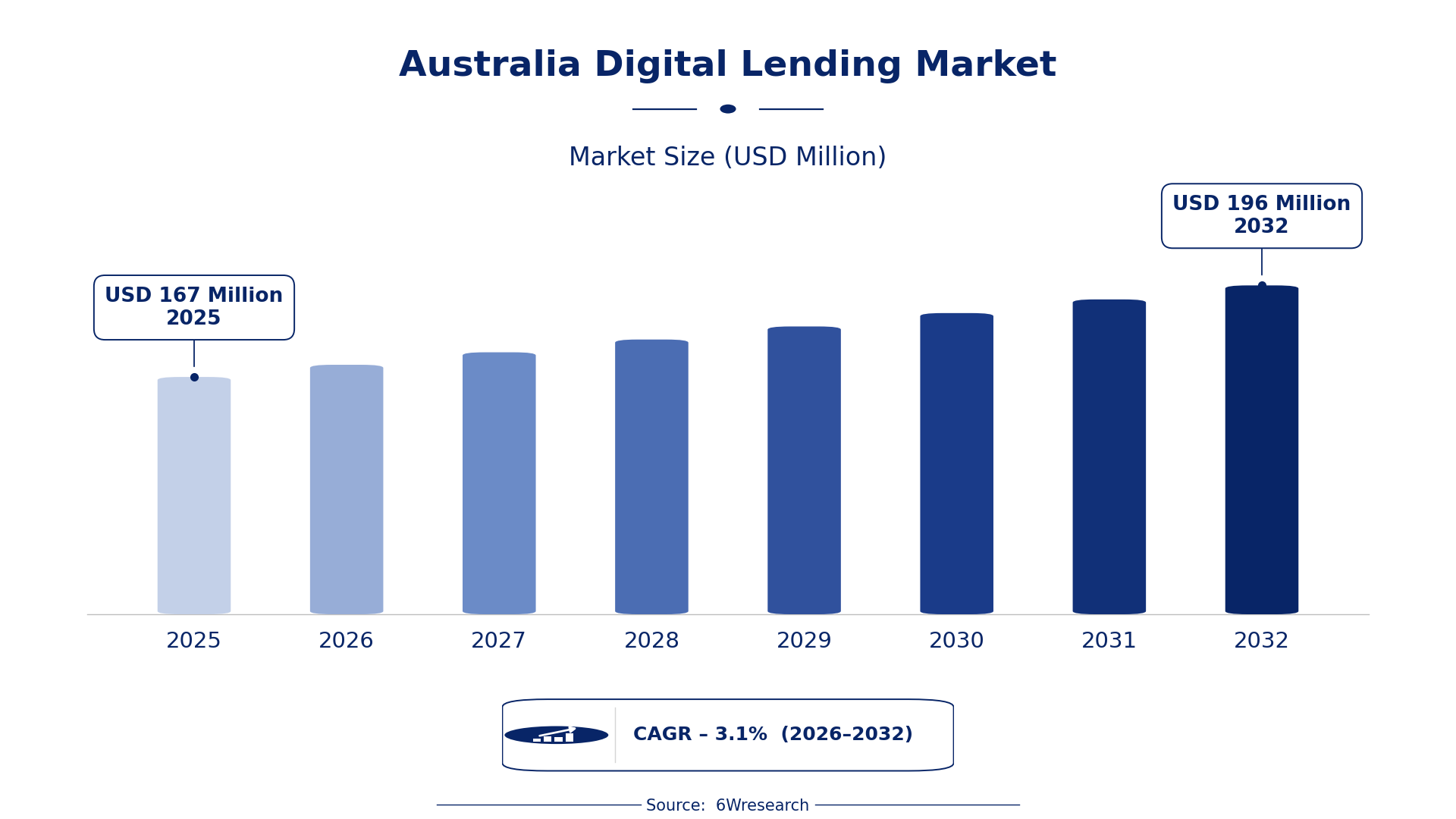
The Australia Digital Lending Market was estimated at USD 167 Million in 2025 and is projected to reach USD 196 Million by 2032, growing at a CAGR of 3.1% from 2026 to 2032.
Australia Digital Lending Market Synopsis
The surge in digital adoption is the most powerful force currently shaping the Australia Digital Lending Market. With consumers increasingly favoring online platforms for financial services, the demand for streamlined and efficient lending solutions is growing. This trend is evident as traditional banking institutions pivot to digital channels, fostering an environment ripe for innovation and competition.
The rise of fintech startups and alternative lending models like peer-to-peer lending are transforming the borrowing landscape. Additionally, the COVID-19 pandemic has acted as a catalyst, accelerating the shift towards digital channels as consumers and businesses alike seek remote financial services. This evolving scenario is setting the stage for significant market expansion in the coming years.
Australia Digital Lending Market Year-wise Growth Rate and Key Drivers
This graph illustrates the annual growth rates of the Australia Digital Lending Market from 2021 to 2032, highlighting a steady upward trajectory and projected expansion over the forecast period.
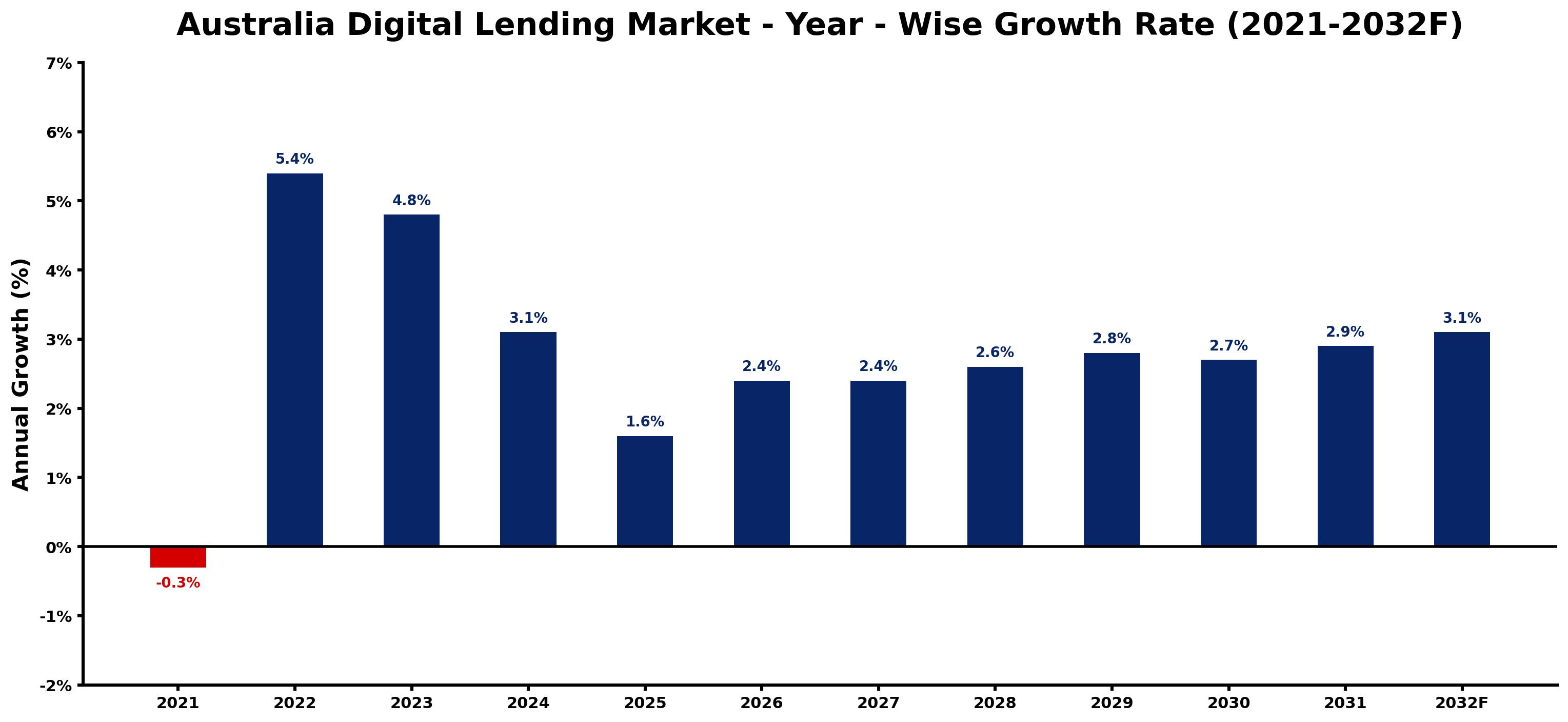
The table below presents the year‑wise growth rates along with the key drivers influencing the market
| Year | Growth Rate | Major Drivers |
| 2021 | -0.3% | Australian fintech regulations tightened by AUSTRAC enforcement. |
| 2022 | 5.4% | New Australian cybersecurity regulations boost digital lending safety |
| 2023 | 4.8% | Increased smartphone penetration enhances online loan accessibility. |
| 2024 | 3.1% | Rising millennial homebuyers drive demand for digital loans. |
| 2025 | 1.6% | Government initiatives promote fintech innovation and accessibility. |
| 2026 | 2.4% | Regulatory support for digital credit assessments expands offerings. |
| 2027 | 2.4% | Increased financial literacy programs boost digital lending adoption. |
| 2028 | 2.6% | Proliferation of peer-to-peer lending platforms enhances market. |
| 2029 | 2.8% | Growing gig economy necessitates flexible lending solutions. |
| 2030 | 2.7% | Local banks partner with fintechs to improve digital services. |
| 2031 | 2.9% | Fintech startups flourish, diversifying digital lending products. |
| 2032 | 3.1% | Increased internet access in rural areas enhances participation. |
Note: Market size estimations and growth projections presented in this report are based on 6Wresearch's proprietary forecasting methodology, utilizing the latest available industry data, government publications, and primary research inputs.
Australia Digital Lending Market Key Takeaways
Below are some of the specific key takeaways from the market, including:
- The market is experiencing a steady growth trajectory, fueled by technological advancements in lending processes.
- Consumer preference for online banking is reshaping how loans are sourced and delivered.
- Regulatory frameworks are evolving to ensure consumer protection while fostering innovation.
- Fintech solutions are increasingly being adopted by both lenders and borrowers.
- Government initiatives are facilitating access to digital lending, particularly during economic uncertainties.
Evaluation of Restraints in Australia Digital Lending Market
Despite its robust growth, the Australia Digital Lending Market faces several constraints. Regulatory compliance is a major hurdle for digital lenders, as they must navigate complex laws designed to protect consumers and ensure fair lending practices. This can be both challenging and costly, particularly for newer companies trying to establish themselves. on top of that, the issue of consumer trust in the digital space remains a barrier, especially with rising concerns over data privacy and security. Competition from traditional banks and other financial services also intensifies the pressure on digital lenders to differentiate their offerings.
Australia Digital Lending Market Trends
Several trends are influencing the Australia Digital Lending Market. The integration of artificial intelligence and big data analytics is streamlining loan approvals and enhancing risk assessment processes. on top of that, there is a growing emphasis on user experience, with platforms focusing on making the application process as intuitive as possible. The emergence of decentralized finance (DeFi) is also gaining traction, offering consumers alternative borrowing options outside traditional banking. These trends indicate that technology will continue to drive the market forward.
Australia Digital Lending Market Opportunities
Investment opportunities abound within the Australia Digital Lending Market. The increasing penetration of smartphones and the internet is opening avenues for digital lenders to reach untapped demographics, particularly in rural areas. Collaborations between fintech firms and established financial institutions can lead to innovative product offerings that cater to specific consumer needs. on top of that, as the regulatory environment matures, it may pave the way for more sophisticated lending solutions and greater consumer trust.
Government Initiatives in the Australia Digital Lending Market
Government policy plays a crucial role in shaping the Australia Digital Lending Market. Recent initiatives focus on fostering innovation while ensuring consumer protection. Regulatory bodies are actively working to create frameworks that support fintech development, which is vital for maintaining a competitive edge in the digital lending space.
- A regulatory framework introduced in 2025 mandating transparency in lending practices to protect consumers.
- The Australia Financial Technology and Regulatory Sandbox (AFTRS), currently in operation, provides a controlled environment for fintech innovations.
- Recent government-backed schemes, such as the First Home Loan Deposit Scheme (FHLDS), have made digital lending more accessible to first-time homebuyers.
- A planned initiative aimed at enhancing data privacy measures for digital lenders is expected to be rolled out by 2026.
- Current discussions on streamlining the National Consumer Credit Protection Act (NCCP) to accommodate emerging lending technologies.
Future Insights of the Australia Digital Lending Market
Looking ahead to 2026-2032, the Australia Digital Lending Market is set to undergo transformative changes. The adoption of advanced technologies will continue to redefine consumer expectations, pushing lenders to innovate continually. As regulatory environments become more conducive to fintech growth, expect a wave of new products tailored to meet diverse consumer needs. The ongoing shift towards digital services will further solidify digital lending as a staple in the financial services sector.
Australia Digital Lending Market Latest Developments
Over the past year, the Australia Digital Lending Market has witnessed a surge in activity, driven by technological advancements and shifting consumer preferences. Lenders are increasingly focusing on enhancing their digital platforms to improve customer experience and streamline loan processes. This trend is expected to continue as more players enter the market.
- A major technology vendor launched a new AI-driven credit assessment tool in early 2025, designed to expedite the loan approval process.
- An initiative that began in mid-2025 aims to integrate blockchain technology into lending processes to enhance security and transparency.
- A leading regional operator is currently expanding its digital loan offerings to include personal loans, expected to be fully available by Q4 2025.
- A planned partnership between fintech startups and traditional banks is set to begin in late 2026, focusing on co-developing innovative lending solutions.
- A regulatory review process initiated in early 2025 is ongoing, aiming to refine consumer protection regulations for digital lending platforms.
Australia Digital Lending Market - Key Attractiveness of the Report
- 10 Years of Market Numbers
- Historical Data Starting from 2022 to 2025
- Base Year: 2025
- Forecast Data until 2032
- Key Performance Indicators Impacting the Market
- Major Upcoming Developments and Projects
Key Highlights of the Report:
- Australia Digital Lending Market Outlook
- Market Size of Australia Digital Lending Market, 2025
- Forecast of Australia Digital Lending Market, 2032
- Historical Data and Forecast of Australia Digital Lending Revenues & Volume for the Period 2022-2032F
- Australia Digital Lending Market Trend Evolution
- Australia Digital Lending Market Drivers and Challenges
- Australia Digital Lending Price Trends
- Australia Digital Lending Porter's Five Forces
- Australia Digital Lending Industry Life Cycle
- Historical Data and Forecast of Australia Digital Lending Market Revenues & Volume By Offering for the Period 2022-2032F
- Historical Data and Forecast of Australia Digital Lending Market Revenues & Volume By Solutions for the Period 2022-2032F
- Historical Data and Forecast of Australia Digital Lending Market Revenues & Volume By Services for the Period 2022-2032F
- Historical Data and Forecast of Australia Digital Lending Market Revenues & Volume By Deployment Mode for the Period 2022-2032F
- Historical Data and Forecast of Australia Digital Lending Market Revenues & Volume By Cloud for the Period 2022-2032F
- Historical Data and Forecast of Australia Digital Lending Market Revenues & Volume By On-premises for the Period 2022-2032F
- Historical Data and Forecast of Australia Digital Lending Market Revenues & Volume By End User for the Period 2022-2032F
- Historical Data and Forecast of Australia Digital Lending Market Revenues & Volume By Banks for the Period 2022-2032F
- Historical Data and Forecast of Australia Digital Lending Market Revenues & Volume By Credit Unions for the Period 2022-2032F
- Historical Data and Forecast of Australia Digital Lending Market Revenues & Volume By NBFCs for the Period 2022-2032F
- Australia Digital Lending Import Export Trade Statistics
- Market Opportunity Assessment By Offering
- Market Opportunity Assessment By Deployment Mode
- Market Opportunity Assessment By End User
- Australia Digital Lending Top Companies Market Share
- Australia Digital Lending Competitive Benchmarking By Technical and Operational Parameters
- Australia Digital Lending Company Profiles
- Australia Digital Lending Key Strategic Recommendations






































