Australia Electric and Acoustic Guitar Strings Market Size, Share & Growth Rate
The Australia Electric and Acoustic Guitar Strings Market was estimated at USD 232 Million in 2025 and is projected to reach USD 273 Million by 2032, growing at a CAGR of 2.4% from 2026 to 2032. This growth trajectory is underscored by a notable increase in the number of musicians and hobbyists engaged in guitar playing across Australia. The accessibility of online tutorials and music streaming services, coupled with rising disposable incomes, is fueling a heightened demand for high-quality guitar strings.
Australia Electric and Acoustic Guitar Strings Market Year-wise Growth Rate and Key Drivers
This graph highlights how the Australia Electric and Acoustic Guitar Strings Market has steadily grown over the years, supported by major growth factors.
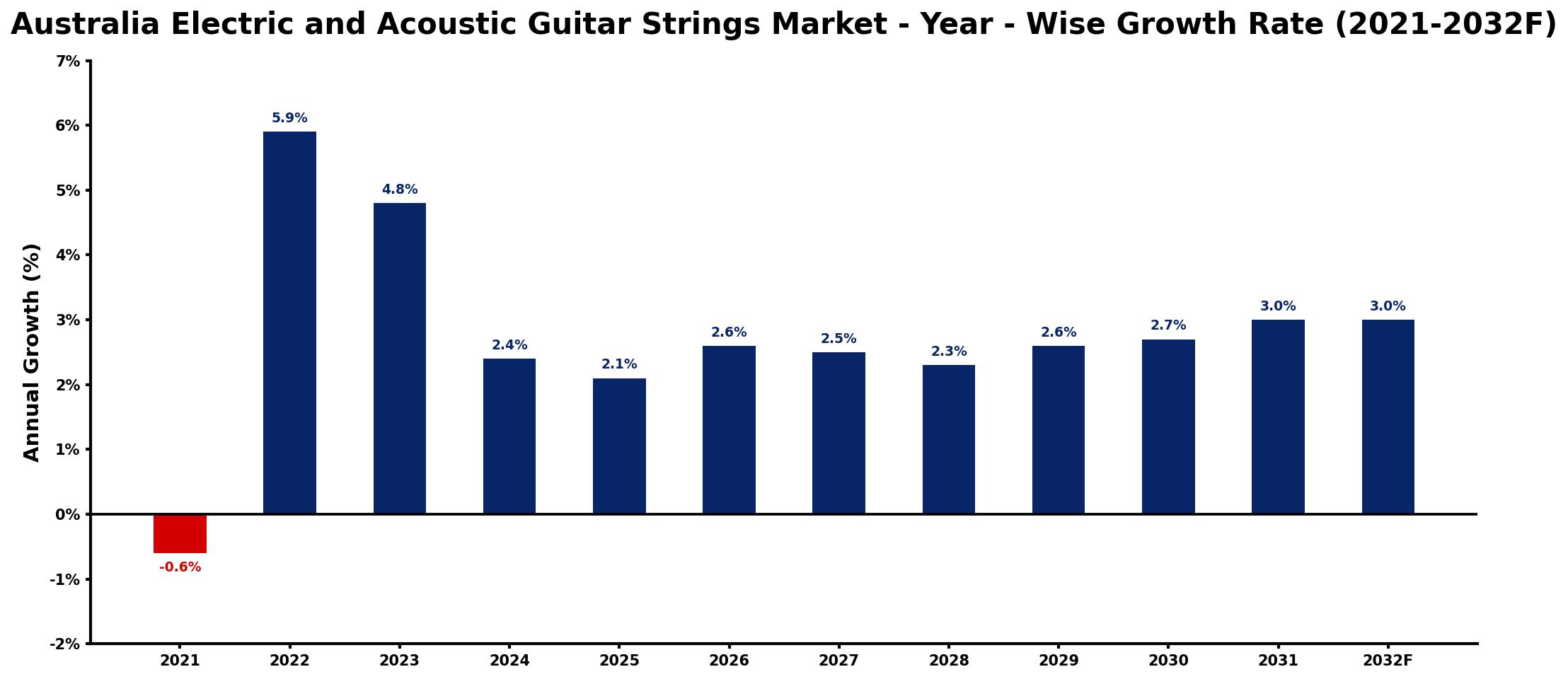
The table below presents the year‑wise growth rates along with the key drivers influencing the market
| Year | Growth Rate | Major Drivers |
| 2021 | -0.6% | Supply chain disruptions impact availability |
| 2022 | 5.9% | Rising consumer interest in music |
| 2023 | 4.8% | Increased online retail opportunities |
| 2024 | 2.4% | Growing popularity of music festivals |
| 2025 | 2.1% | Expanding music education programs |
| 2026 | 2.6% | Emerging trends in music genres |
| 2027 | 2.5% | Rising disposable income for hobbies |
| 2028 | 2.3% | Innovations in manufacturing technology |
| 2029 | 2.6% | Collaborations with popular artists |
| 2030 | 2.7% | Increased focus on sustainability initiatives |
| 2031 | 3.0% | Growth in home recording studios |
| 2032 | 3.0% | Enhanced social media marketing strategies |
Note: Market size estimations and growth projections presented in this report are based on 6Wresearch's proprietary forecasting methodology, utilizing the latest available industry data, government publications, and primary research inputs.
Australia Electric and Acoustic Guitar Strings Market Synopsis
In recent years, the Australia electric and acoustic guitar strings market has experienced robust momentum, largely driven by a surge in music education programs and live performances. However, as the market matures, it is anticipated that continued innovations in string materials and manufacturing processes will play a crucial role in shaping future growth.
Moreover, the advent of social media platforms has propelled the visibility of guitar playing, allowing emerging artists to showcase their talents and inspiring a new wave of enthusiasts. This dynamic environment suggests that the demand for premium guitar strings, which enhance instrument playability and sound quality, will remain strong.
Australia Electric and Acoustic Guitar Strings Market Key Takeaways
- Increasing interest in guitar playing among varied age groups is driving consistent market demand.
- Technological advancements are leading to the production of innovative and durable guitar strings.
- Ongoing competition from low-cost imports poses challenges to established brands and quality assurance.
- The market is supported by a growth in music education initiatives, promoting engagement across demographics.
- Government policies focus on consumer protection and industry standards, ensuring product quality.
Evaluation of Restraints in Australia Electric and Acoustic Guitar Strings Market
While the Australia electric and acoustic guitar strings market is positioned for growth, it is not without its challenges. The prevalence of low-cost imports can undercut established brands, making it difficult for consumers to discern quality and authenticity. Additionally, fluctuations in the pricing of raw materials, particularly for high-quality metals used in string production, can lead to variability in production costs. This creates a delicate balancing act for manufacturers as they strive to maintain competitive pricing without sacrificing quality. Furthermore, the market faces a pressing need for continuous innovation to meet the evolving preferences of diverse playing styles and musical genres.
Australia Electric and Acoustic Guitar Strings Market Trends
Current trends within the Australia electric and acoustic guitar strings market include a shift towards the use of advanced materials, such as synthetic composites, which offer enhanced durability and improved tonal characteristics. Additionally, custom string sets designed to meet specific genres or playing techniques are gaining popularity among musicians. The rise of sustainable practices in manufacturing is also notable, as brands increasingly focus on environmentally friendly materials and production processes.
Australia Electric and Acoustic Guitar Strings Market Opportunities
As the market evolves, there are substantial opportunities for growth through product diversification and innovation. Companies can explore niche markets by creating specialized strings for various genres, such as jazz, rock, or classical. Moreover, tapping into online retail channels and leveraging digital marketing strategies could expand reach and enhance customer engagement. With the increasing trend of DIY music production, manufacturers have the potential to cater to home studio musicians seeking premium quality strings to elevate their sound.
Government Initiatives in the Australia Electric and Acoustic Guitar Strings Market
The Australian government emphasizes consumer protection in the electric and acoustic guitar strings market through regulatory frameworks designed to ensure product safety and quality. These policies address material composition, durability, and performance characteristics, safeguarding both musicians and manufacturers. In addition, initiatives supporting industry associations focus on the establishment of guidelines that promote best practices and uphold the integrity of the market, enhancing consumer trust in product offerings.
Future Insights of the Australia Electric and Acoustic Guitar Strings Market
Looking ahead to the period from 2026 to 2032, the Australia electric and acoustic guitar strings market is set to witness transformative changes driven by technological advancements and evolving consumer preferences. As the popularity of guitar playing continues to surge, manufacturers will likely respond with increasingly innovative products that meet the demands of a diverse musical landscape. Enhanced focus on sustainability and customization will further characterize this market, paving the way for new entrants and established brands to capture growth opportunities.
Australia Electric and Acoustic Guitar Strings Market Latest Developments (2025 - 2026)
Recent developments in the Australia electric and acoustic guitar strings market indicate a shift towards more sustainable production practices and innovative material usage. Companies are increasingly introducing products that not only enhance performance but also adhere to eco-friendly standards. Additionally, there has been a noticeable uptick in collaborations between manufacturers and music educators, aiming to develop tailored products that meet the needs of aspiring musicians. These trends reflect a commitment to quality and consumer-centric approaches, further positioning the market for sustained growth.
Australia Electric and Acoustic Guitar Strings Market - Key Attractiveness of the Report
- 10 Years of Market Numbers
- Historical Data Starting from 2022 to 2025
- Base Year: 2025
- Forecast Data until 2032
- Key Performance Indicators Impacting the Market
- Major Upcoming Developments and Projects
Key Highlights of the Report:
- Australia Electric and Acoustic Guitar Strings Market Outlook
- Market Size of Australia Electric and Acoustic Guitar Strings Market, 2025
- Forecast of Australia Electric and Acoustic Guitar Strings Market, 2032
- Historical Data and Forecast of Australia Electric and Acoustic Guitar Strings Revenues & Volume for the Period 2022-2032F
- Australia Electric and Acoustic Guitar Strings Market Trend Evolution
- Australia Electric and Acoustic Guitar Strings Market Drivers and Challenges
- Australia Electric and Acoustic Guitar Strings Price Trends
- Australia Electric and Acoustic Guitar Strings Porter's Five Forces
- Australia Electric and Acoustic Guitar Strings Industry Life Cycle
- Historical Data and Forecast of Australia Electric and Acoustic Guitar Strings Market Revenues & Volume By Product Type for the Period 2022-2032F
- Historical Data and Forecast of Australia Electric and Acoustic Guitar Strings Market Revenues & Volume By Light, Custom Light for the Period 2022-2032F
- Historical Data and Forecast of Australia Electric and Acoustic Guitar Strings Market Revenues & Volume By Extra Light for the Period 2022-2032F
- Historical Data and Forecast of Australia Electric and Acoustic Guitar Strings Market Revenues & Volume By Application for the Period 2022-2032F
- Historical Data and Forecast of Australia Electric and Acoustic Guitar Strings Market Revenues & Volume By Acoustic Guitar for the Period 2022-2032F
- Historical Data and Forecast of Australia Electric and Acoustic Guitar Strings Market Revenues & Volume By Electric Guitar for the Period 2022-2032F
- Australia Electric and Acoustic Guitar Strings Import Export Trade Statistics
- Market Opportunity Assessment By Product Type
- Market Opportunity Assessment By Application
- Australia Electric and Acoustic Guitar Strings Top Companies Market Share
- Australia Electric and Acoustic Guitar Strings Competitive Benchmarking By Technical and Operational Parameters
- Australia Electric and Acoustic Guitar Strings Company Profiles
- Australia Electric and Acoustic Guitar Strings Key Strategic Recommendations






































