Australia Electric Connectors Market Summary
The australia electric connectors market was estimated at USD 125 Million in 2025 and is projected to reach USD 147 Million by 2032, growing at a CAGR of 2.9% from 2026 to 2032.
Australia Electric Connectors Market Year-wise Growth Rate and Key Drivers
This graph highlights how the Australia Electric Connectors Market has steadily grown over the past five years, supported by major growth factors.
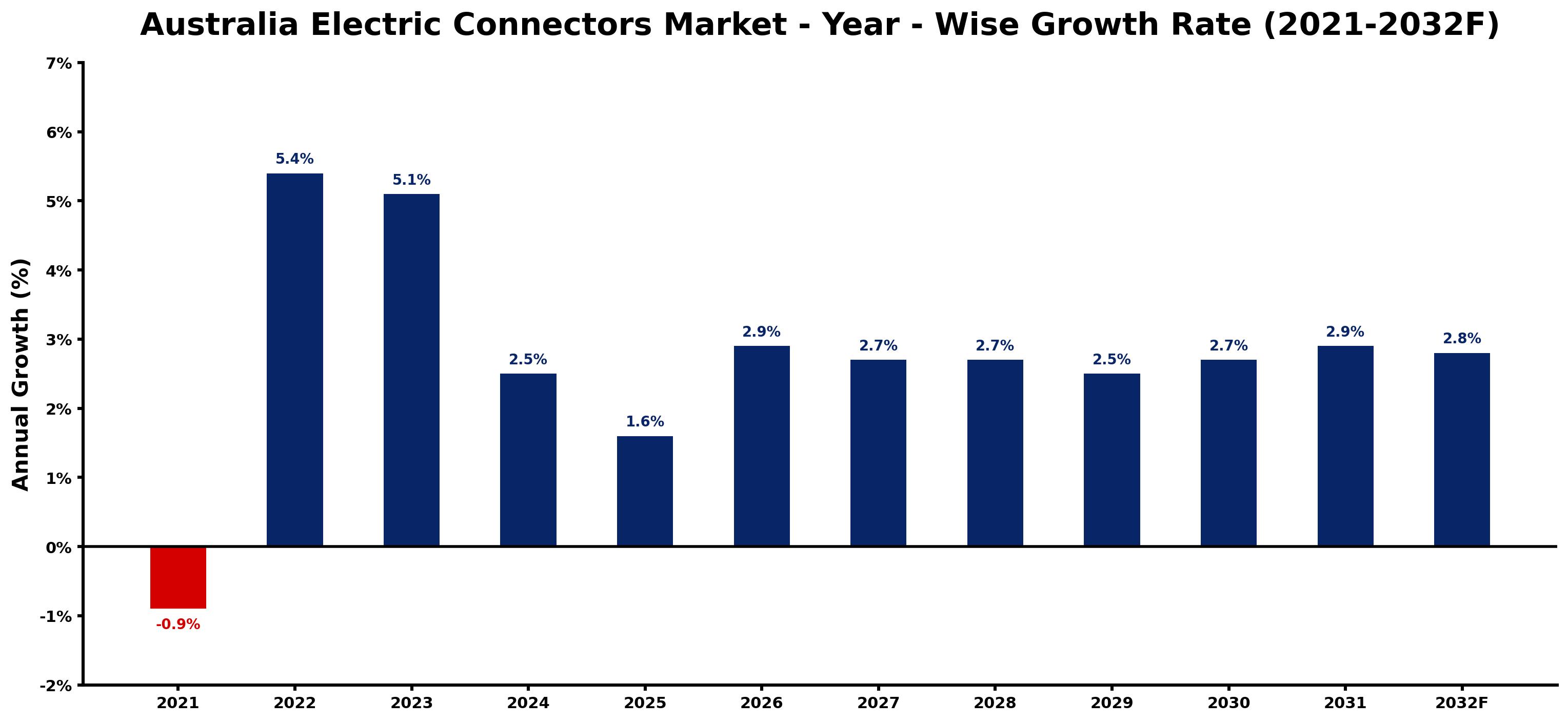
The table below presents the year wise growth rates along with the key drivers influencing the market
| Year | Growth Rate | Major Drivers |
| 2021 | -0.9% | Supply chain disruptions hindered manufacturing efficiency, leading to delays and reduced availability of electric connectors. |
| 2022 | 5.4% | Transition to renewable energy projects highlighted the need for advanced electric connectors. |
| 2023 | 5.1% | Local manufacturing capabilities improved, reducing import dependency for electric connector supply. |
| 2024 | 2.5% | Technological upgrades in smart grids necessitated higher quality connector solutions. |
| 2025 | 1.6% | Increased residential solar panel installations created a demand for specialized connectors. |
| 2026 | 2.9% | Heavy investment in infrastructure projects expanded the market for durable electric connectors. |
| 2027 | 2.7% | Emerging electric vehicle charging stations increased the necessity for reliable connectors. |
| 2028 | 2.7% | Consumer electronics innovations prompted a surge in connector design modifications. |
| 2029 | 2.5% | Energy efficiency targets pushed industries to upgrade their connector systems significantly. |
| 2030 | 2.7% | Sustainability trends motivated manufacturers to develop eco-friendly connector materials. |
| 2031 | 2.9% | Growing telecommunications networks required robust connectors for enhanced signal reliability. |
| 2032 | 2.8% | Smart home technology integration led to increased complexity in connector requirements. |
Note - Market size estimations and growth projections presented in this report are based on 6Wresearch's advanced forecasting approach, validated with industry datasets as of June 2026.
Australia Electric Connectors Market Synopsis
The Australia Electric Connectors Market is projected to reach 2.9% and witness significant growth during the forecast period (2026-2032). This market is essential for the efficiency and reliability of electrical connections across various industries, including automotive, aerospace, telecommunications, and consumer electronics. Electric connectors are indispensable in facilitating the seamless transmission of power and signals among electronic components and systems. The array of electric connectors available in Australia includes cable connectors, PCB connectors, and wire-to-wire connectors, each designed to meet specific application requirements and industry standards.
Australia Electric Connectors Market Growth Drivers
The Australia Electric Connectors Market is witnessing substantial growth fueled by multiple factors. Firstly, the increasing demand for innovative connectors across key industries plays a pivotal role in market expansion. The automotive sector's transition toward electric vehicles is driving the need for advanced electric connectors to ensure efficient power transmission. Additionally, the telecommunications industry is experiencing a surge in connectivity requirements, necessitating high-performance connectors for data transmission.
- The rise in consumer electronics is another critical driver. With the proliferation of electronic devices, connectors are essential for ensuring reliable connections, thereby supporting the growth of the electric connectors market.
- Furthermore, the emphasis on energy efficiency and reducing carbon emissions is leading to increased investments in renewable energy systems. This shift necessitates the use of connectors for efficient energy transmission and management.
- Technological advancements, including the development of miniaturized and high-speed connectors, are broadening the scope of applications across various industries. These innovations are crucial for enhancing performance and meeting the demands of modern technology.
- The ongoing focus on the Internet of Things (IoT) connectivity is driving the need for connectors that can facilitate seamless communication among devices, further propelling market demand.
- Overall, these drivers are collectively influencing the Australia Electric Connectors Market, leading to robust growth and continued innovation.
Australia Electric Connectors Market Challenges and Restraints
While the Australia Electric Connectors Market is poised for growth, it faces several challenges that may hinder its progress. One significant issue is the interoperability and standardization of connectors, especially in sectors like electric vehicles. Various manufacturers employ different connector types and standards, which can lead to compatibility problems that impede the integration of charging infrastructure.
- These compatibility issues not only complicate the consumer experience but also slow down the adoption of electric vehicles, which are essential for meeting environmental goals.
- Additionally, regulatory compliance related to safety and performance standards poses another challenge. Manufacturers must navigate complex regulations set by authorities, which can impact production timelines and costs.
- Market players may also encounter competitive pressures as innovations and technological advancements drive rapid changes in consumer preferences and industry standards.
- Supply chain disruptions caused by global events can also affect the availability of components, hindering manufacturers' ability to meet demand.
- Finally, the ongoing challenge of maintaining quality while reducing costs can strain resources and impact market dynamics.
Australia Electric Connectors Market Government Investment and Initiatives
Government policies and initiatives are instrumental in shaping the landscape of the Australia Electric Connectors Market. Regulations enforced by bodies like the Australian Communications and Media Authority (ACMA) and the Australian Competition and Consumer Commission (ACCC) govern the safety, performance, and compliance of electric connectors, ensuring that they meet stringent industry standards.
- The government is also prioritizing the development of infrastructure for electric vehicles, which includes investments in charging stations that require reliable and standardized connectors to ensure compatibility and efficiency.
- Policies aimed at promoting renewable energy have led to increased funding and incentives for projects that rely on innovative electric connectors for energy management.
- In addition, research initiatives backed by the government are fostering innovation in advanced manufacturing technologies, which may enhance the competitiveness of Australian manufacturers in the global market.
- The focus on improving industrial capabilities and transparency in procurement processes is also expected to enhance market dynamics, driving demand for high-quality connectors.
- Overall, government initiatives play a crucial role in supporting the growth and development of the electric connectors market in Australia, paving the way for sustainable practices and advanced technology integration.
Australia Electric Connectors Market Latest Developments (May 2025 - June 2026)
The period from May 2025 to June 2026 has been marked by notable developments in the Australia Electric Connectors Market. The industry has seen increased collaboration among stakeholders in the automotive and renewable energy sectors, driven by the need for enhanced performance and reliability of electric connectors. The growth of smart technologies has spurred innovation, leading to the introduction of connectors designed to meet the requirements of advanced applications.
- Key advancements in miniaturized connector technology have emerged, responding to the demand for compact and efficient solutions in consumer electronics.
- The manufacturing sector is increasingly focusing on sustainability, with a push toward environmentally friendly materials in connector production.
- Research and development initiatives funded by government grants have led to breakthroughs in high-speed and high-performance connectors, allowing for more robust applications in telecommunications.
- The rise in remote working environments has prompted a surge in demand for reliable connectors in networking equipment, highlighting the critical role of connectors in daily operations.
- Overall, industry trends indicate a commitment to quality, reliability, and innovation that is expected to shape the future of the electric connectors market in Australia.
Australia Electric Connectors Market - Key Attractiveness of the Report
- 10 Years of Market Numbers
- Historical Data Starting from 2022 to 2025
- Base Year: 2025
- Forecast Data until 2032
- Key Performance Indicators Impacting the Market
- Major Upcoming Developments and Projects
Key Highlights of the Report:
- Australia Electric Connectors Market Outlook
- Market Size of Australia Electric Connectors Market, 2025
- Forecast of Australia Electric Connectors Market, 2032
- Historical Data and Forecast of Australia Electric Connectors Revenues & Volume for the Period 2022-2032F
- Australia Electric Connectors Market Trend Evolution
- Australia Electric Connectors Market Drivers and Challenges
- Australia Electric Connectors Price Trends
- Australia Electric Connectors Porter's Five Forces
- Australia Electric Connectors Industry Life Cycle
- Historical Data and Forecast of Australia Electric Connectors Market Revenues & Volume By Type for the Period 2022-2032F
- Historical Data and Forecast of Australia Electric Connectors Market Revenues & Volume By Aluminum Electrical Connectors for the Period 2022-2032F
- Historical Data and Forecast of Australia Electric Connectors Market Revenues & Volume By Copper Electrical Connectors for the Period 2022-2032F
- Historical Data and Forecast of Australia Electric Connectors Market Revenues & Volume By Others for the Period 2022-2032F
- Historical Data and Forecast of Australia Electric Connectors Market Revenues & Volume By ?Application for the Period 2022-2032F
- Historical Data and Forecast of Australia Electric Connectors Market Revenues & Volume By Electrical Device for the Period 2022-2032F
- Historical Data and Forecast of Australia Electric Connectors Market Revenues & Volume By Airplanes for the Period 2022-2032F
- Historical Data and Forecast of Australia Electric Connectors Market Revenues & Volume By National Defense for the Period 2022-2032F
- Historical Data and Forecast of Australia Electric Connectors Market Revenues & Volume By Industrial Equipments for the Period 2022-2032F
- Historical Data and Forecast of Australia Electric Connectors Market Revenues & Volume By Others for the Period 2022-2032F
- Australia Electric Connectors Import Export Trade Statistics
- Market Opportunity Assessment By Type
- Market Opportunity Assessment By ?Application
- Australia Electric Connectors Top Companies Market Share
- Australia Electric Connectors Competitive Benchmarking By Technical and Operational Parameters
- Australia Electric Connectors Company Profiles
- Australia Electric Connectors Key Strategic Recommendations






































