Australia Electric lighting equipment Market Summary
The australia electric lighting equipment market was estimated at USD 219 Million in 2025 and is projected to reach USD 258 Million by 2032, growing at a CAGR of 2.5% from 2026 to 2032.
Australia Electric lighting equipment Market Year-wise Growth Rate and Key Drivers
This graph highlights how the Australia Electric lighting equipment Market has steadily grown over the past five years, supported by major growth factors.
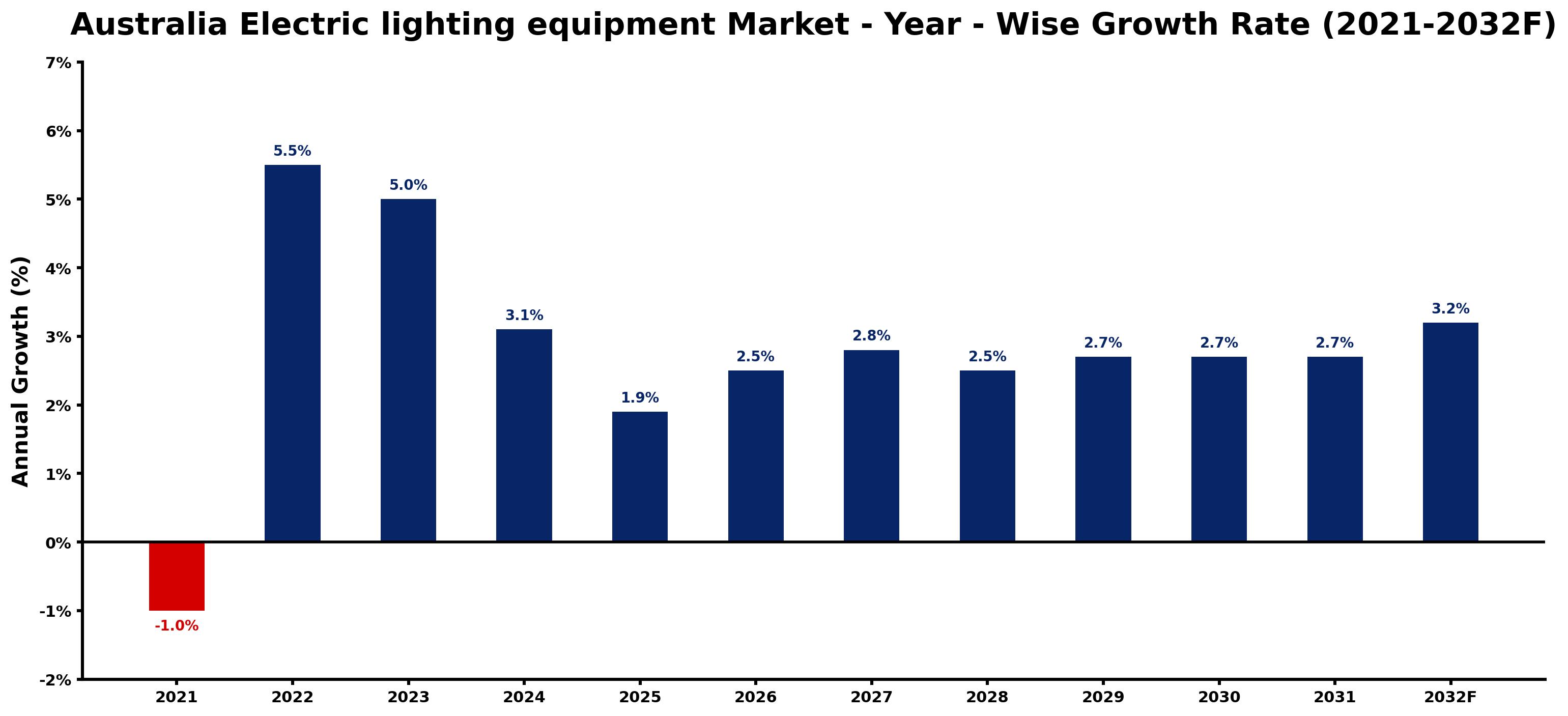
The table below presents the year wise growth rates along with the key drivers influencing the market
| Year | Growth Rate | Major Drivers |
| 2021 | -1.0% | Increased adoption of energyefficient solutions diminished demand for traditional electric lighting equipment. |
| 2022 | 5.5% | Consumer preference shifted towards smart lighting, enhancing home automation experiences significantly. |
| 2023 | 5.0% | Legacy copper grid failures prompted investments in modern electrical infrastructure nationwide. |
| 2024 | 3.1% | Corporate sustainability goals increasingly emphasize energy-efficient lighting technologies in operations. |
| 2025 | 1.9% | The construction sector's recovery sparked a surge in residential and commercial lighting projects. |
| 2026 | 2.5% | Technological innovations in LED efficiency resulted in lower operational costs for manufacturers. |
| 2027 | 2.8% | Growing e-commerce platforms expanded opportunities for innovative lighting products in homes. |
| 2028 | 2.5% | Urbanization trends intensified the need for effective street and public lighting solutions. |
| 2029 | 2.7% | Collaborations between tech companies and lighting firms evolved smart city initiatives across regions. |
| 2030 | 2.7% | Developments in renewable energy integration transformed traditional lighting supply chains effectively. |
| 2031 | 2.7% | Consumer education on sustainable practices fueled interest in eco-friendly lighting options. |
| 2032 | 3.2% | Market players increasingly recognize potential in retrofitting older buildings with modern technologies. |
Note - Market size estimations and growth projections presented in this report are based on 6Wresearch's advanced forecasting approach, validated with industry datasets as of June 2026.
Australia Electric lighting equipment Market Synopsis
The Australia Electric lighting equipment Market is projected to reach 2.5% and witness significant growth during the forecast period (2026-2032). This market encompasses a diverse array of products, including light bulbs, fixtures, controls, and supporting accessories. The increasing adoption of energy-efficient technologies, such as LED lighting and smart lighting systems, is primarily driven by regulatory mandates and a shifting consumer preference towards sustainable solutions.
Australia Electric lighting equipment Market Growth Drivers
The growth of the Australia Electric lighting equipment market is underpinned by several critical drivers:
- Urbanization plays a pivotal role in spurring demand for electric lighting solutions across residential, commercial, and public infrastructures, necessitating enhanced lighting equipment.
- The transition to energy-efficient lighting technologies, particularly LED systems, is significantly influenced by governmental regulations aimed at promoting sustainability and reducing energy consumption.
- Advancements in lighting design and control, such as smart lighting technologies, are rapidly catering to evolving consumer expectations regarding aesthetic appeal and energy savings.
- Innovation within the sector, including the development of connected lighting and human-centric designs, enhances user experience and promotes energy efficiency.
- Increased emphasis on environmental sustainability among consumers is driving manufacturers to focus on creating products that are both high-performing and environmentally friendly.
Australia Electric lighting equipment Market Challenges and Restraints
Despite the positive growth trajectory, the Australia Electric lighting equipment market faces several challenges:
- As energy conservation awareness rises, the demand for energy-efficient products such as LEDs increases, leading to intensified price competition among manufacturers.
- The commoditization of LED lighting products necessitates that companies differentiate themselves based on quality, performance, and unique features.
- Compliance with regulatory changes regarding lighting efficiency and quality can impose significant burdens on manufacturers and distributors, requiring ongoing investment in development and training.
- Market competition continues to heighten, compelling companies to identify innovative pathways to maintain their market share and adhere to customer expectations.
- Rapid technological advancements necessitate continuous investment in research and development to keep pace with consumer preferences and new market entrants.
Australia Electric lighting equipment Market Trends and Opportunities
Emerging trends and opportunities within the Australia Electric lighting equipment market are shaping the future landscape:
- The increasing integration of Internet of Things (IoT) with lighting solutions enables greater automation and control, appealing to tech-savvy consumers.
- Demand for smart homes and buildings is fostering innovation in home automation systems, providing businesses with opportunities to offer integrated lighting solutions.
- Energy-efficient upgrades for existing infrastructure present substantial opportunities for both manufacturers and service providers, as retrofitting becomes more common.
- Sustainability-focused initiatives are prompting a shift towards circular economy models, encouraging manufacturers to explore recyclable materials in product design.
- Government incentives aimed at promoting energy efficiency will likely create a conducive environment for expanding product lines that meet regulatory standards.
Australia Electric lighting equipment Market Government Investment and Initiatives
Government policies are instrumental in shaping the dynamics of the Australia Electric lighting equipment market:
- Regulatory frameworks are being established to set minimum performance standards for lighting products, promoting the adoption of energy-efficient technologies like LEDs.
- Government-led energy efficiency programs encourage consumers to choose energy-saving lighting solutions, thereby increasing market demand.
- Building codes and procurement policies often mandate the use of energy-efficient lighting in public sector projects, further underpinning market growth.
- Environmental regulations addressing the disposal and recycling of lighting products compel manufacturers to incorporate sustainable practices in their operations.
- Public funding for research and development in the lighting sector supports innovation and helps align industry practices with environmental sustainability goals.
Australia Electric lighting equipment Market Latest Developments (May 2025 - June 2026)
Recent developments in the Australia Electric lighting equipment market between May 2025 and June 2026 indicate a continued emphasis on innovation and sustainability:
- There has been a noticeable increase in product launches focused on smart lighting solutions, responding to consumer demands for enhanced control and customization.
- Collaborations between technological firms and lighting manufacturers have intensified, particularly in the realm of IoT-enabled lighting solutions.
- Market participants are increasingly prioritizing sustainable practices in their product development, focusing on recyclable materials and energy-efficient technologies.
- Regulatory agencies have announced updates to energy efficiency standards, further pushing for the adoption of advanced lighting solutions in both public and private sectors.
- Trade exhibitions and industry conferences have showcased the latest advancements in smart lighting technology, presenting opportunities for networking and collaboration among stakeholders.
Australia Electric lighting equipment Market - Key Attractiveness of the Report
- 10 Years of Market Numbers
- Historical Data Starting from 2022 to 2025
- Base Year: 2025
- Forecast Data until 2032
- Key Performance Indicators Impacting the Market
- Major Upcoming Developments and Projects
Key Highlights of the Report:
- Australia Electric lighting equipment Market Outlook
- Market Size of Australia Electric lighting equipment Market, 2025
- Forecast of Australia Electric lighting equipment Market, 2032
- Historical Data and Forecast of Australia Electric lighting equipment Revenues & Volume for the Period 2022-2032F
- Australia Electric lighting equipment Market Trend Evolution
- Australia Electric lighting equipment Market Drivers and Challenges
- Australia Electric lighting equipment Price Trends
- Australia Electric lighting equipment Porter's Five Forces
- Australia Electric lighting equipment Industry Life Cycle
- Historical Data and Forecast of Australia Electric lighting equipment Market Revenues & Volume By Type for the Period 2022-2032F
- Historical Data and Forecast of Australia Electric lighting equipment Market Revenues & Volume By General Lighting for the Period 2022-2032F
- Historical Data and Forecast of Australia Electric lighting equipment Market Revenues & Volume By Automotive Lighting for the Period 2022-2032F
- Historical Data and Forecast of Australia Electric lighting equipment Market Revenues & Volume By Back Lighting for the Period 2022-2032F
- Historical Data and Forecast of Australia Electric lighting equipment Market Revenues & Volume By Application for the Period 2022-2032F
- Historical Data and Forecast of Australia Electric lighting equipment Market Revenues & Volume By Residential for the Period 2022-2032F
- Historical Data and Forecast of Australia Electric lighting equipment Market Revenues & Volume By Commercial for the Period 2022-2032F
- Historical Data and Forecast of Australia Electric lighting equipment Market Revenues & Volume By Automotive for the Period 2022-2032F
- Historical Data and Forecast of Australia Electric lighting equipment Market Revenues & Volume By Others for the Period 2022-2032F
- Historical Data and Forecast of Australia Electric lighting equipment Market Revenues & Volume By Sales Channel for the Period 2022-2032F
- Historical Data and Forecast of Australia Electric lighting equipment Market Revenues & Volume By OEM for the Period 2022-2032F
- Historical Data and Forecast of Australia Electric lighting equipment Market Revenues & Volume By Aftermarket? for the Period 2022-2032F
- Historical Data and Forecast of Australia Electric lighting equipment Market Revenues & Volume By Mode for the Period 2022-2032F
- Historical Data and Forecast of Australia Electric lighting equipment Market Revenues & Volume By Offline for the Period 2022-2032F
- Historical Data and Forecast of Australia Electric lighting equipment Market Revenues & Volume By Online for the Period 2022-2032F
- Australia Electric lighting equipment Import Export Trade Statistics
- Market Opportunity Assessment By Type
- Market Opportunity Assessment By Application
- Market Opportunity Assessment By Sales Channel
- Market Opportunity Assessment By Mode
- Australia Electric lighting equipment Top Companies Market Share
- Australia Electric lighting equipment Competitive Benchmarking By Technical and Operational Parameters
- Australia Electric lighting equipment Company Profiles
- Australia Electric lighting equipment Key Strategic Recommendations






































