Australia electric vehicle charging infrastructure market report comprehensively covers the market by-charger types and end consumers. Australia electric vehicle charging infrastructure market report provides an unbiased and detailed analysis of the on-going trends, opportunities/high growth areas, and market drivers which would help the stakeholders to devise and align their market strategies according to the current and future market dynamics.
Australia Electric Vehicle Charging Infrastructure Market Synopsis
The investment in public charging infrastructure across Australia has been witnessing a continuous increase since 2019 due to which the country witnessed an increase of 40% in the number of charging stations since July 2019. Till August 2020, the country accounts for 357 fast and ultra-fast charging stations at over 157 locations 2,000 standard charging stations at over 1,200 locations which represents an increase of 42% in the number of fast-charging stations and 16% in the number of standard charging stations respectively. However, the market witnessed a decline during the outbreak of the Covid-19 pandemic and is expected to recover over the coming years.
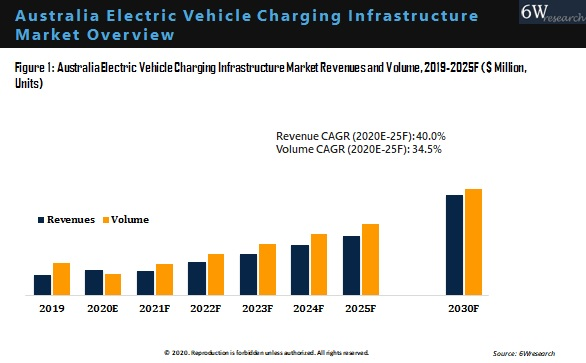
According to 6Wresearch, Australia electric vehicle charging infrastructure market size grew at a CAGR of 40.0% during 2020-2025. Government initiatives such as the Queensland state government would partner with the RACQ and state-owned energy company Yurika to add 13 new EV charging stations to the state’s Electric Vehicle Super Highway (QESH) which would boost the total number of charge points in the region. Further, despite the lack of government support, NRMA would roll out 20 new fast-chargers across rural NSW which would rise their network to 59 chargers in the region.
Market Analysis By Charger Types
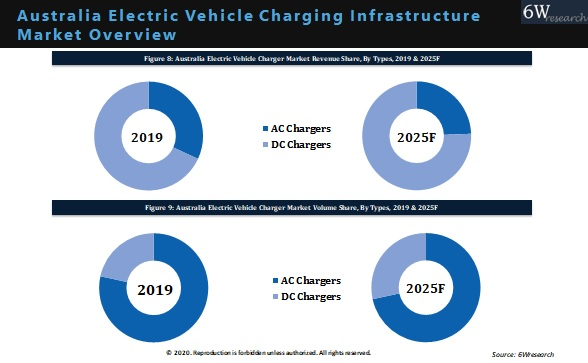
AC chargers held the highest revenue share in the overall electric vehicle charging infrastructure market. Moreover, government funding has so far been typically directed towards the capital costs of setting up this infrastructure which is making electricity supply costs high and difficult to recover due to distribution network charges which could act as a barrier to the growth of charging stations in the country in the near future.
Key Attractiveness of the Report
- COVID-19 Impact on the Market.
- 6 Years Market Numbers.
- Estimated Data Starting from 2020 to 2025F.
- Base Year: 2019
- Forecast Data until 2025F.
- Key Performance Indicators Impacting the Market.
- Major Upcoming Developments and Projects.
Key Highlights of the Report:
- Australia electric vehicle charging infrastructure Market Overview
- Australia electric vehicle charging infrastructure Market Outlook
- Australia electric vehicle charging infrastructure Market Forecast
- Historical Data and Forecast Australia electric vehicle charging infrastructure Market Revenues and Volume for the Period 2019-2025F
- Historical Data and Forecast of Australia electric vehicle charging infrastructure Market Revenues and Volume, By Charger Types, for the Period 2019-2025F
- Historical Data and Forecast of Australia electric vehicle charging infrastructure Market Revenues and Volume, By End Consumers, for the Period 2019-2025F
- Market Drivers and Restraints
- Industry Life Cycle
- Porter’s Five Force Analysis
- Impact Analysis of COVID-19
- Market Trends
- Indonesia Vehicle Market Revenue Ranking, By Companies
- Competitive Benchmarking
- Company Profiles
- Key Strategic Recommendations
Market Scope and Segmentation
Thereportprovides a detailed analysis of the following market segments:
By Charger Types
- AC
- DC
By End Consumers
- Public
- Private






































