Australia Electronics Packaging Market Summary
The australia electronics packaging market was estimated at USD 139 Million in 2025 and is projected to reach USD 162 Million by 2032, growing at a CAGR of 2.6% from 2026 to 2032.
Australia Electronics Packaging Market Year-wise Growth Rate and Key Drivers
This graph highlights how the Australia Electronics Packaging Market has steadily grown over the past five years, supported by major growth factors.
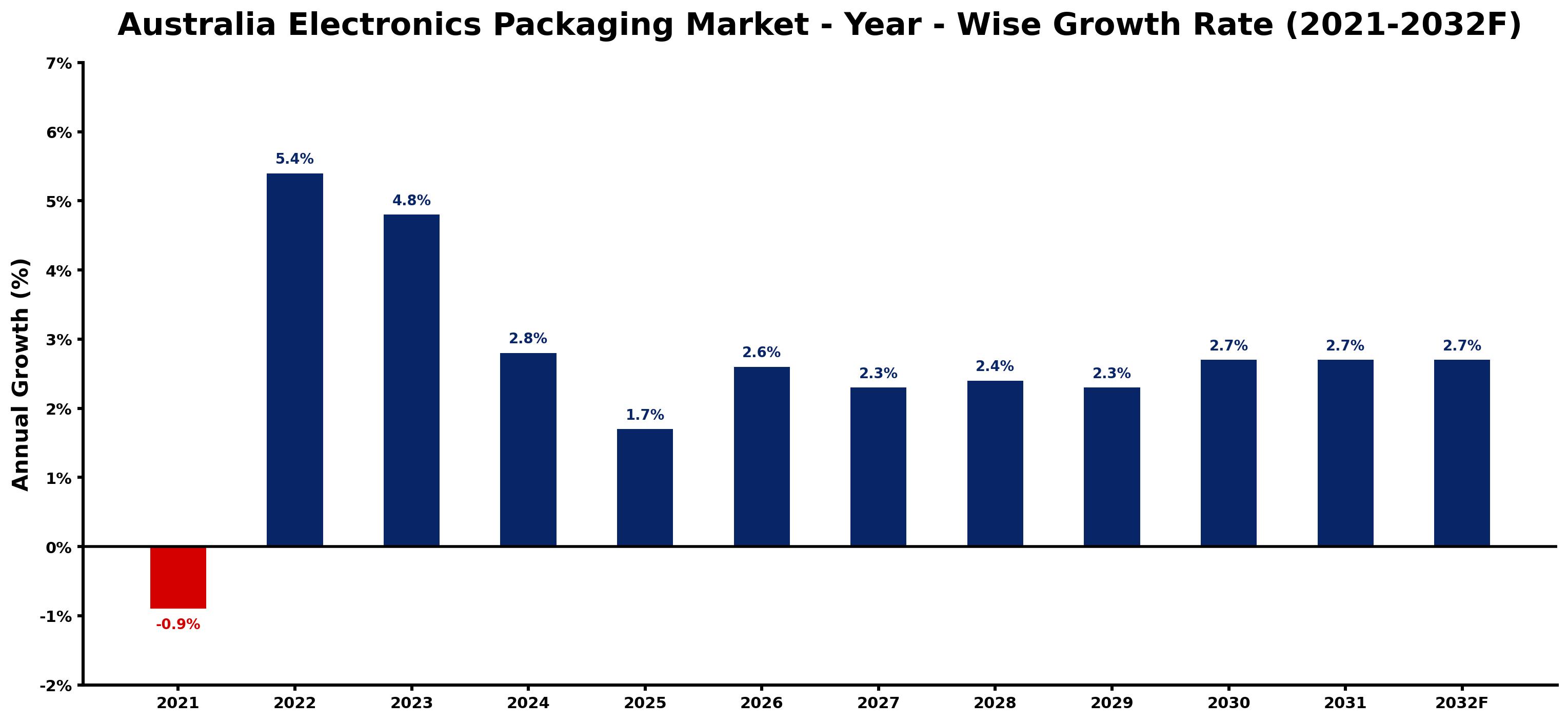
The table below presents the year wise growth rates along with the key drivers influencing the market
| Year | Growth Rate | Major Drivers |
| 2021 | -0.9% | Supply chain disruptions hindered the availability of key electronic components, leading to decreased production activity. |
| 2022 | 5.4% | Sustainability concerns prompted shifts towards eco-friendly packaging solutions in electronics. |
| 2023 | 4.8% | Increasing online shopping necessitated robust packaging solutions for electronic deliveries. |
| 2024 | 2.8% | Emerging technologies mandated specialized packaging to protect sensitive electronic components. |
| 2025 | 1.7% | Consumer electronics trends pushed for innovative, multifunctional packaging designs and materials. |
| 2026 | 2.6% | Corporate budgets prioritized supply chain resilience, impacting packaging procurement strategies. |
| 2027 | 2.3% | E-commerce growth brought about unique packaging challenges tailored to diverse products. |
| 2028 | 2.4% | Advancements in smart packaging technology enhanced product safety and consumer engagement. |
| 2029 | 2.3% | Market dynamics favored local manufacturing, reducing reliance on imported packaging solutions. |
| 2030 | 2.7% | Corporate social responsibility initiatives influenced packaging designs towards reduced environmental impact. |
| 2031 | 2.7% | Technological integration in packaging systems improved efficiency and reduced waste generation. |
| 2032 | 2.7% | Collaborations among manufacturers and retailers fostered innovation in electronics packaging solutions. |
Note - Market size estimations and growth projections presented in this report are based on 6Wresearch's advanced forecasting approach, validated with industry datasets as of June 2026.
Australia Electronics Packaging Market Synopsis
The Australia Electronics Packaging Market is projected to reach 2.6% and witness significant growth during the forecast period (2026-2032). This market serves a critical function in the electronics supply chain, providing essential protection for a wide array of electronic components and products during various stages, including transportation, storage, and handling. The breadth of packaging solutions extends from basic protective options for individual components to intricate designs tailored for consumer electronics and industrial machinery, all aimed at ensuring product integrity and reliability.
Australia Electronics Packaging Market Growth Drivers
Several key drivers contribute to the expansion of the Australia Electronics Packaging Market. One of the primary factors is the escalating demand for innovative packaging solutions that cater to the growing complexity of electronic products. As manufacturers aim for miniaturization and heightened functionality, the need for specialized packaging materials that provide robust protection against environmental challenges and mechanical stresses becomes increasingly critical.
- Advancements in electronic product design necessitate packaging that can effectively shield against electrostatic discharge, optimizing the longevity and performance of the devices.
- The rising awareness among consumers regarding the sustainability of packaging materials is prompting manufacturers to seek eco-friendly alternatives, driving innovation within the sector.
- Increased e-commerce activities are propelling demand for reliable packaging solutions that prevent damage during transit, further boosting the market.
- Technological developments in packaging materials, such as the use of smart packaging that incorporates sensors and indicators, are gaining traction, enhancing product safety and traceability.
- Heightened regulatory requirements surrounding electronic product safety are compelling companies to re-evaluate their packaging strategies, instigating growth in the market.
Australia Electronics Packaging Market Challenges and Restraints
Despite the promising growth trajectory, the Australia Electronics Packaging Market faces significant challenges that could hinder its progress. One of the most pressing issues is the need for sustainable packaging solutions. Manufacturers are under increasing pressure to minimize waste and reduce the carbon footprint associated with packaging materials, necessitating a shift toward more environmentally responsible practices.
- Finding balance between the protective qualities of packaging and sustainability can lead to trade-offs in performance, posing challenges for manufacturers.
- The complexity of compliance with various regulatory standards regarding product safety and labeling can complicate the packaging process, resulting in elevated operational costs.
- There is ongoing research and development required to pioneer new materials that meet both performance metrics and sustainability goals, which can strain resources.
- Volatility in the prices of raw materials used in packaging production can affect profitability and pricing strategies for manufacturers.
- The rapid evolution of technology in packaging demands ongoing investments in innovative solutions, presenting a challenge for companies to keep pace with market changes.
Australia Electronics Packaging Market Government Investment and Initiatives
Government policies play a pivotal role in shaping the landscape of the Australia Electronics Packaging Market. These policies are increasingly focused on reducing the environmental impact of packaging materials through various waste management and recycling initiatives. As part of these efforts, regulations are being introduced to endorse the use of recyclable and biodegradable materials in packaging.
Moreover, government incentives may be aligned with fostering innovation in sustainable packaging, encouraging manufacturers to explore alternative materials and design methodologies that meet eco-friendly standards. Public funding and support for research projects aimed at developing new packaging technologies are also anticipated, which could significantly enhance the growth of sustainable practices within the industry.
Australia Electronics Packaging Market Latest Developments (May 2025 - June 2026)
Recent trends in the Australia Electronics Packaging Market indicate a strong emphasis on sustainability and technological integration in packaging solutions. Industry stakeholders are increasingly focusing on adopting smart packaging technologies that improve product safety and user experience. There has been a notable shift towards the development of packaging materials that not only protect electronic components but also provide consumers with information on disposal and recycling.
Additionally, collaborations between manufacturers and research institutions are being established to accelerate the development of environmentally friendly packaging materials. The regulatory landscape is evolving, with more stringent guidelines being introduced, compelling manufacturers to adapt swiftly to comply with new standards. Overall, innovation and sustainability are at the forefront of recent strategic initiatives in the market.
Australia Electronics Packaging Market - Key Attractiveness of the Report
- 10 Years of Market Numbers
- Historical Data Starting from 2022 to 2025
- Base Year: 2025
- Forecast Data until 2032
- Key Performance Indicators Impacting the Market
- Major Upcoming Developments and Projects
Key Highlights of the Report:
- Australia Electronics Packaging Market Outlook
- Market Size of Australia Electronics Packaging Market, 2025
- Forecast of Australia Electronics Packaging Market, 2032
- Historical Data and Forecast of Australia Electronics Packaging Revenues & Volume for the Period 2022-2032F
- Australia Electronics Packaging Market Trend Evolution
- Australia Electronics Packaging Market Drivers and Challenges
- Australia Electronics Packaging Price Trends
- Australia Electronics Packaging Porter's Five Forces
- Australia Electronics Packaging Industry Life Cycle
- Historical Data and Forecast of Australia Electronics Packaging Market Revenues & Volume By Material Types for the Period 2022-2032F
- Historical Data and Forecast of Australia Electronics Packaging Market Revenues & Volume By Plastic for the Period 2022-2032F
- Historical Data and Forecast of Australia Electronics Packaging Market Revenues & Volume By Metal for the Period 2022-2032F
- Historical Data and Forecast of Australia Electronics Packaging Market Revenues & Volume By Glass for the Period 2022-2032F
- Historical Data and Forecast of Australia Electronics Packaging Market Revenues & Volume By Others for the Period 2022-2032F
- Historical Data and Forecast of Australia Electronics Packaging Market Revenues & Volume By End-users for the Period 2022-2032F
- Historical Data and Forecast of Australia Electronics Packaging Market Revenues & Volume By Consumer Electronics for the Period 2022-2032F
- Historical Data and Forecast of Australia Electronics Packaging Market Revenues & Volume By Aerospace and Defense for the Period 2022-2032F
- Historical Data and Forecast of Australia Electronics Packaging Market Revenues & Volume By Automotive for the Period 2022-2032F
- Historical Data and Forecast of Australia Electronics Packaging Market Revenues & Volume By Healthcare for the Period 2022-2032F
- Historical Data and Forecast of Australia Electronics Packaging Market Revenues & Volume By Others for the Period 2022-2032F
- Australia Electronics Packaging Import Export Trade Statistics
- Market Opportunity Assessment By Material Types
- Market Opportunity Assessment By End-users
- Australia Electronics Packaging Top Companies Market Share
- Australia Electronics Packaging Competitive Benchmarking By Technical and Operational Parameters
- Australia Electronics Packaging Company Profiles
- Australia Electronics Packaging Key Strategic Recommendations






































