Australia Emergency Ambulance Vehicle Market Size, Share & Growth Rate
The Australia Emergency Ambulance Vehicle Market was estimated at USD 93 Million in 2025 and is projected to reach USD 110 Million by 2032, growing at a CAGR of 2.4% from 2026 to 2032. This growth trajectory is propelled by several factors, including an increasing aging population and heightened public awareness around the importance of timely emergency medical services. Coupled with significant government investments aimed at modernizing healthcare infrastructure, the demand for advanced ambulance vehicles continues to rise, leading to a dynamic evolution in vehicle design and capabilities.
Australia Emergency Ambulance Vehicle Market Year-wise Growth Rate and Key Drivers
This graph highlights how the Australia Emergency Ambulance Vehicle Market has steadily grown over the years, supported by major growth factors.
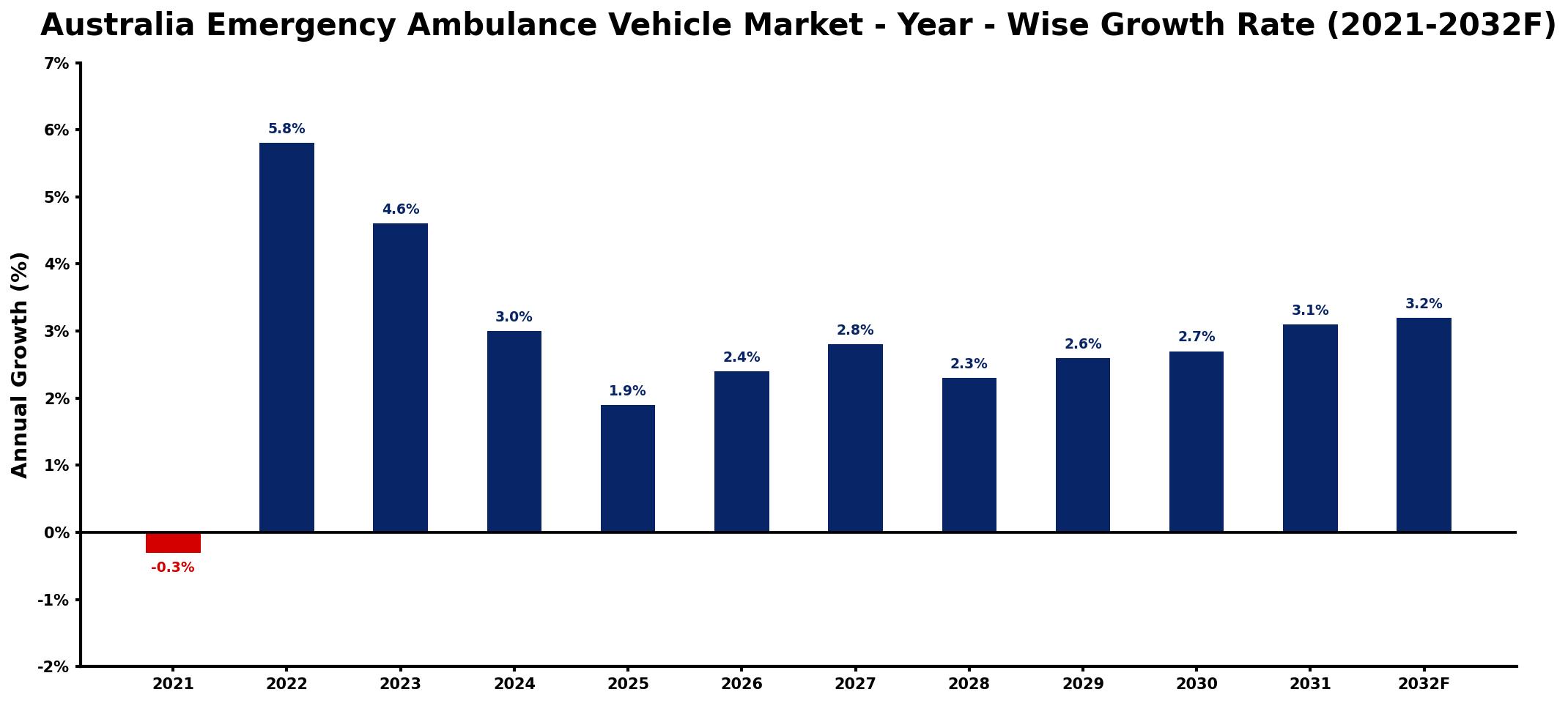
The table below presents the year‑wise growth rates along with the key drivers influencing the market
| Year | Growth Rate | Major Drivers |
| 2021 | -0.3% | decreased public sector funding |
| 2022 | 5.8% | increased healthcare service investments |
| 2023 | 4.6% | growing demand for rapid response |
| 2024 | 3.0% | expansion of telemedicine services |
| 2025 | 1.9% | rising public health awareness |
| 2026 | 2.4% | rising export shipment volumes |
| 2027 | 2.8% | expanding manufacturing base activity |
| 2028 | 2.3% | growing urban population density |
| 2029 | 2.6% | rising demand for medical transport |
| 2030 | 2.7% | advancements in medical equipment |
| 2031 | 3.1% | increased integration of AI systems |
| 2032 | 3.2% | rising end-use demand growth |
Note: Market size estimations and growth projections presented in this report are based on 6Wresearch's proprietary forecasting methodology, utilizing the latest available industry data, government publications, and primary research inputs.
Australia Emergency Ambulance Vehicle Market Synopsis
As urban areas expand and populations grow, the need for efficient emergency medical transport services has become increasingly vital. Ambulance vehicles must now be outfitted with cutting-edge medical equipment and communication systems to respond swiftly and effectively in emergencies. This evolution underscores the importance of not only procuring new vehicles but also upgrading existing fleets to meet the current demands.
Furthermore, rural and remote regions in Australia face unique challenges in ensuring that emergency medical services are accessible. This underscores a critical need for specialized vehicles capable of navigating diverse terrains while providing advanced medical care on-site, thereby enhancing patient outcomes in less accessible areas.
Australia Emergency Ambulance Vehicle Market Key Takeaways
- The market is driven by increasing demand for efficient emergency medical services and advancements in vehicle technology.
- Government investments in healthcare and disaster response play a crucial role in supporting fleet modernization.
- Unique challenges persist in remote areas, necessitating specialized ambulance vehicles that can operate effectively across varied terrains.
- Ambulance services are evolving to integrate advanced communication systems and medical equipment for improved patient care.
- The aging population in Australia significantly influences the rising demand for timely emergency medical response.
Evaluation of Restraints in Australia Emergency Ambulance Vehicle Market
Despite the promising growth in the Australia Emergency Ambulance Vehicle Market, certain restraints hinder its progress. The high costs associated with modernizing and maintaining ambulance fleets present significant challenges for many healthcare providers. This is particularly pronounced in rural areas where funding and resources are limited. Additionally, the ongoing need to recruit and retain qualified paramedics and emergency medical technicians remains critical, as an effective ambulance service relies heavily on having skilled personnel ready to respond at a moment's notice.
Australia Emergency Ambulance Vehicle Market Trends
Current trends in the market include a shift towards electric and hybrid ambulance vehicles, reflecting a growing commitment to sustainability within the healthcare sector. Moreover, advancements in telemedicine technology are increasingly being integrated into ambulance design, allowing paramedics to consult with specialists during transport. Such innovations not only enhance the level of care provided to patients en route but also contribute to better overall outcomes. Additionally, the increased utilization of data analytics is helping to optimize response times and improve fleet management.
Australia Emergency Ambulance Vehicle Market Opportunities
The market presents substantial opportunities for growth and investment, particularly in the realm of vehicle innovation. Manufacturers focusing on developing advanced communication systems and mobile healthcare technologies can carve out a significant niche. Furthermore, collaborations between public agencies and private sector stakeholders can lead to innovative solutions that enhance the efficiency and effectiveness of emergency medical services. As government initiatives increasingly emphasize preparedness and rapid response, the scope for expanding and modernizing ambulance fleets will continue to grow.
Government Initiatives in the Australia Emergency Ambulance Vehicle Market
Government policies play a pivotal role in shaping the landscape of the Australia Emergency Ambulance Vehicle Market. Funding allocations directed toward upgrading emergency medical services and enhancing public safety are essential. Regulatory frameworks established by state health departments guide procurement practices and establish safety standards for vehicles and medical equipment. Furthermore, ongoing government investment in disaster response initiatives ensures that emergency services remain well-equipped and capable of addressing the needs of Australian communities effectively.
Future Insights of the Australia Emergency Ambulance Vehicle Market
Looking ahead to 2026-2032, the Australia Emergency Ambulance Vehicle Market is poised for transformation. The convergence of technological advancements with evolving patient care standards will dictate the design and functionality of ambulance vehicles. As the population continues to age, demand for rapid emergency response services will increase, further necessitating the integration of innovative medical technologies. With a focus on sustainability and efficiency, manufacturers will likely prioritize development efforts that not only meet regulatory standards but also enhance patient outcomes.
Australia Emergency Ambulance Vehicle Market Latest Developments (2025 - 2026)
Recent developments in the Australia Emergency Ambulance Vehicle Market indicate a proactive shift towards incorporating cutting-edge technologies. Enhanced focus on fleet management through the use of real-time data analytics has become more prevalent, allowing for optimized dispatch and resource allocation. Furthermore, several states have initiated pilot programs to test electric ambulance vehicles, signaling a commitment to reducing the carbon footprint of emergency services.
Australia Emergency Ambulance Vehicle Market - Key Attractiveness of the Report
- 10 Years of Market Numbers
- Historical Data Starting from 2022 to 2025
- Base Year: 2025
- Forecast Data until 2032
- Key Performance Indicators Impacting the Market
- Major Upcoming Developments and Projects
Key Highlights of the Report:
- Australia Emergency Ambulance Vehicle Market Outlook
- Market Size of Australia Emergency Ambulance Vehicle Market, 2025
- Forecast of Australia Emergency Ambulance Vehicle Market, 2032
- Historical Data and Forecast of Australia Emergency Ambulance Vehicle Revenues & Volume for the Period 2022-2032F
- Australia Emergency Ambulance Vehicle Market Trend Evolution
- Australia Emergency Ambulance Vehicle Market Drivers and Challenges
- Australia Emergency Ambulance Vehicle Price Trends
- Australia Emergency Ambulance Vehicle Porter's Five Forces
- Australia Emergency Ambulance Vehicle Industry Life Cycle
- Historical Data and Forecast of Australia Emergency Ambulance Vehicle Market Revenues & Volume By Vehicle Type for the Period 2022-2032F
- Historical Data and Forecast of Australia Emergency Ambulance Vehicle Market Revenues & Volume By Vans for the Period 2022-2032F
- Historical Data and Forecast of Australia Emergency Ambulance Vehicle Market Revenues & Volume By Cars for the Period 2022-2032F
- Historical Data and Forecast of Australia Emergency Ambulance Vehicle Market Revenues & Volume By Motorcycles for the Period 2022-2032F
- Historical Data and Forecast of Australia Emergency Ambulance Vehicle Market Revenues & Volume By Others for the Period 2022-2032F
- Historical Data and Forecast of Australia Emergency Ambulance Vehicle Market Revenues & Volume By Application for the Period 2022-2032F
- Historical Data and Forecast of Australia Emergency Ambulance Vehicle Market Revenues & Volume By Hospitals for the Period 2022-2032F
- Historical Data and Forecast of Australia Emergency Ambulance Vehicle Market Revenues & Volume By Emergency Center for the Period 2022-2032F
- Historical Data and Forecast of Australia Emergency Ambulance Vehicle Market Revenues & Volume By Others for the Period 2022-2032F
- Australia Emergency Ambulance Vehicle Import Export Trade Statistics
- Market Opportunity Assessment By Vehicle Type
- Market Opportunity Assessment By Application
- Australia Emergency Ambulance Vehicle Top Companies Market Share
- Australia Emergency Ambulance Vehicle Competitive Benchmarking By Technical and Operational Parameters
- Australia Emergency Ambulance Vehicle Company Profiles
- Australia Emergency Ambulance Vehicle Key Strategic Recommendations






































