Australia Enterprise Data Management Market Size & Growth Rate (2026-2032)
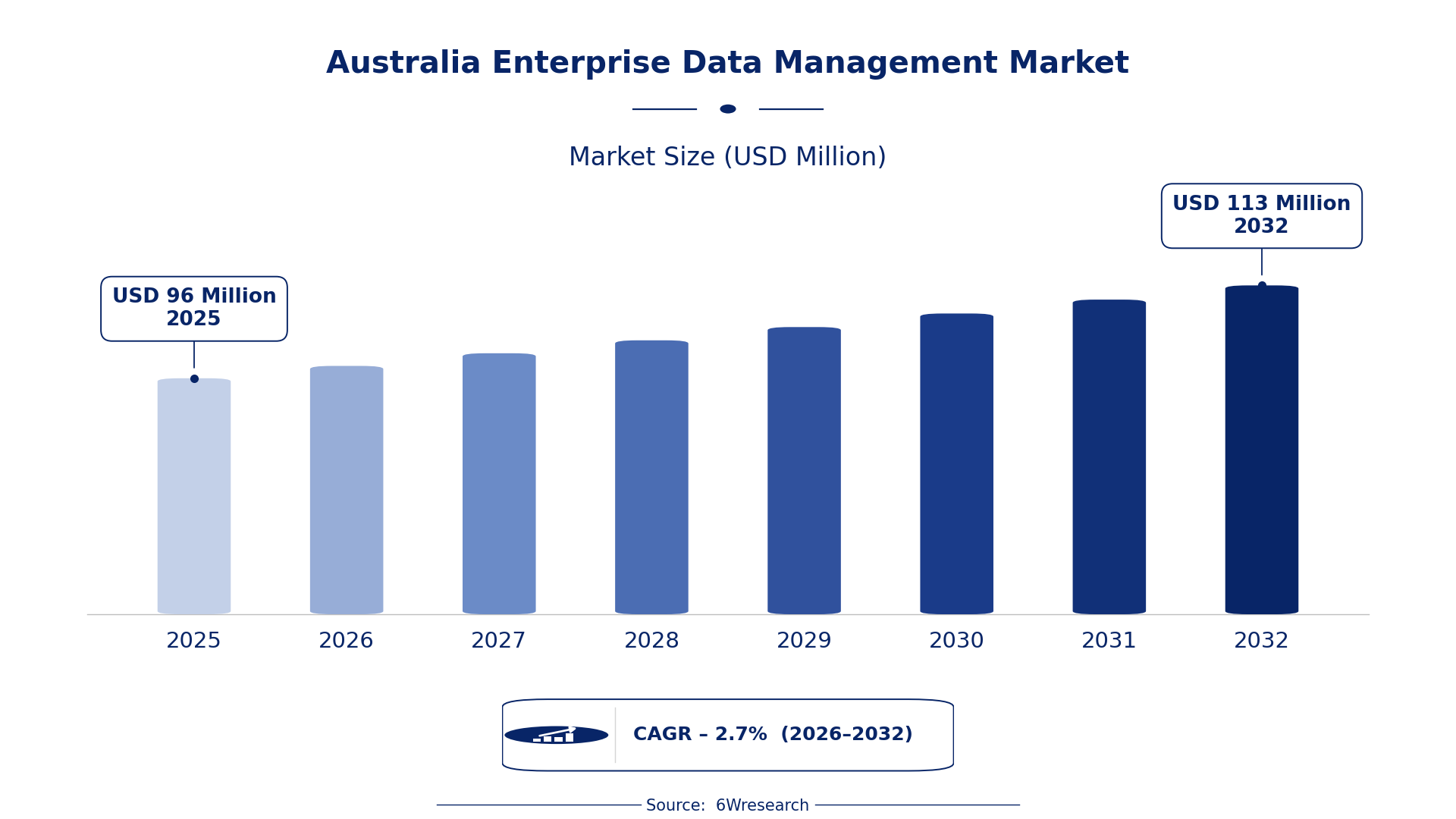
The Australia Enterprise Data Management Market was estimated at USD 96 Million in 2025 and is projected to reach USD 113 Million by 2032, growing at a CAGR of 2.7% from 2026 to 2032.
Australia Enterprise Data Management Market Synopsis
The enterprise data management market in Australia is currently experiencing a surge in investment as organizations recognize the need to harness their data assets. As the volume of data continues to grow exponentially, businesses are shifting focus towards effective data management solutions that can drive actionable insights and enhance decision-making.
Looking ahead, the market is set to evolve, driven by the pressing need for data governance and compliance with privacy regulations. Companies are increasingly prioritizing the integration of advanced analytics and cloud capabilities into their data management strategies, a trend that will shape the competitive dynamics of the sector.
Australia Enterprise Data Management Market Year-wise Growth Rate and Key Drivers
This graph illustrates the annual growth rates of the Australia Enterprise Data Management Market from 2021 to 2032, highlighting a steady upward trajectory and projected expansion over the forecast period.
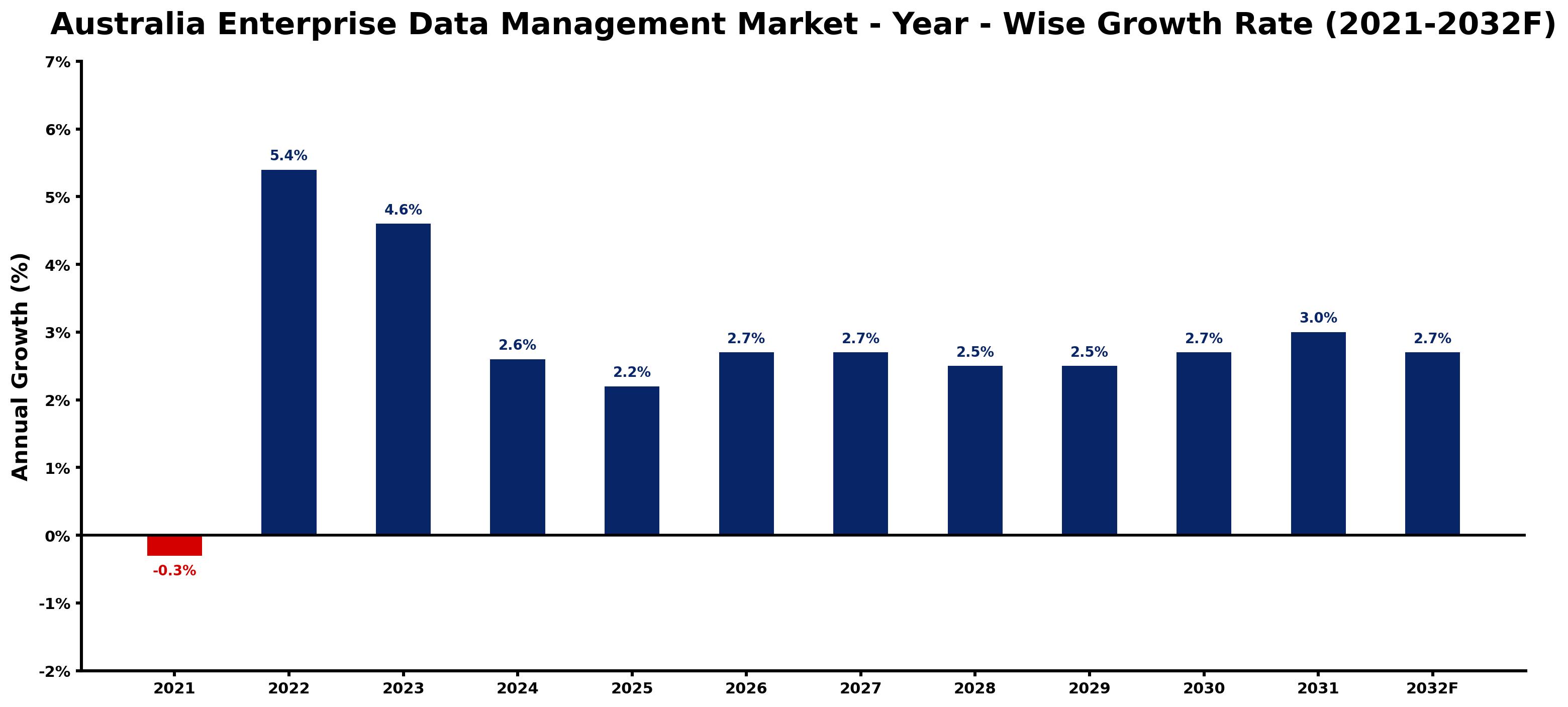
The table below presents the year‑wise growth rates along with the key drivers influencing the market
| Year | Growth Rate | Major Drivers |
| 2021 | -0.3% | Data availability issues under Australian privacy laws. |
| 2022 | 5.4% | Adoption of Australia’s Data Sharing and Release legislation |
| 2023 | 4.6% | Increased focus on cloud-based data management solutions |
| 2024 | 2.6% | Growing investment in AI for data analytics capabilities |
| 2025 | 2.2% | Local businesses shifting to hybrid data management approaches |
| 2026 | 2.7% | Government push for enhancing public sector data accessibility |
| 2027 | 2.7% | Rise in remote work necessitating data security enhancements |
| 2028 | 2.5% | Increased competition among local cloud service providers |
| 2029 | 2.5% | Local regulatory support for data protection technology innovations |
| 2030 | 2.7% | Surge in demand for data-driven decision-making tools |
| 2031 | 3.0% | Implementation of data interoperability standards by local agencies |
| 2032 | 2.7% | Strengthened partnerships between tech firms and government agencies |
Note: Market size estimations and growth projections presented in this report are based on 6Wresearch's proprietary forecasting methodology, utilizing the latest available industry data, government publications, and primary research inputs.
Australia Enterprise Data Management Market Key Takeaways
Below are some of the specific key takeaways from the market, including:
- Data volume growth is the primary driver for enterprises to adopt data management solutions.
- Regulatory pressures surrounding data governance are prompting organizations to invest in compliance frameworks.
- Integration of cloud technologies is accelerating the transition to more agile data management systems.
- Fostering a data-driven culture within organizations is crucial for maximizing the value of data assets.
- Companies face challenges in data integration and quality, requiring comprehensive management strategies.
Evaluation of Restraints in Australia Enterprise Data Management Market
Despite the promising growth trajectory, several constraints hinder the progress of the enterprise data management market in Australia. Organizations often struggle with data silos and the complexities of integrating information from various sources. Ensuring data quality and maintaining security while managing vast data sets can prove daunting. Additionally, the rapid pace of technological change demands continuous adaptation, which can be resource-intensive for many enterprises.
Australia Enterprise Data Management Market Trends
Several trends are shaping the enterprise data management market in Australia. The increasing adoption of artificial intelligence and machine learning technologies is enhancing analytics capabilities, enabling organizations to derive deeper insights from their data. on top of that, there is a growing emphasis on real-time data processing, driven by the need for timely decision-making. Collaborative platforms that facilitate data sharing across departments are also gaining traction, fostering a more integrated approach to data management.
Australia Enterprise Data Management Market Opportunities
Opportunities abound for businesses looking to invest in enterprise data management solutions. The demand for advanced analytics tools is rising, as organizations seek to leverage predictive insights for strategic decision-making. Additionally, the ongoing shift to cloud-based solutions presents a chance for firms to enhance their data management capabilities without the burden of extensive on-premises infrastructure. Collaborations with technology partners to innovate data governance frameworks can also unlock new avenues for growth.
Government Initiatives in the Australia Enterprise Data Management Market
Government policies are playing a crucial role in shaping the enterprise data management market in Australia. By promoting data-driven decision-making across public and private sectors, authorities aim to enhance innovation and transparency. Regulatory frameworks like the National Data Policy are designed to encourage data stewardship and interoperability, which are vital for fostering collaboration among data stakeholders.
- A recently completed initiative involved the establishment of a national data governance framework to improve data sharing practices across government agencies.
- A currently ongoing program focuses on enhancing data quality standards for public sector organizations to comply with new privacy regulations.
- Upcoming, a planned public-private initiative aims to create a data interoperability platform expected to launch by 2026, facilitating better access to public data.
- The government is also working on a digital infrastructure upgrade program to support the secure storage and management of public sector data.
- Ongoing initiatives are assessing the impact of artificial intelligence on data governance, with findings expected to influence future policy development.
Future Insights of the Australia Enterprise Data Management Market
As we look to 2026-2032, the enterprise data management market in Australia is likely to witness substantial transformations. The integration of emerging technologies like blockchain for data security and the expansion of machine learning capabilities will redefine how organizations manage their data. The continued focus on compliance and governance will also shape the development of innovative solutions, positioning enterprises to better leverage their data assets for competitive advantage.
Australia Enterprise Data Management Market Latest Developments
Recent months have seen a flurry of activity in the Australia enterprise data management market, signaling a robust commitment to improving data practices. Companies are investing heavily in advanced analytics tools to enhance decision-making processes. As organizations adapt to new regulatory requirements, the demand for compliance-focused solutions is on the rise.
- A major technology vendor launched a new analytics platform in early 2025 designed specifically for Australian enterprises, enhancing data visualization capabilities.
- An initiative that began in mid-2025 is currently underway, aiming to integrate AI-driven insights into traditional data management systems across multiple sectors.
- By late 2026, a consortium of data management firms is expected to unveil a collaborative framework for improving data interoperability among government agencies.
- Ongoing upgrades to cloud storage solutions are facilitating more secure and efficient data management practices across industries.
- A planned rollout for a comprehensive training program focused on data governance for enterprises is set to begin in early 2026, aiming to build a more data-literate workforce.
Australia Enterprise Data Management Market - Key Attractiveness of the Report
- 10 Years of Market Numbers
- Historical Data Starting from 2022 to 2025
- Base Year: 2025
- Forecast Data until 2032
- Key Performance Indicators Impacting the Market
- Major Upcoming Developments and Projects
Key Highlights of the Report:
- Australia Enterprise Data Management Market Outlook
- Market Size of Australia Enterprise Data Management Market, 2025
- Forecast of Australia Enterprise Data Management Market, 2032
- Historical Data and Forecast of Australia Enterprise Data Management Revenues & Volume for the Period 2022-2032F
- Australia Enterprise Data Management Market Trend Evolution
- Australia Enterprise Data Management Market Drivers and Challenges
- Australia Enterprise Data Management Price Trends
- Australia Enterprise Data Management Porter's Five Forces
- Australia Enterprise Data Management Industry Life Cycle
- Historical Data and Forecast of Australia Enterprise Data Management Market Revenues & Volume By Component for the Period 2022-2032F
- Historical Data and Forecast of Australia Enterprise Data Management Market Revenues & Volume By Software for the Period 2022-2032F
- Historical Data and Forecast of Australia Enterprise Data Management Market Revenues & Volume By Services for the Period 2022-2032F
- Historical Data and Forecast of Australia Enterprise Data Management Market Revenues & Volume By Professional Services for the Period 2022-2032F
- Historical Data and Forecast of Australia Enterprise Data Management Market Revenues & Volume By Consulting for the Period 2022-2032F
- Historical Data and Forecast of Australia Enterprise Data Management Market Revenues & Volume By Deployment and Integration for the Period 2022-2032F
- Historical Data and Forecast of Australia Enterprise Data Management Market Revenues & Volume By Support and Maintenance for the Period 2022-2032F
- Historical Data and Forecast of Australia Enterprise Data Management Market Revenues & Volume By Industry Vertical for the Period 2022-2032F
- Historical Data and Forecast of Australia Enterprise Data Management Market Revenues & Volume By Healthcare and Life science for the Period 2022-2032F
- Historical Data and Forecast of Australia Enterprise Data Management Market Revenues & Volume By Banking, Financial Services and Insurance (BFSI) for the Period 2022-2032F
- Historical Data and Forecast of Australia Enterprise Data Management Market Revenues & Volume By Telecom and Information Technology (IT) for the Period 2022-2032F
- Historical Data and Forecast of Australia Enterprise Data Management Market Revenues & Volume By Retail and Consumer goods for the Period 2022-2032F
- Historical Data and Forecast of Australia Enterprise Data Management Market Revenues & Volume By Media and Entertainment for the Period 2022-2032F
- Historical Data and Forecast of Australia Enterprise Data Management Market Revenues & Volume By Manufacturing for the Period 2022-2032F
- Historical Data and Forecast of Australia Enterprise Data Management Market Revenues & Volume By Energy and Utilities for the Period 2022-2032F
- Historical Data and Forecast of Australia Enterprise Data Management Market Revenues & Volume By Transportation and Logistics for the Period 2022-2032F
- Historical Data and Forecast of Australia Enterprise Data Management Market Revenues & Volume By Organization Size for the Period 2022-2032F
- Historical Data and Forecast of Australia Enterprise Data Management Market Revenues & Volume By Small and Medium-sized Enterprises for the Period 2022-2032F
- Historical Data and Forecast of Australia Enterprise Data Management Market Revenues & Volume By Large enterprises for the Period 2022-2032F
- Historical Data and Forecast of Australia Enterprise Data Management Market Revenues & Volume By Deployment Mode for the Period 2022-2032F
- Historical Data and Forecast of Australia Enterprise Data Management Market Revenues & Volume By Cloud for the Period 2022-2032F
- Historical Data and Forecast of Australia Enterprise Data Management Market Revenues & Volume By On-premises for the Period 2022-2032F
- Australia Enterprise Data Management Import Export Trade Statistics
- Market Opportunity Assessment By Component
- Market Opportunity Assessment By Industry Vertical
- Market Opportunity Assessment By Organization Size
- Market Opportunity Assessment By Deployment Mode
- Australia Enterprise Data Management Top Companies Market Share
- Australia Enterprise Data Management Competitive Benchmarking By Technical and Operational Parameters
- Australia Enterprise Data Management Company Profiles
- Australia Enterprise Data Management Key Strategic Recommendations






































