Australia Equipment for Telephone Networks Market Summary
The australia equipment for telephone networks market was estimated at USD 180 Million in 2025 and is projected to reach USD 212 Million by 2032, growing at a CAGR of 2.4% from 2026 to 2032.
Australia Equipment for Telephone Networks Market Year-wise Growth Rate and Key Drivers
This graph highlights how the Australia Equipment for Telephone Networks Market has steadily grown over the past five years, supported by major growth factors.
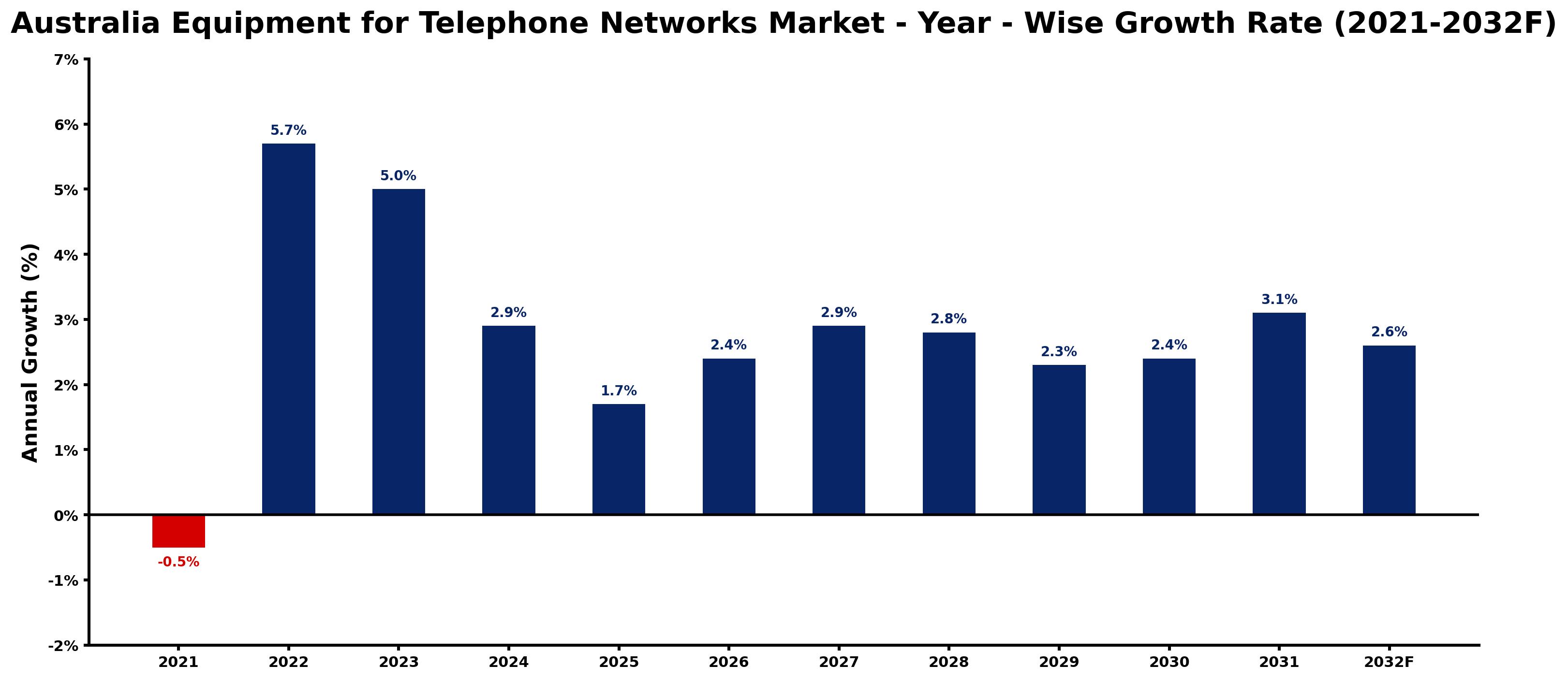
The table below presents the year wise growth rates along with the key drivers influencing the market
| Year | Growth Rate | Major Drivers |
| 2021 | -0.5% | Increased remote work adoption diminished demand for traditional telephone network equipment across businesses. |
| 2022 | 5.7% | Telecom companies faced pressure to enhance reliability amidst increased data traffic demands. |
| 2023 | 5.0% | Investment in fiber-optic networks gained momentum, reducing latency and boosting capacity. |
| 2024 | 2.9% | Emerging technologies required robust infrastructure, shifting focus to 5G network enhancements. |
| 2025 | 1.7% | Partnerships between telecom firms and tech companies strengthened network capabilities significantly. |
| 2026 | 2.4% | Urban development projects prompted expansions in telecommunications infrastructure across major cities. |
| 2027 | 2.9% | Growing competition among service providers spurred innovations in equipment and service offerings. |
| 2028 | 2.8% | Consumer expectations led to faster rollouts of next-gen connectivity solutions across Australia. |
| 2029 | 2.3% | Market consolidation among telecom providers improved service reach and operational efficiencies. |
| 2030 | 2.4% | Cloud-based services gained traction, necessitating upgrades to existing telephone network equipment. |
| 2031 | 3.1% | Sustainability initiatives driven by stakeholders pushed for greener telecom infrastructure solutions. |
| 2032 | 2.6% | Smart city developments created demand for advanced telecommunications systems and equipment. |
Note - Market size estimations and growth projections presented in this report are based on 6Wresearch's advanced forecasting approach, validated with industry datasets as of June 2026.
Australia Equipment for Telephone Networks Market Synopsis
The Australia Equipment for Telephone Networks Market is projected to reach 2.4% and witness significant growth during the forecast period (2026-2032). As the nation undergoes a transformative shift towards enhanced digital infrastructure, the demand for telecommunications equipment is on the rise. This growth is primarily attributed to the increasing need for reliable communication networks, driven by the proliferation of internet-enabled devices and advanced technologies such as 5G.
Australia Equipment for Telephone Networks Market Growth Drivers
Several key factors are propelling the Australia Equipment for Telephone Networks Market. These drivers can be summarized as follows:
- The escalating demand for telecommunications services is fostering a robust marketplace for network equipment, as consumers and businesses alike seek enhanced connectivity.
- Technological advancements in network infrastructure, particularly the shift towards next-generation solutions, are creating new opportunities for equipment manufacturers.
- Government initiatives aimed at expanding digital connectivity are fundamentally reshaping the telecommunications landscape, underpinning the need for improved equipment.
- The growing adoption of smartphones and other connected devices fosters a need for upgraded infrastructure capable of supporting higher bandwidth and faster data transmission.
- Investment in rural connectivity programs is also driving demand for robust telephone network equipment, bridging the gap between urban and remote areas.
Australia Equipment for Telephone Networks Market Challenges and Restraints
While the market presents considerable opportunities, it is not without its challenges. Key constraints include:
- The rapid pace of technological change poses a threat to traditional telephone network equipment, potentially rendering older systems obsolete.
- Telecommunications companies are increasingly prioritizing investment in modern, IP-based systems and wireless technologies, which may marginalize legacy equipment.
- Market players must adapt to evolving customer needs and expectations, necessitating agile responses and continuous innovation.
- Increased competition among equipment suppliers may lead to price pressures, affecting profit margins and market stability.
- The complexity of compliance with emerging regulatory standards can be daunting for manufacturers, requiring substantial investment in quality assurance and testing.
Australia Equipment for Telephone Networks Market Government Investment and Initiatives
The Australian Government plays an instrumental role in shaping the Equipment for Telephone Networks Market through substantial investments and strategic initiatives. Key aspects include:
- Commitment to national broadband initiatives aims to improve connectivity across urban and rural regions, incentivizing investments in modern telecommunications equipment.
- Government-funded programs dedicated to 5G deployment encourage collaboration between various stakeholders, including public and private sectors, enhancing infrastructure resilience.
- Public spending on digital connectivity strives to bridge the digital divide, ensuring equitable access to advanced communication services.
- Policy frameworks established by organizations such as the Australian Communications and Media Authority (ACMA) set stringent standards that equipment manufacturers must adhere to, promoting quality and reliability.
- Investment in cybersecurity measures for telecommunications infrastructure underpins the government's commitment to safeguarding network integrity and user privacy.
Australia Equipment for Telephone Networks Market Latest Developments (May 2025 - June 2026)
In the latest industry developments, the Australia Equipment for Telephone Networks Market has seen notable advancements. The period from May 2025 to June 2026 has been characterized by:
- An accelerated rollout of 5G infrastructure, driven by significant investment from telecommunications firms focusing on next-generation network capabilities.
- Increased collaboration between the public and private sectors aimed at enhancing rural connectivity, facilitating access to advanced telecommunications equipment in underserved regions.
- Strengthened regulatory measures ensuring compliance with national standards for equipment interoperability and technical specifications.
- Continued emphasis on sustainable practices within the telecommunications sector, with manufacturers exploring eco-friendly technologies and materials.
- The emergence of innovative telecommunications solutions, including cloud-based services and artificial intelligence applications, reshaping the functionality and efficiency of existing equipment.
Australia Equipment for Telephone Networks Market - Key Attractiveness of the Report
- 10 Years of Market Numbers
- Historical Data Starting from 2022 to 2025
- Base Year: 2025
- Forecast Data until 2032
- Key Performance Indicators Impacting the Market
- Major Upcoming Developments and Projects
Key Highlights of the Report:
- Australia Equipment for Telephone Networks Market Outlook
- Market Size of Australia Equipment for Telephone Networks Market, 2025
- Forecast of Australia Equipment for Telephone Networks Market, 2032
- Historical Data and Forecast of Australia Equipment for Telephone Networks Revenues & Volume for the Period 2022-2032F
- Australia Equipment for Telephone Networks Market Trend Evolution
- Australia Equipment for Telephone Networks Market Drivers and Challenges
- Australia Equipment for Telephone Networks Price Trends
- Australia Equipment for Telephone Networks Porter's Five Forces
- Australia Equipment for Telephone Networks Industry Life Cycle
- Historical Data and Forecast of Australia Equipment for Telephone Networks Market Revenues & Volume By Infrastructure for the Period 2022-2032F
- Historical Data and Forecast of Australia Equipment for Telephone Networks Market Revenues & Volume By Wire for the Period 2022-2032F
- Historical Data and Forecast of Australia Equipment for Telephone Networks Market Revenues & Volume By Wireless for the Period 2022-2032F
- Historical Data and Forecast of Australia Equipment for Telephone Networks Market Revenues & Volume By Offerings for the Period 2022-2032F
- Historical Data and Forecast of Australia Equipment for Telephone Networks Market Revenues & Volume By Product for the Period 2022-2032F
- Historical Data and Forecast of Australia Equipment for Telephone Networks Market Revenues & Volume By Software for the Period 2022-2032F
- Historical Data and Forecast of Australia Equipment for Telephone Networks Market Revenues & Volume By Services for the Period 2022-2032F
- Historical Data and Forecast of Australia Equipment for Telephone Networks Market Revenues & Volume By End-users for the Period 2022-2032F
- Historical Data and Forecast of Australia Equipment for Telephone Networks Market Revenues & Volume By Consumer Electronics for the Period 2022-2032F
- Historical Data and Forecast of Australia Equipment for Telephone Networks Market Revenues & Volume By Bfsi for the Period 2022-2032F
- Historical Data and Forecast of Australia Equipment for Telephone Networks Market Revenues & Volume By Retail for the Period 2022-2032F
- Historical Data and Forecast of Australia Equipment for Telephone Networks Market Revenues & Volume By Media for the Period 2022-2032F
- Historical Data and Forecast of Australia Equipment for Telephone Networks Market Revenues & Volume By Defense for the Period 2022-2032F
- Historical Data and Forecast of Australia Equipment for Telephone Networks Market Revenues & Volume By Others for the Period 2022-2032F
- Australia Equipment for Telephone Networks Import Export Trade Statistics
- Market Opportunity Assessment By Infrastructure
- Market Opportunity Assessment By Offerings
- Market Opportunity Assessment By End-users
- Australia Equipment for Telephone Networks Top Companies Market Share
- Australia Equipment for Telephone Networks Competitive Benchmarking By Technical and Operational Parameters
- Australia Equipment for Telephone Networks Company Profiles
- Australia Equipment for Telephone Networks Key Strategic Recommendations






































