Australia Flat-Rolled Stainless Steel Market Size, Share & Growth Rate
The Australia Flat-Rolled Stainless Steel Market was estimated at USD 202 Million in 2025 and is projected to reach USD 273 Million by 2032, growing at a CAGR of 4.4% from 2026 to 2032. This growth trajectory is primarily fueled by significant investments in infrastructure and a burgeoning automotive sector that demands high-quality materials. Additionally, consumer preferences are increasingly leaning towards sustainable and durable solutions, further boosting demand for flat-rolled stainless steel products across various industries.
Australia Flat-Rolled Stainless Steel Market Year-wise Growth Rate and Key Drivers
This graph highlights how the Australia Flat-Rolled Stainless Steel Market has steadily grown over the years, supported by major growth factors.
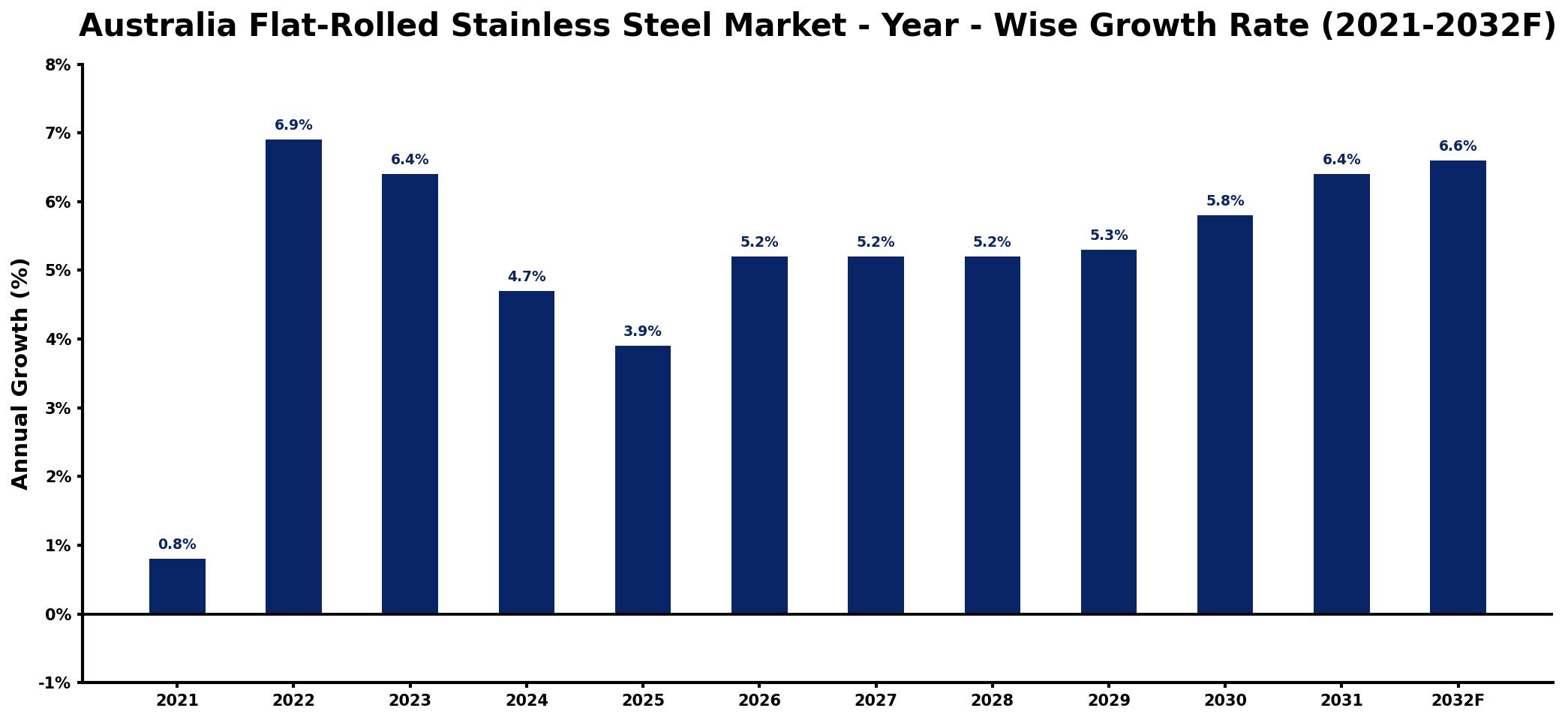
The table below presents the year‑wise growth rates along with the key drivers influencing the market
| Year | Growth Rate | Major Drivers |
| 2021 | 0.8% | Rising construction sector activities |
| 2022 | 6.9% | Increased demand from automotive industry |
| 2023 | 6.4% | Growth in renewable energy investments |
| 2024 | 4.7% | Expansion of manufacturing facilities |
| 2025 | 3.9% | Surge in infrastructure projects |
| 2026 | 5.2% | Boost in electronics production rates |
| 2027 | 5.2% | Growing demand from food processing |
| 2028 | 5.2% | Increased investments in healthcare technologies |
| 2029 | 5.3% | Expanding aerospace sector requirements |
| 2030 | 5.8% | Rising demand for consumer goods |
| 2031 | 6.4% | expanding industrial usage applications |
| 2032 | 6.6% | Increased focus on sustainable practices |
Note: Market size estimations and growth projections presented in this report are based on 6Wresearch's proprietary forecasting methodology, utilizing the latest available industry data, government publications, and primary research inputs.
Australia Flat-Rolled Stainless Steel Market Synopsis
In Australia, the flat-rolled stainless steel market is thriving, with a diverse range of applications from construction to automotive. The unique properties of stainless steel, such as its corrosion resistance and aesthetic appeal, position it as a preferred choice among manufacturers and builders alike.
As the nation witnesses a surge in infrastructure projects, the demand for high-performance materials continues to rise. Moreover, innovation in production technologies is enhancing the efficiency and quality of flat-rolled stainless steel, further solidifying its relevance in the Australian market.
Australia Flat-Rolled Stainless Steel Market Key Takeaways
- The market is expected to see a robust CAGR of 4.4% from 2026 to 2032, driven by infrastructure development.
- Applications in the automotive sector are increasingly leveraging stainless steel for improved performance and design.
- Technological advancements are enhancing production processes and product quality.
- Consumer trends are shifting towards sustainable and durable materials, fostering market demand.
- Government regulations are impacting pricing dynamics and market competition through tariffs and standards.
Evaluation of Restraints in Australia Flat-Rolled Stainless Steel Market
Despite the positive growth outlook, the flat-rolled stainless steel market in Australia faces several challenges that could impede its progress. Notably, fluctuations in the prices of key raw materials, particularly nickel and chromium, create significant volatility in production costs. This unpredictability can strain profit margins for manufacturers and influence market prices. Additionally, local producers encounter stiff competition from cheaper imported products and alternative materials, necessitating strategic differentiation to maintain market share. The ability to navigate these challenges will be critical for stakeholders looking to thrive in this competitive environment.
Australia Flat-Rolled Stainless Steel Market Trends
The Australian market is currently witnessing several notable trends that are reshaping the landscape of flat-rolled stainless steel. A growing focus on sustainability is prompting manufacturers to innovate and offer eco-friendly product options. Additionally, the trend towards lightweight materials in automotive applications is driving demand for flat-rolled stainless steel, which can provide strength without adding excessive weight. Furthermore, digitalization in manufacturing processes is enhancing efficiency and transparency, allowing for better quality control and product tracking.
Australia Flat-Rolled Stainless Steel Market Opportunities
There are significant growth opportunities within the Australian flat-rolled stainless steel market, particularly in sectors like green building and renewable energy. The increasing adoption of energy-efficient construction materials opens new avenues for flat-rolled stainless steel as builders seek sustainable solutions. Moreover, the expanding automotive market presents opportunities for product innovation, where manufacturers can develop tailored solutions to meet specific performance requirements. Overall, aligning product offerings with evolving market demands will be crucial for capitalizing on these opportunities.
Government Initiatives in the Australia Flat-Rolled Stainless Steel Market
Government policies and initiatives play a pivotal role in shaping the flat-rolled stainless steel market in Australia. Public spending on infrastructure development is expected to significantly enhance demand for construction-related materials. Trade agreements and tariffs on imported steel also influence market dynamics, affecting local producers and their competitive positioning. Additionally, regulatory frameworks focusing on environmental compliance and safety standards are increasingly impacting product specifications and market access, pushing manufacturers towards higher quality and sustainability.
Future Insights of the Australia Flat-Rolled Stainless Steel Market
Looking ahead to the period from 2026 to 2032, the Australia flat-rolled stainless steel market is poised for substantial growth. Continued investment in infrastructure and an upswing in manufacturing activity will likely drive demand. Moreover, technological advancements in production will enhance material properties and cost-efficiency, promoting wider adoption. The focus on sustainability and high-quality materials will further solidify flat-rolled stainless steel's position as a preferred choice in various industries, particularly as environmental regulations tighten. This trajectory suggests a robust market environment ripe for investment and innovation.
Australia Flat-Rolled Stainless Steel Market Latest Developments (2025 - 2026)
Recent developments in the Australia flat-rolled stainless steel market indicate a strong momentum towards innovation and efficiency. Manufacturers are increasingly investing in advanced production technologies that enhance product quality while reducing waste and energy consumption. Furthermore, collaborations between various industry stakeholders are emerging, aimed at addressing supply chain challenges and improving market competitiveness. As the market evolves, ongoing shifts in consumer preferences towards sustainable products are prompting manufacturers to adapt their strategies and offerings.
Australia Flat-Rolled Stainless Steel Market - Key Attractiveness of the Report
- 10 Years of Market Numbers
- Historical Data Starting from 2022 to 2025
- Base Year: 2025
- Forecast Data until 2032
- Key Performance Indicators Impacting the Market
- Major Upcoming Developments and Projects
Key Highlights of the Report:
- Australia Flat-Rolled Stainless Steel Market Outlook
- Market Size of Australia Flat-Rolled Stainless Steel Market, 2025
- Forecast of Australia Flat-Rolled Stainless Steel Market, 2032
- Historical Data and Forecast of Australia Flat-Rolled Stainless Steel Revenues & Volume for the Period 2022-2032F
- Australia Flat-Rolled Stainless Steel Market Trend Evolution
- Australia Flat-Rolled Stainless Steel Market Drivers and Challenges
- Australia Flat-Rolled Stainless Steel Price Trends
- Australia Flat-Rolled Stainless Steel Porter's Five Forces
- Australia Flat-Rolled Stainless Steel Industry Life Cycle
- Historical Data and Forecast of Australia Flat-Rolled Stainless Steel Market Revenues & Volume By Types for the Period 2022-2032F
- Historical Data and Forecast of Australia Flat-Rolled Stainless Steel Market Revenues & Volume By Hot/Cold-Rolled Coil for the Period 2022-2032F
- Historical Data and Forecast of Australia Flat-Rolled Stainless Steel Market Revenues & Volume By Hot/Cold-Rolled Strips for the Period 2022-2032F
- Historical Data and Forecast of Australia Flat-Rolled Stainless Steel Market Revenues & Volume By Hot/Cold-Rolled Sheets for the Period 2022-2032F
- Historical Data and Forecast of Australia Flat-Rolled Stainless Steel Market Revenues & Volume By Plates for the Period 2022-2032F
- Historical Data and Forecast of Australia Flat-Rolled Stainless Steel Market Revenues & Volume By Others for the Period 2022-2032F
- Historical Data and Forecast of Australia Flat-Rolled Stainless Steel Market Revenues & Volume By Applications for the Period 2022-2032F
- Historical Data and Forecast of Australia Flat-Rolled Stainless Steel Market Revenues & Volume By Construction for the Period 2022-2032F
- Historical Data and Forecast of Australia Flat-Rolled Stainless Steel Market Revenues & Volume By Automotive for the Period 2022-2032F
- Historical Data and Forecast of Australia Flat-Rolled Stainless Steel Market Revenues & Volume By Capital and Consumer Goods for the Period 2022-2032F
- Historical Data and Forecast of Australia Flat-Rolled Stainless Steel Market Revenues & Volume By Marine for the Period 2022-2032F
- Historical Data and Forecast of Australia Flat-Rolled Stainless Steel Market Revenues & Volume By Medical for the Period 2022-2032F
- Australia Flat-Rolled Stainless Steel Import Export Trade Statistics
- Market Opportunity Assessment By Types
- Market Opportunity Assessment By Applications
- Australia Flat-Rolled Stainless Steel Top Companies Market Share
- Australia Flat-Rolled Stainless Steel Competitive Benchmarking By Technical and Operational Parameters
- Australia Flat-Rolled Stainless Steel Company Profiles
- Australia Flat-Rolled Stainless Steel Key Strategic Recommendations






































