Australia Food Dehydrators Market Size, Share & Growth Rate
The Australia Food Dehydrators Market was estimated at USD 207 Million in 2025 and is projected to reach USD 243 Million by 2032, growing at a CAGR of 2.3% from 2026 to 2032. This robust growth trajectory is largely driven by an increasing consumer inclination toward healthy snacking and the preservation of seasonal produce. As more Australians prioritize nutritional value and seek convenience in food preparation, the demand for food dehydrators in both households and commercial settings continues to rise.
Australia Food Dehydrators Market Year-wise Growth Rate and Key Drivers
This graph highlights how the Australia Food Dehydrators Market has steadily grown over the years, supported by major growth factors.
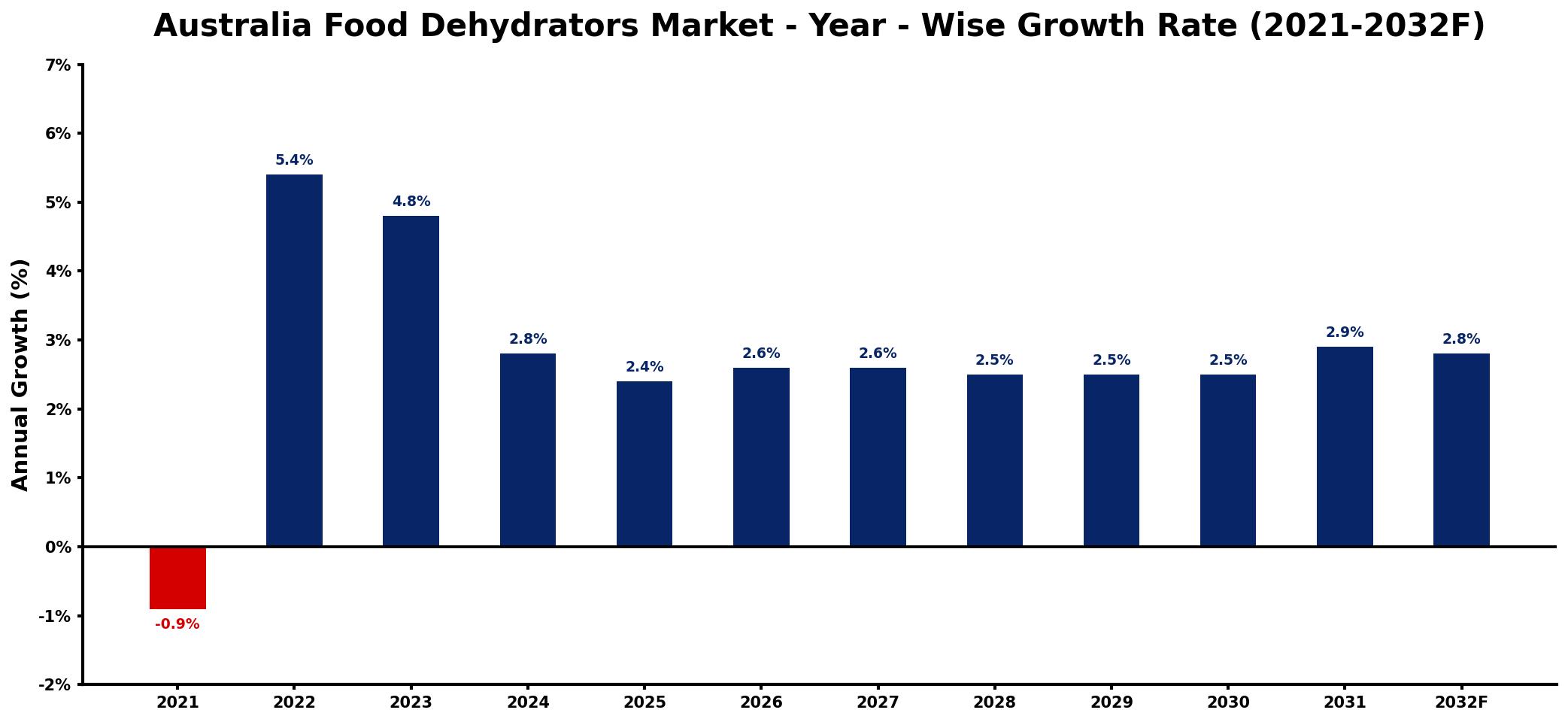
The table below presents the year‑wise growth rates along with the key drivers influencing the market
| Year | Growth Rate | Major Drivers |
| 2021 | -0.9% | decrease in consumer spending habits |
| 2022 | 5.4% | rise in health consciousness trends |
| 2023 | 4.8% | increased interest in home preservation |
| 2024 | 2.8% | growing popularity of sustainable practices |
| 2025 | 2.4% | expansion of online retail platforms |
| 2026 | 2.6% | higher demand for eco-friendly solutions |
| 2027 | 2.6% | increased focus on nutrition education |
| 2028 | 2.5% | growing interest in DIY projects |
| 2029 | 2.5% | surge in organic product availability |
| 2030 | 2.5% | increased investment in home appliances |
| 2031 | 2.9% | improved raw material availability |
| 2032 | 2.8% | growth in urban gardening initiatives |
Note: Market size estimations and growth projections presented in this report are based on 6Wresearch's proprietary forecasting methodology, utilizing the latest available industry data, government publications, and primary research inputs.
Australia Food Dehydrators Market Synopsis
Recent years have seen a notable uptick in the Australian food dehydrators market, bolstered by a shift towards healthier lifestyle choices. However, as consumer awareness grows, the market is poised for even greater expansion, with expectations that the trend of homemade snacks will further drive product adoption.
This markets momentum contrasts with the inherent challenges posed by raw material availability and quality. As the demand surges, manufacturers face the dual pressures of ensuring their products meet stringent safety standards while maintaining the desirable qualities of dehydrated foods.
Australia Food Dehydrators Market Key Takeaways
- The market is witnessing growth fueled by rising health consciousness among Australian consumers.
- Food dehydrators are increasingly viewed as essential kitchen appliances for preserving nutritional content.
- Challenges related to raw material sourcing can affect market stability and pricing dynamics.
- Government regulations play a significant role in shaping food safety standards and industry practices.
- Investment in research and development is crucial for enhancing product quality and expanding market reach.
Evaluation of Restraints in Australia Food Dehydrators Market
Despite the positive outlook, the food dehydrators market in Australia is constrained by the volatility in the prices and supply of raw materials such as fruits, vegetables, and meats. Agricultural fluctuations, driven by climate change and natural disasters, can drastically affect availability and pricing. Furthermore, maintaining high standards of nutritional quality and flavor during the dehydration process poses significant technical challenges for manufacturers, often leading to increased production costs and market uncertainties.
Australia Food Dehydrators Market Trends
Current trends indicate a strong consumer preference for organic and minimally processed foods, which is driving the adoption of food dehydrators. Additionally, technological advancements in dehydration processes are enhancing efficiency and product quality, making it easier for consumers and manufacturers alike to explore new dehydrated products. The rise of online platforms for home-based food businesses also contributes to the increasing popularity of food dehydrators.
Australia Food Dehydrators Market Opportunities
There are significant growth opportunities in the Australian food dehydrators market, particularly for manufacturers focusing on innovation and product diversity. Developing dehydrators that cater to specific dietary needs, such as gluten-free and vegan options, could tap into niche markets. Furthermore, expanding partnerships with health-conscious retailers and online marketplaces presents a chance for enhanced market visibility and consumer engagement.
Government Initiatives in the Australia Food Dehydrators Market
Government policies in Australia emphasize food safety and quality standards, which directly influence the food dehydrators market. Agencies such as Food Standards Australia New Zealand (FSANZ) enforce regulations aimed at ensuring the safety and hygienic standards of dehydrated products. Additionally, government initiatives to reduce food waste and promote sustainable food production align with the use of food dehydrators, encouraging consumers and manufacturers to adopt these appliances more widely.
Future Insights of the Australia Food Dehydrators Market
Looking ahead, the Australia Food Dehydrators Market is expected to grow steadily through 2026-2032, fueled by continuous advancements in technology and a greater emphasis on health and wellness. Consumer preferences will likely shift further towards sustainable and minimally processed food options, creating an ongoing demand for food dehydrators. As awareness surrounding food preservation techniques rises, the market is anticipated to evolve with innovative solutions that address both consumer desires and regulatory expectations.
Australia Food Dehydrators Market Latest Developments (2025 - 2026)
In the latest developments, there has been a notable increase in collaborations among manufacturers to enhance product offerings and improve supply chain efficiencies. Additionally, the market has seen a rise in eco-friendly dehydrators designed to minimize energy consumption while maximizing performance. Innovations in digital technology are also emerging, with smart dehydrators offering customizable settings and connectivity features that appeal to tech-savvy consumers.
Australia Food Dehydrators Market - Key Attractiveness of the Report
- 10 Years of Market Numbers
- Historical Data Starting from 2022 to 2025
- Base Year: 2025
- Forecast Data until 2032
- Key Performance Indicators Impacting the Market
- Major Upcoming Developments and Projects
Key Highlights of the Report:
- Australia Food Dehydrators Market Outlook
- Market Size of Australia Food Dehydrators Market, 2025
- Forecast of Australia Food Dehydrators Market, 2032
- Historical Data and Forecast of Australia Food Dehydrators Revenues & Volume for the Period 2022-2032F
- Australia Food Dehydrators Market Trend Evolution
- Australia Food Dehydrators Market Drivers and Challenges
- Australia Food Dehydrators Price Trends
- Australia Food Dehydrators Porter's Five Forces
- Australia Food Dehydrators Industry Life Cycle
- Historical Data and Forecast of Australia Food Dehydrators Market Revenues & Volume By Technology for the Period 2022-2032F
- Historical Data and Forecast of Australia Food Dehydrators Market Revenues & Volume By Vertical Flow for the Period 2022-2032F
- Historical Data and Forecast of Australia Food Dehydrators Market Revenues & Volume By Horizontal Flow for the Period 2022-2032F
- Historical Data and Forecast of Australia Food Dehydrators Market Revenues & Volume By End-Use for the Period 2022-2032F
- Historical Data and Forecast of Australia Food Dehydrators Market Revenues & Volume By Industrial for the Period 2022-2032F
- Historical Data and Forecast of Australia Food Dehydrators Market Revenues & Volume By Commercial for the Period 2022-2032F
- Historical Data and Forecast of Australia Food Dehydrators Market Revenues & Volume By Residential for the Period 2022-2032F
- Historical Data and Forecast of Australia Food Dehydrators Market Revenues & Volume By Others for the Period 2022-2032F
- Historical Data and Forecast of Australia Food Dehydrators Market Revenues & Volume By Energy Source for the Period 2022-2032F
- Historical Data and Forecast of Australia Food Dehydrators Market Revenues & Volume By Electricity for the Period 2022-2032F
- Historical Data and Forecast of Australia Food Dehydrators Market Revenues & Volume By Biofuel for the Period 2022-2032F
- Historical Data and Forecast of Australia Food Dehydrators Market Revenues & Volume By Solar for the Period 2022-2032F
- Historical Data and Forecast of Australia Food Dehydrators Market Revenues & Volume By Others for the Period 2022-2032F
- Australia Food Dehydrators Import Export Trade Statistics
- Market Opportunity Assessment By Technology
- Market Opportunity Assessment By End-Use
- Market Opportunity Assessment By Energy Source
- Australia Food Dehydrators Top Companies Market Share
- Australia Food Dehydrators Competitive Benchmarking By Technical and Operational Parameters
- Australia Food Dehydrators Company Profiles
- Australia Food Dehydrators Key Strategic Recommendations






































