Australia Greenhouse, Nursery, and Flowers Market: Import Trend Analysis
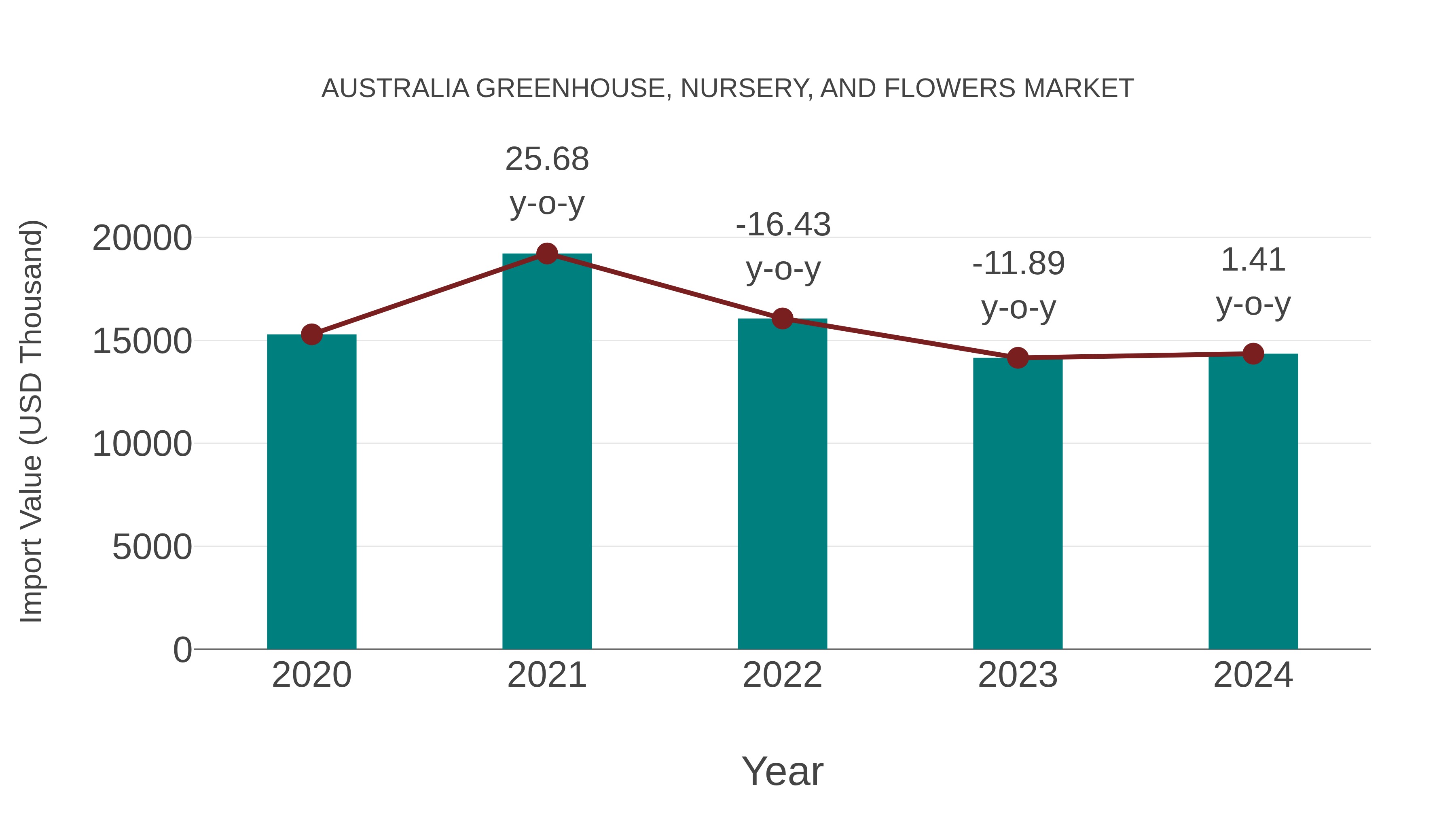
In the Australia greenhouse, nursery, and flowers market, the import trend from 2023 to 2024 exhibited a growth rate of 1.41%, contrasting with a compound annual growth rate (CAGR) of -1.57% from 2020 to 2024. This shift may be attributed to evolving consumer preferences or alterations in trade policies impacting import momentum.
Australia Greenhouse Nursery and Flowers Market Overview
The greenhouse nursery and flowers market in Australia cater to the demand for ornamental plants, flowers, and nursery products grown in controlled environments. With a focus on quality, diversity, and sustainability, the market offers a variety of greenhouse-grown plants and flowers for landscaping, gardening, and decorative purposes.
Drivers of the market
The Australia greenhouse nursery and flowers market are driven by several key factors contributing to its growth. Firstly, the growing demand for ornamental plants, flowers, and nursery products for landscaping, gardening, and decorative purposes is driving investments in greenhouse nursery operations. Greenhouses provide controlled environments that enable year-round cultivation, propagation, and production of a wide variety of plant species, including flowers, shrubs, and ornamental trees. Additionally, the rise of urban gardening, gardening clubs, and community gardening initiatives is fueling demand for greenhouse-grown plants and flowers among urban dwellers. Moreover, the expansion of e-commerce platforms and online retail channels is increasing accessibility and market reach for greenhouse nursery and flowers products in Australia.
Challenges of the market
Challenges in the Australia greenhouse nursery and flowers market include seasonality, competition from outdoor cultivation, and market demand fluctuations. While greenhouse nurseries offer advantages such as year-round production and controlled growing conditions, challenges such as high operational costs, weather-related risks, and fluctuations in consumer preferences and demand pose challenges for growers and market stability.
Government Policy of the market
The Australia government may implement policies to support the greenhouse nursery and flowers industry through initiatives promoting horticultural innovation, supporting plant biosecurity, and regulating nursery operations. Regulations concerning plant health standards, quarantine measures, and import/export controls may influence market dynamics. Additionally, initiatives promoting research and development in floriculture, supporting local nurseries, and regulating floral imports may shape market trends.
Key Highlights of the Report:
- Australia Greenhouse, Nursery, And Flowers Market Outlook
- Market Size of Australia Greenhouse, Nursery, And Flowers Market, 2025
- Forecast of Australia Greenhouse, Nursery, And Flowers Market, 2032
- Historical Data and Forecast of Australia Greenhouse, Nursery, And Flowers Revenues & Volume for the Period 2022-2032F
- Australia Greenhouse, Nursery, And Flowers Market Trend Evolution
- Australia Greenhouse, Nursery, And Flowers Market Drivers and Challenges
- Australia Greenhouse, Nursery, And Flowers Price Trends
- Australia Greenhouse, Nursery, And Flowers Porter's Five Forces
- Australia Greenhouse, Nursery, And Flowers Industry Life Cycle
- Historical Data and Forecast of Australia Greenhouse, Nursery, And Flowers Market Revenues & Volume By Type for the Period 2022-2032F
- Historical Data and Forecast of Australia Greenhouse, Nursery, And Flowers Market Revenues & Volume By Food Crops Grown Under Cover for the Period 2022-2032F
- Historical Data and Forecast of Australia Greenhouse, Nursery, And Flowers Market Revenues & Volume By Nursery and Floriculture Production for the Period 2022-2032F
- Historical Data and Forecast of Australia Greenhouse, Nursery, And Flowers Market Revenues & Volume By End-User for the Period 2022-2032F
- Historical Data and Forecast of Australia Greenhouse, Nursery, And Flowers Market Revenues & Volume By B2B for the Period 2022-2032F
- Historical Data and Forecast of Australia Greenhouse, Nursery, And Flowers Market Revenues & Volume By B2C for the Period 2022-2032F
- Australia Greenhouse, Nursery, And Flowers Import Export Trade Statistics
- Market Opportunity Assessment By Type
- Market Opportunity Assessment By End-User
- Australia Greenhouse, Nursery, And Flowers Top Companies Market Share
- Australia Greenhouse, Nursery, And Flowers Competitive Benchmarking By Technical and Operational Parameters
- Australia Greenhouse, Nursery, And Flowers Company Profiles
- Australia Greenhouse, Nursery, And Flowers Key Strategic Recommendations






































