Australia Grinding Mills Market Size, Share & Growth Rate
The Australia Grinding Mills Market was estimated at USD 213 Million in 2025 and is projected to reach USD 251 Million by 2032, growing at a CAGR of 2.4% from 2026 to 2032. This growth trajectory is primarily fueled by the escalating demand for processed food products, including grains and cereals, which necessitates advanced grinding technologies. Furthermore, the rapid expansion of the food and beverage industry, combined with urbanization and evolving consumer preferences, is significantly enhancing the markets outlook.
Australia Grinding Mills Market Year-wise Growth Rate and Key Drivers
This graph highlights how the Australia Grinding Mills Market has steadily grown over the years, supported by major growth factors.
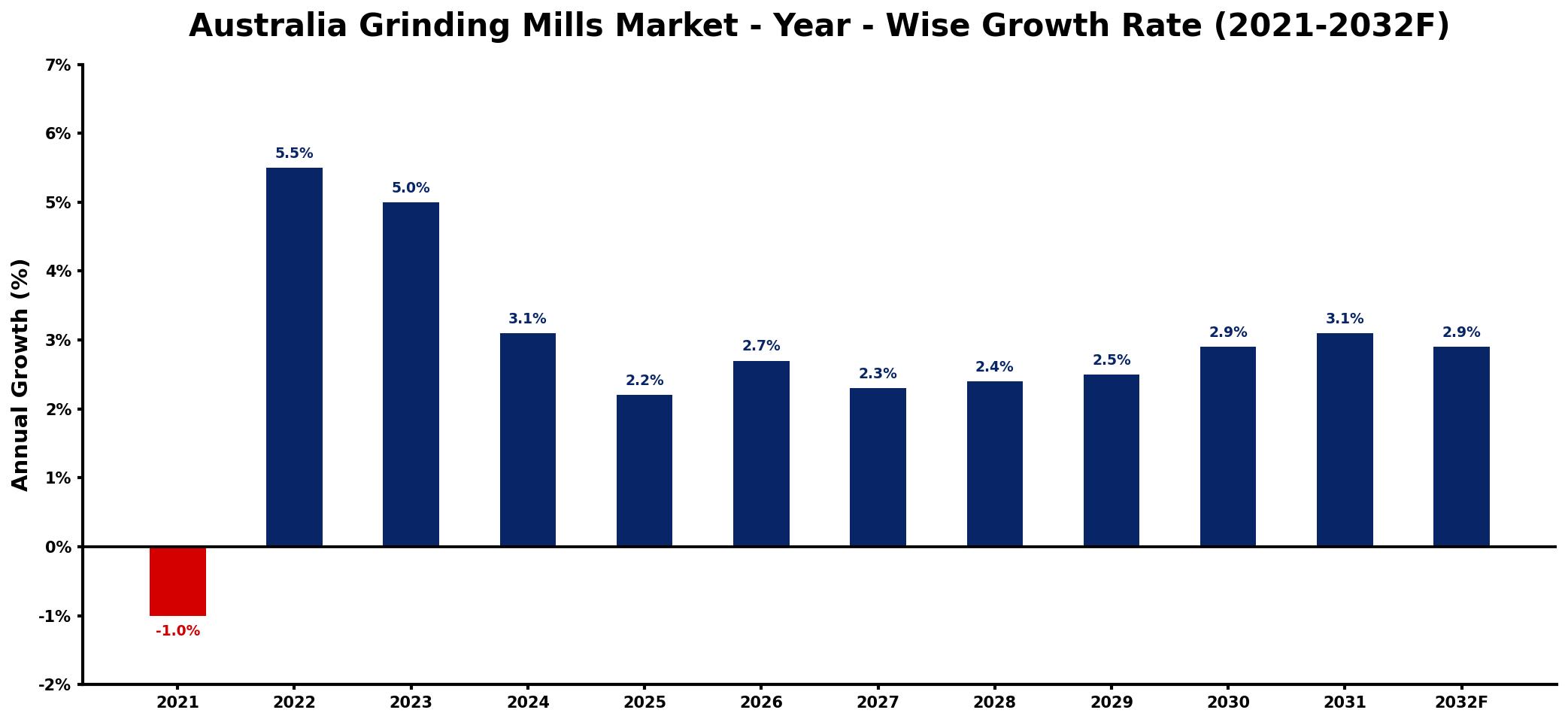
The table below presents the year‑wise growth rates along with the key drivers influencing the market
| Year | Growth Rate | Major Drivers |
| 2021 | -1.0% | decreased industrial manufacturing output |
| 2022 | 5.5% | increased demand for minerals processing |
| 2023 | 5.0% | growth in construction sector investments |
| 2024 | 3.1% | expansion of renewable energy projects |
| 2025 | 2.2% | rising global commodity prices |
| 2026 | 2.7% | increased focus on sustainability initiatives |
| 2027 | 2.3% | expanding industrial usage applications |
| 2028 | 2.4% | improved raw material availability |
| 2029 | 2.5% | increased automation in manufacturing |
| 2030 | 2.9% | rising demand for advanced technologies |
| 2031 | 3.1% | increased infrastructure development projects |
| 2032 | 2.9% | rising export shipment volumes |
Note: Market size estimations and growth projections presented in this report are based on 6Wresearch's proprietary forecasting methodology, utilizing the latest available industry data, government publications, and primary research inputs.
Australia Grinding Mills Market Synopsis
The Australia Grinding Mills Market is currently characterized by a strong need for efficient and sustainable milling solutions across various sectors, including mining and agriculture. As industries increasingly prioritize product quality and operational efficiency, the demand for advanced grinding mill technologies is surging.
Recent innovations in milling technology, including improvements in energy efficiency and material flexibility, have positioned Australia as a leader in grinding mill applications. These advancements are particularly pertinent in the food processing sector, where precise particle size control is vital for product consistency and quality.
Australia Grinding Mills Market Key Takeaways
- The market is experiencing steady growth driven by the food and beverage industry.
- Technological advancements are enhancing product quality and operational efficiency.
- Urbanization and changing consumer lifestyles are significant demand drivers.
- Regulatory policies are shaping the market dynamics and encouraging sustainable practices.
- Challenges related to energy consumption and raw material availability continue to pose hurdles.
Evaluation of Restraints in Australia Grinding Mills Market
While the Australia Grinding Mills Market is poised for growth, certain restraints need addressing. High energy consumption remains a pivotal concern, as many grinding mills require substantial power for optimal operation. Additionally, achieving consistent product quality can be challenging, particularly in sectors with stringent standards. The fluctuating availability of sustainable raw materials further complicates the landscape, necessitating strategic sourcing and innovation to mitigate these issues.
Australia Grinding Mills Market Trends
Emerging trends in the Australia Grinding Mills Market indicate a shift towards sustainable and energy-efficient technologies. Manufacturers are increasingly investing in equipment that reduces waste and minimizes energy use, aligning with global sustainability goals. Furthermore, the rise of automation and smart technology in milling processes is enhancing operational efficiency and precision, allowing companies to remain competitive in a rapidly evolving marketplace.
Australia Grinding Mills Market Opportunities
Significant growth opportunities lie within the food processing sector, where the rising demand for quality and consistency presents a compelling case for investments in modern grinding technologies. Additionally, the mining and minerals processing industries are evolving, creating space for innovative solutions that enhance productivity and environmental sustainability. These sectors are primed for investment as they navigate a landscape increasingly focused on resource efficiency and quality improvement.
Government Initiatives in the Australia Grinding Mills Market
Government policies in Australia are actively influencing the grinding mills market, particularly through initiatives aimed at supporting sustainable practices and technological innovation. Regulatory frameworks that promote responsible mining operations and environmental protection are shaping manufacturing processes in the milling sector. Public spending on infrastructure and technology development further strengthens the market by fostering advancements that enhance the efficiency and sustainability of grinding mill operations.
Future Insights of the Australia Grinding Mills Market
Looking towards the future, the Australia Grinding Mills Market is anticipated to evolve significantly from 2026 to 2032. Continued technological innovation, coupled with rising consumer demand for high-quality processed foods, will be critical in driving market dynamics. As sustainability becomes a central concern, companies will likely focus on integrating eco-friendly technologies to enhance their competitive edge. The trajectory of urbanization and shifts in consumer lifestyles will also play pivotal roles in shaping future demand patterns.
Australia Grinding Mills Market Latest Developments (2025 - 2026)
Recent developments in the Australia Grinding Mills Market indicate a growing emphasis on smart milling technologies that improve efficiency and reduce energy consumption. Companies are exploring partnerships to advance innovative solutions, with a focus on sustainability and productivity enhancements. Furthermore, the industry is witnessing an influx of new entrants aiming to capitalize on the opportunities presented by evolving consumer demands and regulatory landscapes.
Australia Grinding Mills Market - Key Attractiveness of the Report
- 10 Years of Market Numbers
- Historical Data Starting from 2022 to 2025
- Base Year: 2025
- Forecast Data until 2032
- Key Performance Indicators Impacting the Market
- Major Upcoming Developments and Projects
Key Highlights of the Report:
- Australia Grinding Mills Market Outlook
- Market Size of Australia Grinding Mills Market, 2025
- Forecast of Australia Grinding Mills Market, 2032
- Historical Data and Forecast of Australia Grinding Mills Revenues & Volume for the Period 2022-2032F
- Australia Grinding Mills Market Trend Evolution
- Australia Grinding Mills Market Drivers and Challenges
- Australia Grinding Mills Price Trends
- Australia Grinding Mills Porter's Five Forces
- Australia Grinding Mills Industry Life Cycle
- Historical Data and Forecast of Australia Grinding Mills Market Revenues & Volume By Types for the Period 2022-2032F
- Historical Data and Forecast of Australia Grinding Mills Market Revenues & Volume By Wet Grinding Mills for the Period 2022-2032F
- Historical Data and Forecast of Australia Grinding Mills Market Revenues & Volume By Dry Grinding Mills for the Period 2022-2032F
- Historical Data and Forecast of Australia Grinding Mills Market Revenues & Volume By Applications for the Period 2022-2032F
- Historical Data and Forecast of Australia Grinding Mills Market Revenues & Volume By Metal Mining for the Period 2022-2032F
- Historical Data and Forecast of Australia Grinding Mills Market Revenues & Volume By Mineral Mining for the Period 2022-2032F
- Historical Data and Forecast of Australia Grinding Mills Market Revenues & Volume By Others for the Period 2022-2032F
- Australia Grinding Mills Import Export Trade Statistics
- Market Opportunity Assessment By Types
- Market Opportunity Assessment By Applications
- Australia Grinding Mills Top Companies Market Share
- Australia Grinding Mills Competitive Benchmarking By Technical and Operational Parameters
- Australia Grinding Mills Company Profiles
- Australia Grinding Mills Key Strategic Recommendations






































