Australia Hepatitis Vaccine Market Size, Share & Growth Rate
The Australia Hepatitis Vaccine Market was estimated at USD 215 Million in 2025 and is projected to reach USD 253 Million by 2032, growing at a CAGR of 2.4% from 2026 to 2032. This growth trajectory reflects robust public health initiatives and increasing awareness around hepatitis prevention. Furthermore, the push towards routine immunization programs and government-backed campaigns to eliminate hepatitis as a public health threat will continue to drive the market forward.
Australia Hepatitis Vaccine Market Year-wise Growth Rate and Key Drivers
This graph highlights how the Australia Hepatitis Vaccine Market has steadily grown over the years, supported by major growth factors.
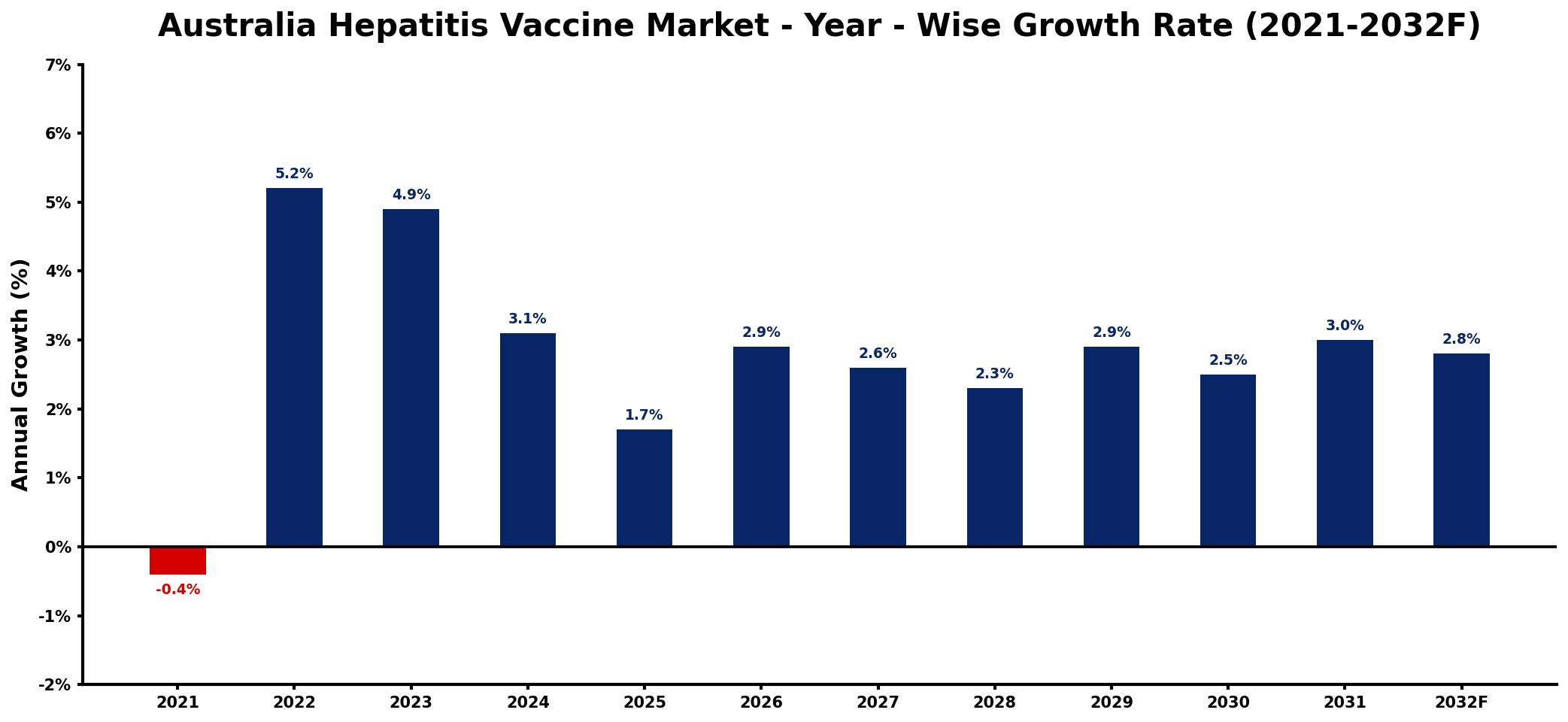
The table below presents the year‑wise growth rates along with the key drivers influencing the market
| Year | Growth Rate | Major Drivers |
| 2021 | -0.4% | decrease in healthcare investment funding |
| 2022 | 5.2% | increased public health awareness campaigns |
| 2023 | 4.9% | growth in preventive healthcare initiatives |
| 2024 | 3.1% | expansion of immunization programs nationwide |
| 2025 | 1.7% | rising demand for healthcare accessibility |
| 2026 | 2.9% | increase in international travel regulations |
| 2027 | 2.6% | enhanced focus on disease prevention |
| 2028 | 2.3% | growing partnerships with healthcare providers |
| 2029 | 2.9% | improved distribution and logistics networks |
| 2030 | 2.5% | strengthened government health policies |
| 2031 | 3.0% | advancements in medical research funding |
| 2032 | 2.8% | wider adoption of health technologies |
Note: Market size estimations and growth projections presented in this report are based on 6Wresearch's proprietary forecasting methodology, utilizing the latest available industry data, government publications, and primary research inputs.
Australia Hepatitis Vaccine Market Synopsis
Australia's hepatitis vaccine landscape is marked by a strong commitment to immunization, with government programs actively promoting vaccination against hepatitis A and B. Recent outbreaks and rising public health awareness have heightened the urgency for effective vaccine distribution and accessibility.
The demand for vaccines is further supported by ongoing research into new formulations and the potential for combination vaccines that could streamline immunization efforts. A well-coordinated approach is evident in the growing partnerships between public health authorities and healthcare providers to improve vaccine uptake.
Australia Hepatitis Vaccine Market Key Takeaways
- The market is primarily driven by government immunization initiatives and public health campaigns.
- Increasing awareness of hepatitis risks is fostering greater vaccine uptake.
- Research and innovation in vaccine formulations are pivotal for future market growth.
- Challenges related to vaccine access in remote areas present significant market hurdles.
- Collaboration among health agencies and stakeholders is essential for expanding vaccine coverage.
Evaluation of Restraints in Australia Hepatitis Vaccine Market
Despite the promising landscape, the Australia hepatitis vaccine market is hindered by several restraints. Vaccine hesitancy remains a critical issue, with certain population groups reluctant to accept vaccinations due to misinformation or cultural beliefs. Moreover, high manufacturing costs and regulatory hurdles complicate the introduction of new vaccines and may slow the market's growth. Accessibility issues, particularly in remote regions, create disparities in vaccine coverage, undermining the overall effectiveness of public health initiatives.
Australia Hepatitis Vaccine Market Trends
Several trends are currently shaping the Australia hepatitis vaccine market. One notable trend is the shift towards personalized medicine, with emerging research focusing on tailored vaccine solutions that cater to specific population needs. Additionally, digital health tools are being increasingly utilized to educate the public and track vaccination rates, promoting more effective disease management strategies. The integration of modern technology into vaccine distribution, including mobile clinics and online scheduling, is also enhancing access to vaccines across Australia.
Australia Hepatitis Vaccine Market Opportunities
The landscape presents several genuine growth opportunities, particularly in enhancing vaccine accessibility and public education. Collaborations with community organizations can facilitate outreach programs aimed at increasing immunization rates among underserved populations. Furthermore, advancements in vaccine technology and the potential for developing multi-target vaccines present avenues for significant investment. Companies focusing on these innovations stand to benefit greatly, especially as Australia continues its efforts to eliminate hepatitis as a public health threat.
Government Initiatives in the Australia Hepatitis Vaccine Market
Government policies in Australia have been pivotal in shaping the hepatitis vaccine market. Federal and state health departments actively promote immunization through various programs, ensuring vaccines are included in the National Immunization Program. Public spending aimed at increasing vaccine awareness, supporting research initiatives, and regulating vaccine imports further enhance the market dynamics. The collaborative efforts between public health agencies and healthcare providers exemplify Australia's commitment to reducing the burden of hepatitis.
Future Insights of the Australia Hepatitis Vaccine Market
Looking ahead to 2026-2032, the Australia hepatitis vaccine market is expected to evolve significantly. Enhanced vaccine formulations, including combination vaccines, may become prevalent, offering broader protection with fewer doses. Furthermore, an increased emphasis on addressing vaccine hesitancy through education will be crucial for improving public health outcomes. As global partnerships expand and more innovative solutions emerge, Australia is well-positioned to strengthen its vaccination programs and ultimately achieve its public health goals.
Australia Hepatitis Vaccine Market Latest Developments (2025 - 2026)
Recent developments in the Australia hepatitis vaccine market indicate a concerted effort towards enhancing vaccine distribution networks. Health authorities are collaborating with technology firms to improve tracking systems for vaccine supply chains, ensuring timely availability across regions. Additionally, awareness campaigns focused on the importance of hepatitis vaccination have been launched, demonstrating a proactive approach to disease prevention.
Australia Hepatitis Vaccine Market - Key Attractiveness of the Report
- 10 Years of Market Numbers
- Historical Data Starting from 2022 to 2025
- Base Year: 2025
- Forecast Data until 2032
- Key Performance Indicators Impacting the Market
- Major Upcoming Developments and Projects
Key Highlights of the Report:
- Australia Hepatitis Vaccine Market Outlook
- Market Size of Australia Hepatitis Vaccine Market, 2025
- Forecast of Australia Hepatitis Vaccine Market, 2032
- Historical Data and Forecast of Australia Hepatitis Vaccine Revenues & Volume for the Period 2022-2032F
- Australia Hepatitis Vaccine Market Trend Evolution
- Australia Hepatitis Vaccine Market Drivers and Challenges
- Australia Hepatitis Vaccine Price Trends
- Australia Hepatitis Vaccine Porter's Five Forces
- Australia Hepatitis Vaccine Industry Life Cycle
- Historical Data and Forecast of Australia Hepatitis Vaccine Market Revenues & Volume By Indication for the Period 2022-2032F
- Historical Data and Forecast of Australia Hepatitis Vaccine Market Revenues & Volume By Hepatitis A for the Period 2022-2032F
- Historical Data and Forecast of Australia Hepatitis Vaccine Market Revenues & Volume By Hepatitis B for the Period 2022-2032F
- Historical Data and Forecast of Australia Hepatitis Vaccine Market Revenues & Volume By Vaccine Type for the Period 2022-2032F
- Historical Data and Forecast of Australia Hepatitis Vaccine Market Revenues & Volume By Recombinant Vaccine for the Period 2022-2032F
- Historical Data and Forecast of Australia Hepatitis Vaccine Market Revenues & Volume By Inactivated Vaccine for the Period 2022-2032F
- Historical Data and Forecast of Australia Hepatitis Vaccine Market Revenues & Volume By Distribution Channel for the Period 2022-2032F
- Historical Data and Forecast of Australia Hepatitis Vaccine Market Revenues & Volume By Hospitals for the Period 2022-2032F
- Historical Data and Forecast of Australia Hepatitis Vaccine Market Revenues & Volume By Retail Pharmacy for the Period 2022-2032F
- Historical Data and Forecast of Australia Hepatitis Vaccine Market Revenues & Volume By Online Pharmacy for the Period 2022-2032F
- Australia Hepatitis Vaccine Import Export Trade Statistics
- Market Opportunity Assessment By Indication
- Market Opportunity Assessment By Vaccine Type
- Market Opportunity Assessment By Distribution Channel
- Australia Hepatitis Vaccine Top Companies Market Share
- Australia Hepatitis Vaccine Competitive Benchmarking By Technical and Operational Parameters
- Australia Hepatitis Vaccine Company Profiles
- Australia Hepatitis Vaccine Key Strategic Recommendations






































