Australia Hexane Market: Import Trend Analysis
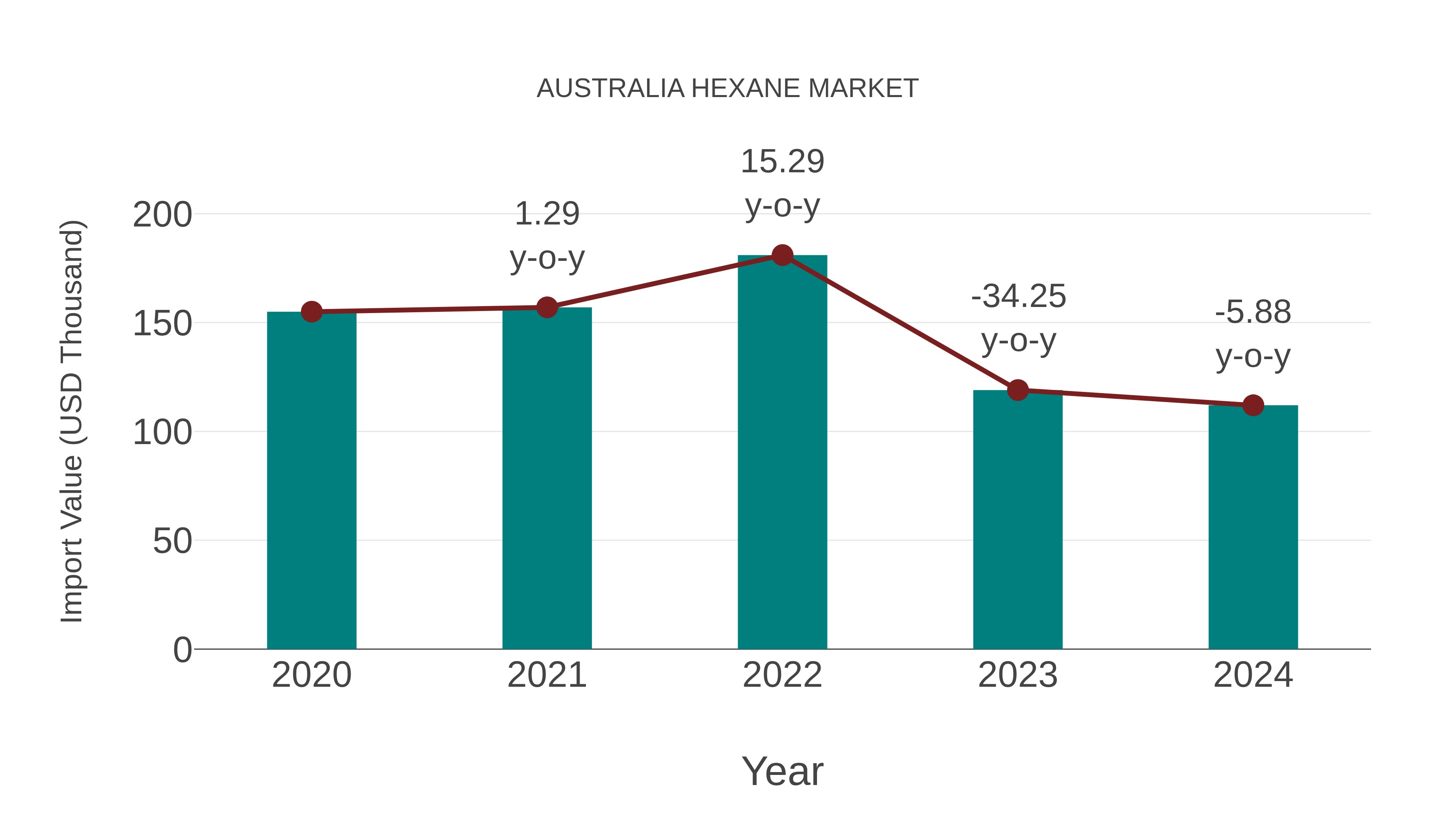
Australia`s import trend for the hexane market experienced a decline from 2023 to 2024, with a growth rate of -5.88%. The compound annual growth rate (CAGR) for the period 2020-2024 was -7.8%. This negative momentum can be attributed to shifting demand patterns or changes in trade policies impacting market stability.
Australia Hexane Market Overview
Hexane is a volatile organic solvent widely used in industrial processes such as extraction, purification, and degreasing. In Australia, the demand for hexane is driven by its applications in the food processing, pharmaceutical, and chemical industries. Hexane is primarily used as a solvent for the extraction of edible oils from seeds and vegetables, as well as in the production of adhesives, coatings, and cleaning agents. Moreover, hexane finds applications in the pharmaceutical industry for the extraction of natural products and the synthesis of pharmaceutical intermediates. Market players are focusing on ensuring product quality, safety, and compliance with regulatory standards to meet the diverse needs of end-user industries and maintain their competitiveness in the market.
Drivers of the market
The hexane market in Australia is driven by its widespread use as a solvent in various industrial processes such as extraction, purification, and cleaning. Hexane is utilized in the extraction of oils from seeds and vegetables, as well as in the production of adhesives, coatings, and pharmaceuticals. The expanding food processing and manufacturing sectors are driving the demand for hexane as a solvent. Moreover, stringent environmental regulations regarding solvent emissions and increasing focus on sustainability are influencing market dynamics.
Challenges of the market
In the hexane market, challenges revolve around sustainability, feedstock availability, and market demand dynamics. Hexane is primarily used as a solvent in various industries, including food processing, pharmaceuticals, and chemicals, but concerns over its environmental impact and potential health risks drive demand for alternative solvents. Additionally, fluctuations in crude oil prices, which affect the cost of petrochemical feedstocks, can impact the competitiveness of hexane-derived products in the market. Embracing sustainable production practices and exploring renewable feedstock sources are critical for long-term viability in the hexane market.
Government Policy of the market
The Australia government regulates the use of hexane in industrial processes, including its application as a solvent in the extraction of oils and fats. Hexane emissions are subject to monitoring and control under environmental regulations aimed at reducing air and water pollution. Additionally, workplace health and safety regulations mandate proper handling procedures to minimize occupational exposure to hexane vapors. Government policies prioritize the use of safer alternatives and pollution prevention measures in industries where hexane is used.
Key Highlights of the Report:
- Australia Hexane Market Outlook
- Market Size of Australia Hexane Market, 2025
- Forecast of Australia Hexane Market, 2032
- Historical Data and Forecast of Australia Hexane Revenues & Volume for the Period 2022-2032F
- Australia Hexane Market Trend Evolution
- Australia Hexane Market Drivers and Challenges
- Australia Hexane Price Trends
- Australia Hexane Porter's Five Forces
- Australia Hexane Industry Life Cycle
- Historical Data and Forecast of Australia Hexane Market Revenues & Volume By Grade for the Period 2022-2032F
- Historical Data and Forecast of Australia Hexane Market Revenues & Volume By Oil Extraction/Food for the Period 2022-2032F
- Historical Data and Forecast of Australia Hexane Market Revenues & Volume By Pharmaceutical for the Period 2022-2032F
- Historical Data and Forecast of Australia Hexane Market Revenues & Volume By Industrial for the Period 2022-2032F
- Historical Data and Forecast of Australia Hexane Market Revenues & Volume By Application for the Period 2022-2032F
- Historical Data and Forecast of Australia Hexane Market Revenues & Volume By Oil Extraction for the Period 2022-2032F
- Historical Data and Forecast of Australia Hexane Market Revenues & Volume By Pharmaceutical for the Period 2022-2032F
- Historical Data and Forecast of Australia Hexane Market Revenues & Volume By Industrial Cleaning for the Period 2022-2032F
- Historical Data and Forecast of Australia Hexane Market Revenues & Volume By Degreasing for the Period 2022-2032F
- Historical Data and Forecast of Australia Hexane Market Revenues & Volume By Polymerization for the Period 2022-2032F
- Australia Hexane Import Export Trade Statistics
- Market Opportunity Assessment By Grade
- Market Opportunity Assessment By Application
- Australia Hexane Top Companies Market Share
- Australia Hexane Competitive Benchmarking By Technical and Operational Parameters
- Australia Hexane Company Profiles
- Australia Hexane Key Strategic Recommendations






































