Australia Home Furniture and Bedding Market Size, Share & Growth Rate
The Australia Home Furniture and Bedding Market was estimated at USD 121 Million in 2025 and is projected to reach USD 142 Million by 2032, growing at a CAGR of 2.3% from 2026 to 2032. This growth trajectory is driven by a surge in home renovations and urbanization, as consumers increasingly prioritize comfort and style in their living spaces. Moreover, a shift toward multifunctional furniture designed to optimize smaller living areas further fuels demand, catering to the contemporary Australian lifestyle.
Australia Home Furniture and Bedding Market Year-wise Growth Rate and Key Drivers
This graph highlights how the Australia Home Furniture and Bedding Market has steadily grown over the years, supported by major growth factors.
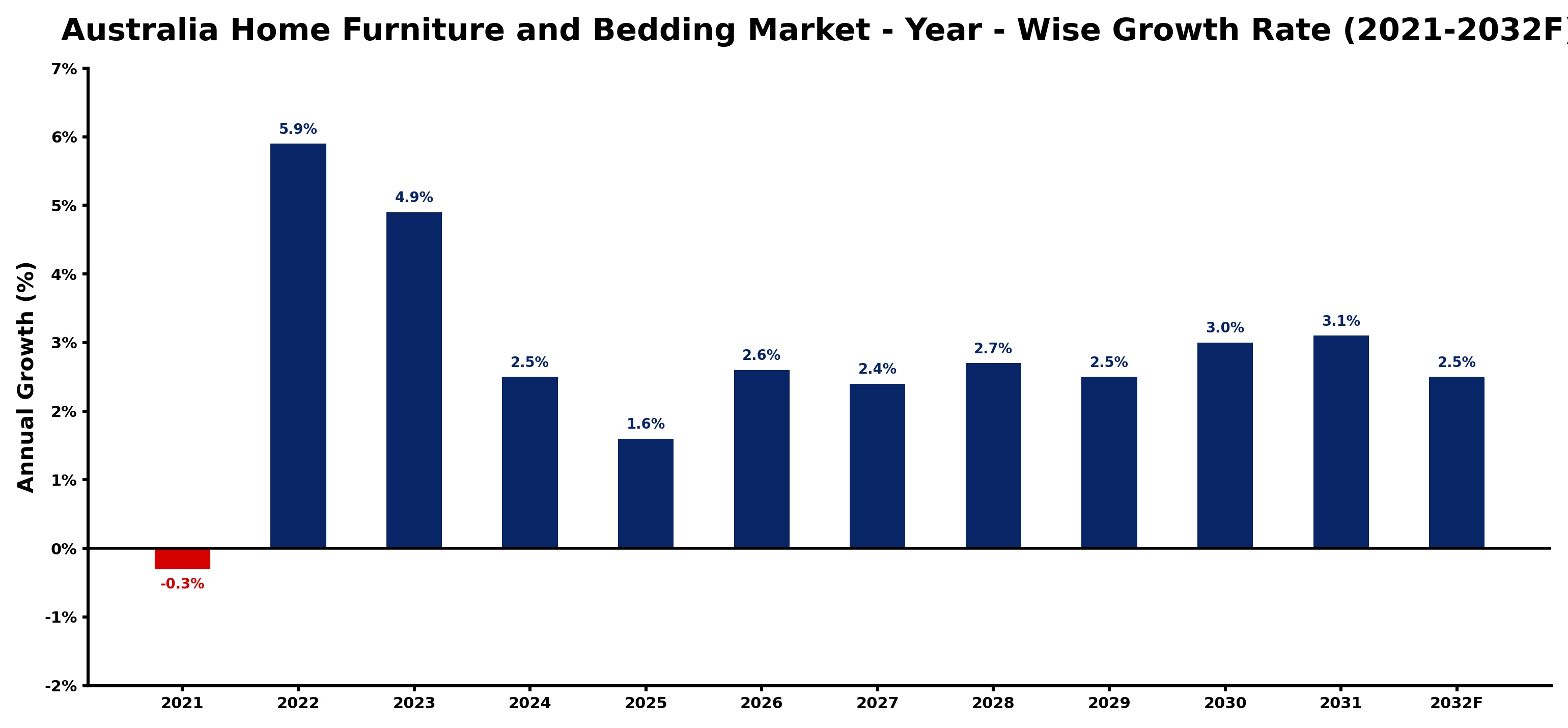
The table below presents the year‑wise growth rates along with the key drivers influencing the market
| Year | Growth Rate | Major Drivers |
| 2021 | -0.3% | Consumer spending decreased significantly |
| 2022 | 5.9% | E-commerce platforms expanded rapidly |
| 2023 | 4.9% | Sustainable materials gained popularity |
| 2024 | 2.5% | Home renovation projects increased demand |
| 2025 | 1.6% | Smart furniture technology attracted interest |
| 2026 | 2.6% | Urbanization trends boosted sales |
| 2027 | 2.4% | Health and wellness focus grew |
| 2028 | 2.7% | Design innovation enhanced market appeal |
| 2029 | 2.5% | Customization options attracted consumers |
| 2030 | 3.0% | Collaborations with designers expanded offerings |
| 2031 | 3.1% | Sustainability initiatives enhanced brand loyalty |
| 2032 | 2.5% | Global trends influenced local preferences |
Note - Market size estimations and growth projections presented in this report are based on 6Wresearch’s advanced forecasting approach, validated with industry datasets as of June 2026.
Australia Home Furniture and Bedding Market Synopsis
Consumer preferences in Australia are shifting towards sustainable and high-quality furniture and bedding solutions. As environmental awareness grows, more buyers are seeking products made from eco-friendly materials that enhance both aesthetics and comfort. This trend not only influences purchasing behavior but also propels manufacturers to innovate in their design and materials.
The demand for bedding products, including advanced mattresses and adjustable bed frames, is witnessing a notable rise as Australians focus on improving sleep quality. With the wellness movement gaining traction, consumers are increasingly investing in their sleep environment, positioning the bedding segment for significant growth within the overall market.
Australia Home Furniture and Bedding Market Key Takeaways
- The market is poised for steady growth, propelled by rising disposable incomes and increased consumer spending on home aesthetics.
- A significant trend is the inclination towards multifunctional furniture that accommodates modern urban lifestyles.
- Technological advancements are enhancing product offerings, particularly in the bedding segment aimed at improving sleep quality.
- Sustainability is becoming a focal point, with consumers favoring eco-friendly materials and responsible manufacturing practices.
- Regulatory frameworks are in place to ensure product safety and environmental compliance, further shaping market dynamics.
Evaluation of Restraints in Australia Home Furniture and Bedding Market
Despite its growth potential, the Australia Home Furniture and Bedding Market faces notable restraints. Supply chain disruptions, particularly in sourcing raw materials and logistics, have created volatility in production timelines and costs. These challenges can lead to increased pricing pressures on end consumers. Furthermore, domestic manufacturers grapple with stiff competition from both local brands and international players, necessitating strategic investment in innovation and quality improvements to stay competitive. Market players must navigate these challenges while ensuring robust supply chain management to sustain growth in this evolving landscape.
Australia Home Furniture and Bedding Market Trends
Several key trends are emerging within the Australia Home Furniture and Bedding Market. First, the rise of remote working has led to increased investments in home office furniture, blending functionality with aesthetics. Additionally, consumers are becoming more discerning about product durability, prompting manufacturers to focus on higher-quality materials and craftsmanship. The trend towards minimalism is evident, as many households favor clean lines and simple designs that provide a sense of spaciousness.
Australia Home Furniture and Bedding Market Opportunities
Opportunities for growth in the Australia Home Furniture and Bedding Market are plentiful. E-commerce channels continue to expand, enabling furniture retailers to reach a broader audience and cater to changing buying preferences. The emphasis on customizability and personalization in furniture design is becoming increasingly appealing, allowing consumers to create unique living environments that reflect their individual style. Furthermore, the growing interest in smart home solutions opens avenues for integrating technology into furniture and bedding products, enhancing functionality and consumer appeal.
Government Initiatives in the Australia Home Furniture and Bedding Market
The Australian government actively supports the home furniture and bedding market through various policies aimed at ensuring consumer safety and promoting sustainable practices. Regulatory bodies like the Australian Competition and Consumer Commission (ACCC) enforce compliance with consumer protection laws, while standards organizations establish guidelines for product quality and safety. There are also initiatives that encourage manufacturers to adopt eco-friendly practices, aiming to reduce waste and promote recycling within the industry, reflecting a commitment to sustainability and environmental responsibility.
Future Insights of the Australia Home Furniture and Bedding Market
Looking ahead to the period from 2026 to 2032, the Australia Home Furniture and Bedding Market is expected to continue its positive trajectory. Driven by ongoing urbanization and an increasing focus on home wellness, the demand for innovative, stylish, and sustainable products will shape market dynamics. As consumer awareness of environmental issues deepens, manufacturers that prioritize sustainable sourcing and production processes are likely to capture a more substantial market share. Moreover, the advent of smart home technologies will likely redefine consumer expectations, pushing businesses to adapt quickly to remain relevant.
Australia Home Furniture and Bedding Market Latest Developments (May 2025 - June 2026)
Recent developments in the Australia Home Furniture and Bedding Market indicate a heightened focus on technological integration within products, particularly in the bedding segment. Retailers are increasingly leveraging online platforms to improve consumer accessibility and engagement, often incorporating virtual reality tools for immersive shopping experiences. Additionally, there is a noticeable uptick in partnerships between manufacturers and technology firms to develop smart furniture solutions, reflecting a trend toward innovation aimed at enhancing consumer convenience.
Australia Home Furniture and Bedding Market - Key Attractiveness of the Report
- 10 Years of Market Numbers
- Historical Data Starting from 2022 to 2025
- Base Year: 2025
- Forecast Data until 2032
- Key Performance Indicators Impacting the Market
- Major Upcoming Developments and Projects
Key Highlights of the Report:
- Australia Home Furniture and Bedding Market Outlook
- Market Size of Australia Home Furniture and Bedding Market, 2025
- Forecast of Australia Home Furniture and Bedding Market, 2032
- Historical Data and Forecast of Australia Home Furniture and Bedding Revenues & Volume for the Period 2022-2032F
- Australia Home Furniture and Bedding Market Trend Evolution
- Australia Home Furniture and Bedding Market Drivers and Challenges
- Australia Home Furniture and Bedding Price Trends
- Australia Home Furniture and Bedding Porter's Five Forces
- Australia Home Furniture and Bedding Industry Life Cycle
- Historical Data and Forecast of Australia Home Furniture and Bedding Market Revenues & Volume By Product Type for the Period 2022-2032F
- Historical Data and Forecast of Australia Home Furniture and Bedding Market Revenues & Volume By Sofa for the Period 2022-2032F
- Historical Data and Forecast of Australia Home Furniture and Bedding Market Revenues & Volume By Bed for the Period 2022-2032F
- Historical Data and Forecast of Australia Home Furniture and Bedding Market Revenues & Volume By Chair for the Period 2022-2032F
- Historical Data and Forecast of Australia Home Furniture and Bedding Market Revenues & Volume By Cupboard for the Period 2022-2032F
- Historical Data and Forecast of Australia Home Furniture and Bedding Market Revenues & Volume By Others for the Period 2022-2032F
- Historical Data and Forecast of Australia Home Furniture and Bedding Market Revenues & Volume By Sales Channel for the Period 2022-2032F
- Historical Data and Forecast of Australia Home Furniture and Bedding Market Revenues & Volume By Online for the Period 2022-2032F
- Historical Data and Forecast of Australia Home Furniture and Bedding Market Revenues & Volume By Offline for the Period 2022-2032F
- Australia Home Furniture and Bedding Import Export Trade Statistics
- Market Opportunity Assessment By Product Type
- Market Opportunity Assessment By Sales Channel
- Australia Home Furniture and Bedding Top Companies Market Share
- Australia Home Furniture and Bedding Competitive Benchmarking By Technical and Operational Parameters
- Australia Home Furniture and Bedding Company Profiles
- Australia Home Furniture and Bedding Key Strategic Recommendations






































