Australia Human Combination Vaccines Market Size, Share & Growth Rate
The Australia Human Combination Vaccines Market was estimated at USD 91 Million in 2025 and is projected to reach USD 107 Million by 2032, growing at a CAGR of 2.3% from 2026 to 2032. This growth trajectory is significantly fueled by rising demand for comprehensive immunization solutions, effectively addressing multiple infectious diseases within a single dose. Enhanced safety profiles and convenience of combination vaccines are fostering acceptance, while government initiatives promoting vaccination further contribute to the market's expansion.
Australia Human Combination Vaccines Market Year-wise Growth Rate and Key Drivers
This graph highlights how the Australia Human Combination Vaccines Market has steadily grown over the years, supported by major growth factors.
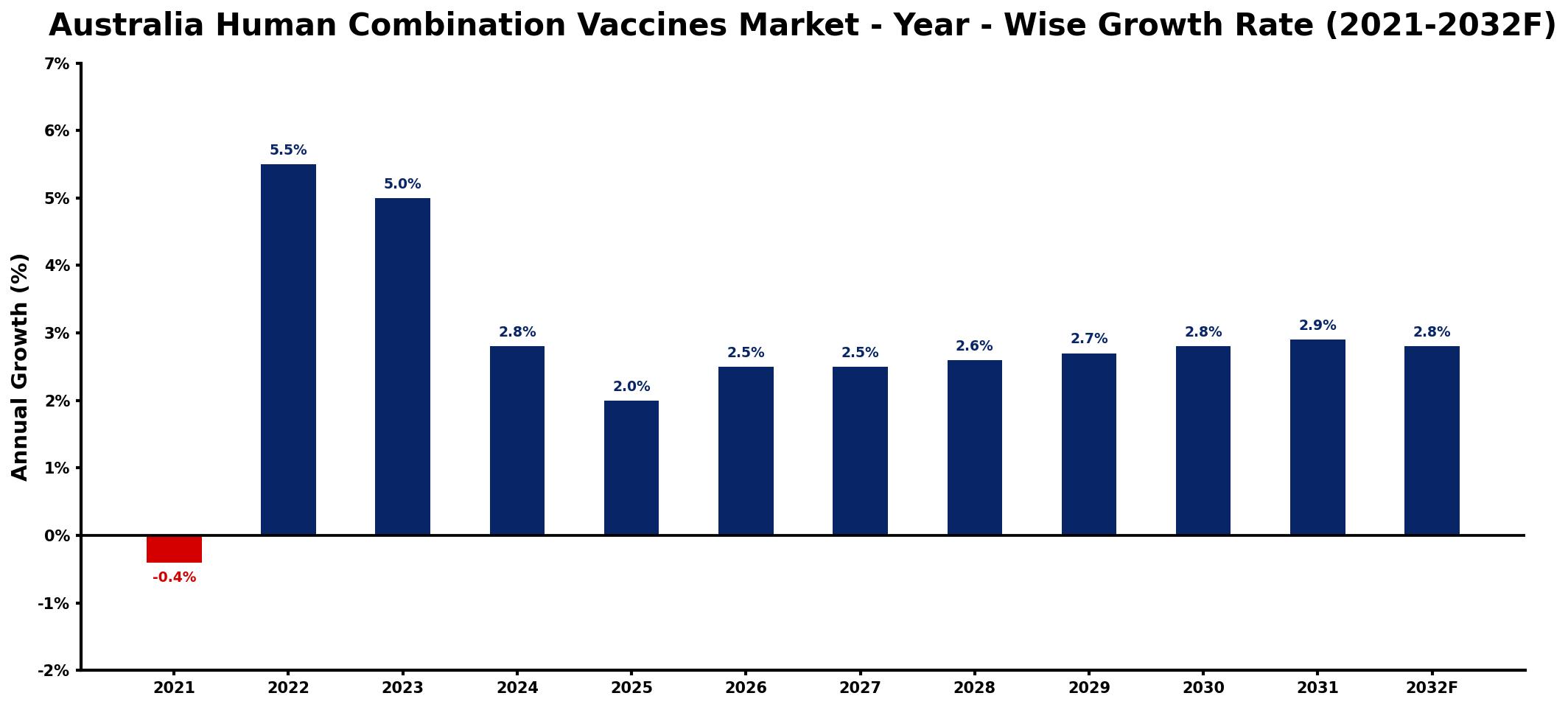
The table below presents the year‑wise growth rates along with the key drivers influencing the market
| Year | Growth Rate | Major Drivers |
| 2021 | -0.4% | decreased public health funding levels |
| 2022 | 5.5% | rising demand for preventive healthcare |
| 2023 | 5.0% | increased government healthcare investments |
| 2024 | 2.8% | growing emphasis on immunization programs |
| 2025 | 2.0% | expanding healthcare infrastructure initiatives |
| 2026 | 2.5% | increased public awareness campaigns |
| 2027 | 2.5% | rising investments in biotechnology sector |
| 2028 | 2.6% | enhanced global health collaboration efforts |
| 2029 | 2.7% | greater focus on disease prevention |
| 2030 | 2.8% | increased research and development funding |
| 2031 | 2.9% | growing partnerships with healthcare providers |
| 2032 | 2.8% | expansion of healthcare access initiatives |
Note: Market size estimations and growth projections presented in this report are based on 6Wresearch's proprietary forecasting methodology, utilizing the latest available industry data, government publications, and primary research inputs.
Australia Human Combination Vaccines Market Synopsis
The Australian healthcare landscape is increasingly embracing combination vaccines, driven by the need for efficient immunization programs that reduce the burden on healthcare facilities. This trend reflects a commitment to enhancing public health outcomes, particularly in pediatric populations where simplified vaccination schedules are crucial.
Moreover, continuous improvements in vaccine formulation and manufacturing technologies are yielding safer and more effective products. The integration of multiple antigens into a single formulation not only streamlines the immunization process but also contributes to higher vaccine coverage rates across various demographics.
Australia Human Combination Vaccines Market Key Takeaways
- The market is experiencing steady growth driven by advancements in vaccine formulation and government vaccination initiatives.
- Combination vaccines enhance compliance through simplified immunization schedules and reduced healthcare visits.
- Public health education campaigns are crucial for addressing vaccine hesitancy and misinformation.
- New vaccine candidates focusing on multiple pathogens are emerging, enhancing overall market dynamism.
- Investment in research and development remains essential for navigating regulatory challenges and safety concerns.
Evaluation of Restraints in Australia Human Combination Vaccines Market
Despite the promising growth, the Australia Human Combination Vaccines Market faces notable restraints. One of the primary concerns revolves around vaccine safety and the need for extensive regulatory approvals, which can delay market entry for new products. Public skepticism regarding vaccine efficacy and adverse reactions poses significant challenges, as misinformation can hinder vaccination uptake. Furthermore, the competitive presence of single-component vaccines may divert attention away from combination solutions, necessitating strategic efforts by developers to highlight the advantages of their products.
Australia Human Combination Vaccines Market Trends
Emerging trends in the Australia Human Combination Vaccines Market include a heightened focus on preventive healthcare and proactive disease management. Increasing collaboration between public health entities and private vaccine manufacturers is fostering innovation in vaccine development. Additionally, as global health concerns shift, there is a growing emphasis on combination vaccines that target emerging infectious diseases, further shaping the future landscape of immunization strategies.
Australia Human Combination Vaccines Market Opportunities
The market presents substantial opportunities for growth, particularly in developing new combination vaccines that can address the evolving epidemiological landscape. The rise of diseases requiring urgent immunization solutions, alongside public health efforts aimed at increasing vaccination coverage, opens avenues for investment and product innovation. Furthermore, partnerships with governmental and non-governmental organizations can amplify the reach and impact of new vaccine initiatives.
Government Initiatives in the Australia Human Combination Vaccines Market
The Australian government plays a pivotal role in shaping the human combination vaccines market through comprehensive immunization policies and funding initiatives. Regulatory bodies such as the Therapeutic Goods Administration (TGA) ensure that vaccines meet stringent safety and efficacy standards. Government-led public health campaigns and educational efforts aim to bolster vaccine uptake, combat misinformation, and ensure equitable access to immunization services across all population segments.
Future Insights of the Australia Human Combination Vaccines Market
Looking ahead to 2026-2032, the Australia Human Combination Vaccines Market is poised for continued evolution. Innovations in vaccine technology, coupled with a strategic focus on expanding immunization programs, will drive market growth. The emergence of new pathogens and public health threats will likely propel further research and development efforts, ensuring that the market remains responsive to the needs of the population. Overall, a collaborative approach between government entities and the pharmaceutical sector will be essential for maximizing the effectiveness and reach of combination vaccines.
Australia Human Combination Vaccines Market Latest Developments (2025 - 2026)
Recent developments in the Australia Human Combination Vaccines Market include several public health initiatives aimed at boosting vaccination coverage across various age groups. Collaborative efforts between health authorities and researchers have led to promising advancements in combination vaccine formulations that enhance safety and efficacy. Additionally, ongoing public education campaigns are addressing vaccine hesitancy, aiming to reinforce community trust in immunization practices.
Australia Human Combination Vaccines Market - Key Attractiveness of the Report
- 10 Years of Market Numbers
- Historical Data Starting from 2022 to 2025
- Base Year: 2025
- Forecast Data until 2032
- Key Performance Indicators Impacting the Market
- Major Upcoming Developments and Projects
Key Highlights of the Report:
- Australia Human Combination Vaccines Market Outlook
- Market Size of Australia Human Combination Vaccines Market, 2025
- Forecast of Australia Human Combination Vaccines Market, 2032
- Historical Data and Forecast of Australia Human Combination Vaccines Revenues & Volume for the Period 2022-2032F
- Australia Human Combination Vaccines Market Trend Evolution
- Australia Human Combination Vaccines Market Drivers and Challenges
- Australia Human Combination Vaccines Price Trends
- Australia Human Combination Vaccines Porter's Five Forces
- Australia Human Combination Vaccines Industry Life Cycle
- Historical Data and Forecast of Australia Human Combination Vaccines Market Revenues & Volume By Product Type for the Period 2022-2032F
- Historical Data and Forecast of Australia Human Combination Vaccines Market Revenues & Volume By Inactivated Vaccine for the Period 2022-2032F
- Historical Data and Forecast of Australia Human Combination Vaccines Market Revenues & Volume By Live Attenuated Vaccine for the Period 2022-2032F
- Historical Data and Forecast of Australia Human Combination Vaccines Market Revenues & Volume By Age Group for the Period 2022-2032F
- Historical Data and Forecast of Australia Human Combination Vaccines Market Revenues & Volume By Children for the Period 2022-2032F
- Historical Data and Forecast of Australia Human Combination Vaccines Market Revenues & Volume By Adults for the Period 2022-2032F
- Historical Data and Forecast of Australia Human Combination Vaccines Market Revenues & Volume By Combination Type for the Period 2022-2032F
- Historical Data and Forecast of Australia Human Combination Vaccines Market Revenues & Volume By Dtap/IPV/HEP B for the Period 2022-2032F
- Historical Data and Forecast of Australia Human Combination Vaccines Market Revenues & Volume By Dtap/HIB/IPV for the Period 2022-2032F
- Historical Data and Forecast of Australia Human Combination Vaccines Market Revenues & Volume By MMR II for the Period 2022-2032F
- Historical Data and Forecast of Australia Human Combination Vaccines Market Revenues & Volume By HEP B-HIB for the Period 2022-2032F
- Historical Data and Forecast of Australia Human Combination Vaccines Market Revenues & Volume By Others for the Period 2022-2032F
- Historical Data and Forecast of Australia Human Combination Vaccines Market Revenues & Volume By Distribution Channel for the Period 2022-2032F
- Historical Data and Forecast of Australia Human Combination Vaccines Market Revenues & Volume By Hospital Pharmacies for the Period 2022-2032F
- Historical Data and Forecast of Australia Human Combination Vaccines Market Revenues & Volume By Retailer Pharmacies for the Period 2022-2032F
- Historical Data and Forecast of Australia Human Combination Vaccines Market Revenues & Volume By Online Pharmacies for the Period 2022-2032F
- Australia Human Combination Vaccines Import Export Trade Statistics
- Market Opportunity Assessment By Product Type
- Market Opportunity Assessment By Age Group
- Market Opportunity Assessment By Combination Type
- Market Opportunity Assessment By Distribution Channel
- Australia Human Combination Vaccines Top Companies Market Share
- Australia Human Combination Vaccines Competitive Benchmarking By Technical and Operational Parameters
- Australia Human Combination Vaccines Company Profiles
- Australia Human Combination Vaccines Key Strategic Recommendations






































