Australia Immunology Market Size, Share & Growth Rate
The Australia Immunology Market was estimated at USD 234 Million in 2025 and is projected to reach USD 275 Million by 2032, growing at a CAGR of 2.3% from 2026 to 2032. This growth trajectory is underpinned by a significant rise in the prevalence of autoimmune diseases and infectious conditions, leading to heightened demand for innovative diagnostics and therapeutics. Furthermore, the ongoing advancements in biotechnology and personalized medicine are actively contributing to an evolving landscape, driving both patient outcomes and market growth.
Australia Immunology Market Year-wise Growth Rate and Key Drivers
This graph highlights how the Australia Immunology Market has steadily grown over the years, supported by major growth factors.
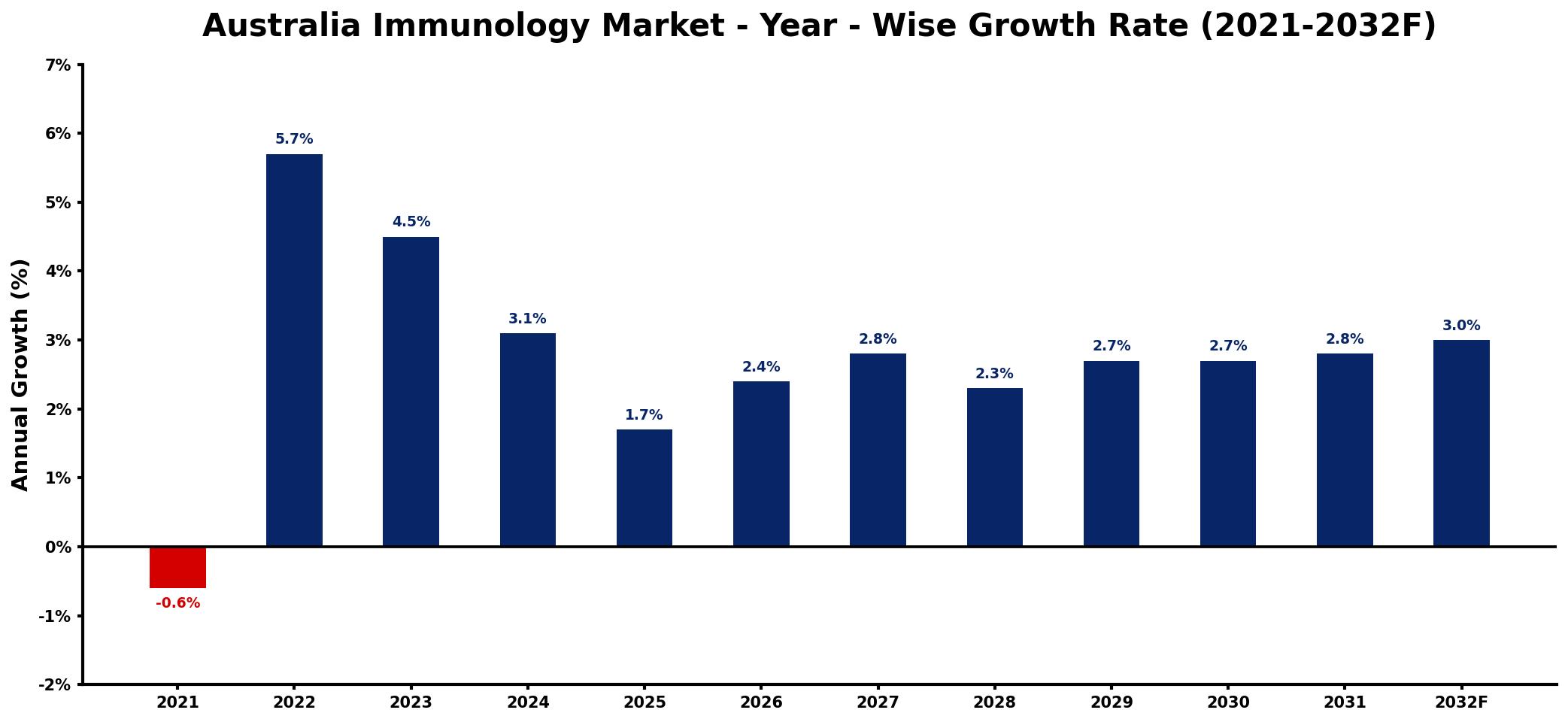
The table below presents the year‑wise growth rates along with the key drivers influencing the market
| Year | Growth Rate | Major Drivers |
| 2021 | -0.6% | decrease in funding for research |
| 2022 | 5.7% | increase in healthcare investments |
| 2023 | 4.5% | rising patient population demands |
| 2024 | 3.1% | expansion of clinical trials network |
| 2025 | 1.7% | growth in biotechnology innovations |
| 2026 | 2.4% | increased collaboration among stakeholders |
| 2027 | 2.8% | development of novel therapies |
| 2028 | 2.3% | enhanced regulatory approvals process |
| 2029 | 2.7% | growing awareness of treatments |
| 2030 | 2.7% | increased domestic production output |
| 2031 | 2.8% | increased focus on personalized medicine |
| 2032 | 3.0% | growing integration of technology |
Note: Market size estimations and growth projections presented in this report are based on 6Wresearch's proprietary forecasting methodology, utilizing the latest available industry data, government publications, and primary research inputs.
Australia Immunology Market Synopsis
In Australia, the demand for immunology products is rapidly evolving, particularly as the aging population increasingly experiences immune-related disorders. Additionally, the healthcare system is adapting to accommodate more personalized treatment approaches, which is essential for addressing diverse patient needs.
Simultaneously, advancements in immunotherapy, particularly in targeting chronic conditions such as rheumatoid arthritis and multiple sclerosis, are reshaping treatment paradigms. This evolving focus on efficacy and safety ensures that the market remains dynamic, offering innovative solutions for patients and healthcare providers alike.
Australia Immunology Market Key Takeaways
- Increasing prevalence of autoimmune diseases significantly drives market demand.
- Technological advancements are enhancing the landscape of immunotherapy and diagnostics.
- Growing aging population contributes to the rising incidence of immune-related disorders.
- Personalized medicine is reshaping treatment approaches, improving patient outcomes.
- Collaboration among stakeholders fosters innovation within the sector.
Evaluation of Restraints in Australia Immunology Market
Despite the optimistic outlook, the Australia Immunology Market faces several restraints. One of the primary challenges is the inherent complexity of the human immune system, which complicates the development of universally effective therapies. Additionally, the variability of immune responses among individuals necessitates a deep understanding of immunological mechanisms. These factors require substantial investments in research and development, posing barriers to swift market entry for new products and therapies.
Australia Immunology Market Trends
Key trends shaping the Australia Immunology Market include a growing emphasis on precision medicine, enabling tailored treatments that align with individual patient profiles. Furthermore, there is increasing interest in combination therapies that leverage the synergies of different immunological approaches. As public awareness of autoimmune diseases continues to rise, so does the demand for effective and efficient diagnostic tests, which are becoming crucial in early detection and management strategies.
Australia Immunology Market Opportunities
The Australia Immunology Market presents genuine growth opportunities, particularly in the realm of research and development for novel immunotherapies. With ongoing advancements in biotechnology, there is significant potential for breakthroughs that could address unmet medical needs. Additionally, the expansion of telehealth services is facilitating greater patient access to specialists and emerging treatments, further amplifying market potential.
Government Initiatives in the Australia Immunology Market
Government initiatives play a pivotal role in shaping the immunology landscape in Australia. Policies aimed at increasing funding for both basic and clinical research are crucial to advancing therapeutic development. Regulatory oversight ensures that pharmaceuticals and biologics meet safety and efficacy standards, while public health programs focused on disease prevention and control contribute to a holistic approach in managing immunological disorders.
Future Insights of the Australia Immunology Market
Looking ahead to 2026-2032, the Australia Immunology Market is poised for growth driven by technological innovations and increasing patient-centric healthcare models. The expansion of research initiatives and collaborations among governmental, academic, and industry players will likely lead to the introduction of groundbreaking therapies. As the healthcare landscape continues to evolve, so too will the strategies to effectively manage autoimmune and infectious diseases, reinforcing the market's vital role in enhancing patient care.
Australia Immunology Market Latest Developments (2025 - 2026)
Recent industry developments highlight a trend towards collaborative research efforts among Australian universities and biotech firms, aiming to accelerate the discovery of innovative immunotherapies. Additionally, there has been a notable increase in clinical trials focusing on personalized medicine approaches, reflecting a commitment to addressing individual patient needs more effectively. This direction indicates a positive shift towards addressing the growing demand for advanced treatment options.
Australia Immunology Market - Key Attractiveness of the Report
- 10 Years of Market Numbers
- Historical Data Starting from 2022 to 2025
- Base Year: 2025
- Forecast Data until 2032
- Key Performance Indicators Impacting the Market
- Major Upcoming Developments and Projects
Key Highlights of the Report:
- Australia Immunology Market Outlook
- Market Size of Australia Immunology Market, 2025
- Forecast of Australia Immunology Market, 2032
- Historical Data and Forecast of Australia Immunology Revenues & Volume for the Period 2022-2032F
- Australia Immunology Market Trend Evolution
- Australia Immunology Market Drivers and Challenges
- Australia Immunology Price Trends
- Australia Immunology Porter's Five Forces
- Australia Immunology Industry Life Cycle
- Historical Data and Forecast of Australia Immunology Market Revenues & Volume By Drug Class for the Period 2022-2032F
- Historical Data and Forecast of Australia Immunology Market Revenues & Volume By Monoclonal Antibody (mAb) for the Period 2022-2032F
- Historical Data and Forecast of Australia Immunology Market Revenues & Volume By Fusion Proteins for the Period 2022-2032F
- Historical Data and Forecast of Australia Immunology Market Revenues & Volume By Immunosuppressants for the Period 2022-2032F
- Historical Data and Forecast of Australia Immunology Market Revenues & Volume By Polyclonal Antibody (pAb) for the Period 2022-2032F
- Historical Data and Forecast of Australia Immunology Market Revenues & Volume By Others for the Period 2022-2032F
- Historical Data and Forecast of Australia Immunology Market Revenues & Volume By Disease Indication for the Period 2022-2032F
- Historical Data and Forecast of Australia Immunology Market Revenues & Volume By Rheumatoid Arthritis for the Period 2022-2032F
- Historical Data and Forecast of Australia Immunology Market Revenues & Volume By Psoriatic Arthritis for the Period 2022-2032F
- Historical Data and Forecast of Australia Immunology Market Revenues & Volume By Plaque Psoriasis for the Period 2022-2032F
- Historical Data and Forecast of Australia Immunology Market Revenues & Volume By Ankylosing Spondylitis for the Period 2022-2032F
- Historical Data and Forecast of Australia Immunology Market Revenues & Volume By Inflammatory Bowel Disease for the Period 2022-2032F
- Historical Data and Forecast of Australia Immunology Market Revenues & Volume By Prophylaxis of Organ Rejection for the Period 2022-2032F
- Historical Data and Forecast of Australia Immunology Market Revenues & Volume By Others for the Period 2022-2032F
- Historical Data and Forecast of Australia Immunology Market Revenues & Volume By Distribution Channel for the Period 2022-2032F
- Historical Data and Forecast of Australia Immunology Market Revenues & Volume By Hospital Pharmacies for the Period 2022-2032F
- Historical Data and Forecast of Australia Immunology Market Revenues & Volume By Retail Pharmacies for the Period 2022-2032F
- Historical Data and Forecast of Australia Immunology Market Revenues & Volume By Online Pharmacies for the Period 2022-2032F
- Australia Immunology Import Export Trade Statistics
- Market Opportunity Assessment By Drug Class
- Market Opportunity Assessment By Disease Indication
- Market Opportunity Assessment By Distribution Channel
- Australia Immunology Top Companies Market Share
- Australia Immunology Competitive Benchmarking By Technical and Operational Parameters
- Australia Immunology Company Profiles
- Australia Immunology Key Strategic Recommendations






































