Australia Industrial Fasteners Market Size Growth Rate
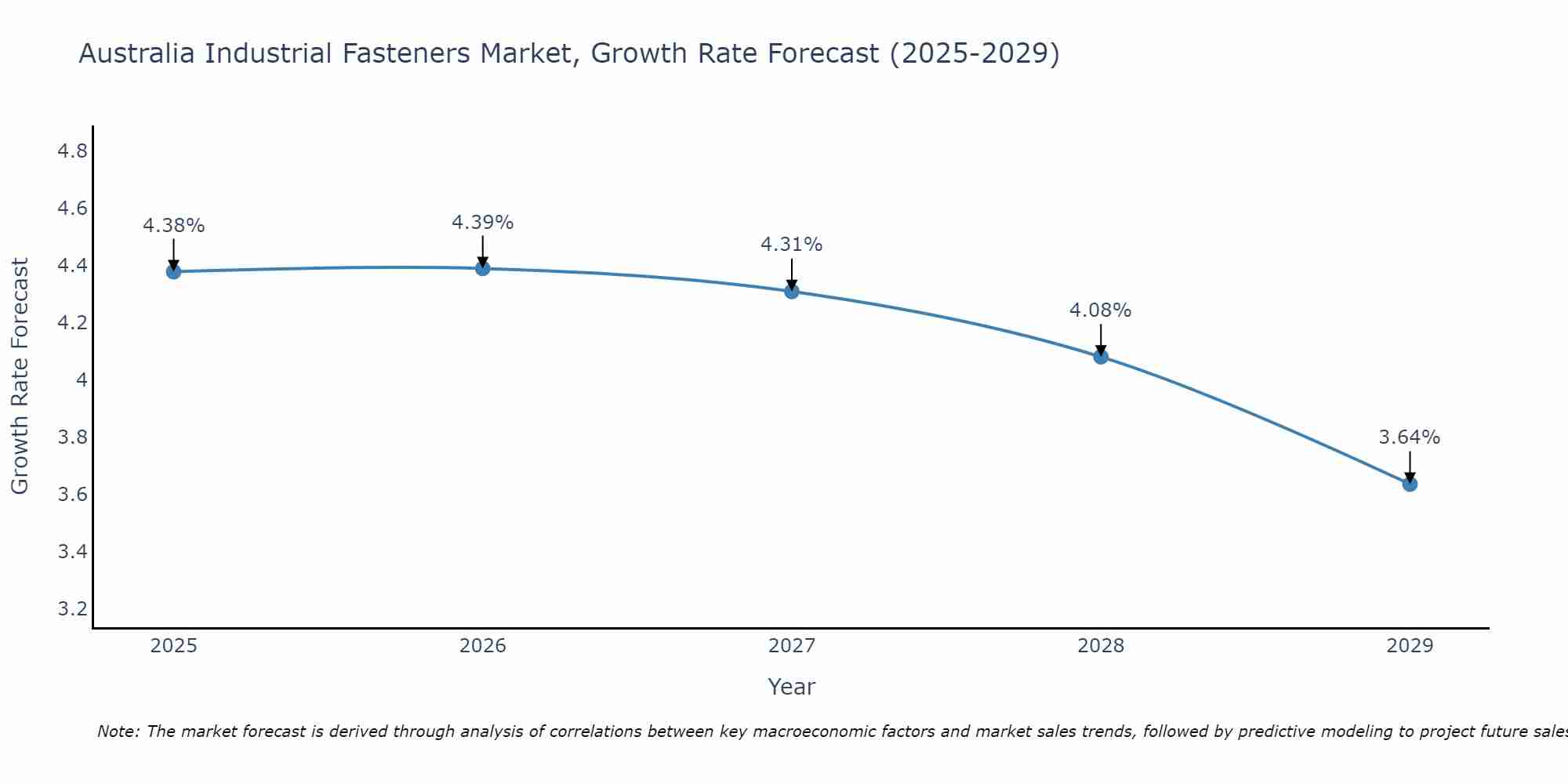
The Australia Industrial Fasteners Market is projected to witness mixed growth rate patterns during 2025 to 2029. Starting at 4.38% in 2025, the market peaks at 4.39% in 2026, and settles at 3.64% by 2029.
Australia Industrial Fasteners Market Overview
The industrial fasteners market in Australia is experiencing steady growth, driven by the demand for fastening solutions in construction, manufacturing, automotive, and aerospace industries. Industrial fasteners, including screws, bolts, nuts, and rivets, are essential for joining and securing components, structures, and machinery in various applications. With the increasing focus on quality, reliability, and performance, there is a rising adoption of high-strength and corrosion-resistant fasteners made from materials such as stainless steel, titanium, and alloy steel. Key players in the market are offering a wide range of industrial fastener products, including standard and customized designs, to meet the diverse fastening requirements of industrial customers in Australia.
Drivers of the market
The Australia Industrial Fasteners market is driven by the demand for mechanical joining solutions in manufacturing, construction, and automotive sectors. With the need for secure and reliable connections, there is a rising requirement for industrial fasteners that offer high strength, corrosion resistance, and ease of installation. Moreover, the expansion of infrastructure projects and the development of lightweight materials further accelerate market growth, driving the adoption of industrial fastener products.
Challenges of the market
Challenges in the industrial fasteners market include optimizing fastener design for strength, corrosion resistance, and ease of installation. Developing fasteners that can withstand harsh operating conditions, reduce assembly time, and meet industry standards and specifications remains a technical challenge for fastener manufacturers.
Government Policy of the market
In the manufacturing and construction sectors, government policies may aim to ensure product quality, safety, and industry competitiveness in regulating the industrial fasteners market. Measures may include standards development for fastener specifications, regulations ensuring compliance with building codes and safety standards, and incentives for adoption of high-performance fastening technologies. Additionally, support for skills training and workforce development in fastener manufacturing could enhance competitiveness and growth in the industrial fasteners industry.
Key Highlights of the Report:
- Australia Industrial Fasteners Market Outlook
- Market Size of Australia Industrial Fasteners Market, 2024
- Forecast of Australia Industrial Fasteners Market, 2031
- Historical Data and Forecast of Australia Industrial Fasteners Revenues & Volume for the Period 2018 - 2031
- Australia Industrial Fasteners Market Trend Evolution
- Australia Industrial Fasteners Market Drivers and Challenges
- Australia Industrial Fasteners Price Trends
- Australia Industrial Fasteners Porter's Five Forces
- Australia Industrial Fasteners Industry Life Cycle
- Historical Data and Forecast of Australia Industrial Fasteners Market Revenues & Volume By Raw Material for the Period 2018 - 2031
- Historical Data and Forecast of Australia Industrial Fasteners Market Revenues & Volume By Plastic for the Period 2018 - 2031
- Historical Data and Forecast of Australia Industrial Fasteners Market Revenues & Volume By Metal for the Period 2018 - 2031
- Historical Data and Forecast of Australia Industrial Fasteners Market Revenues & Volume By Product for the Period 2018 - 2031
- Historical Data and Forecast of Australia Industrial Fasteners Market Revenues & Volume By Externally Threaded for the Period 2018 - 2031
- Historical Data and Forecast of Australia Industrial Fasteners Market Revenues & Volume By Internally Threaded for the Period 2018 - 2031
- Historical Data and Forecast of Australia Industrial Fasteners Market Revenues & Volume By Non-threaded for the Period 2018 - 2031
- Historical Data and Forecast of Australia Industrial Fasteners Market Revenues & Volume By Aerospace Grade for the Period 2018 - 2031
- Historical Data and Forecast of Australia Industrial Fasteners Market Revenues & Volume By Application for the Period 2018 - 2031
- Historical Data and Forecast of Australia Industrial Fasteners Market Revenues & Volume By Automotive for the Period 2018 - 2031
- Historical Data and Forecast of Australia Industrial Fasteners Market Revenues & Volume By Aerospace for the Period 2018 - 2031
- Historical Data and Forecast of Australia Industrial Fasteners Market Revenues & Volume By Building & Construction for the Period 2018 - 2031
- Historical Data and Forecast of Australia Industrial Fasteners Market Revenues & Volume By Industrial Machinery for the Period 2018 - 2031
- Historical Data and Forecast of Australia Industrial Fasteners Market Revenues & Volume By Lawn and Garden for the Period 2018 - 2031
- Historical Data and Forecast of Australia Industrial Fasteners Market Revenues & Volume By Plumbing Products for the Period 2018 - 2031
- Historical Data and Forecast of Australia Industrial Fasteners Market Revenues & Volume By Others for the Period 2018 - 2031
- Australia Industrial Fasteners Import Export Trade Statistics
- Market Opportunity Assessment By Raw Material
- Market Opportunity Assessment By Product
- Market Opportunity Assessment By Application
- Australia Industrial Fasteners Top Companies Market Share
- Australia Industrial Fasteners Competitive Benchmarking By Technical and Operational Parameters
- Australia Industrial Fasteners Company Profiles
- Australia Industrial Fasteners Key Strategic Recommendations






































