Australia Insurance Telematics Market Size & Growth Rate (2026-2032)
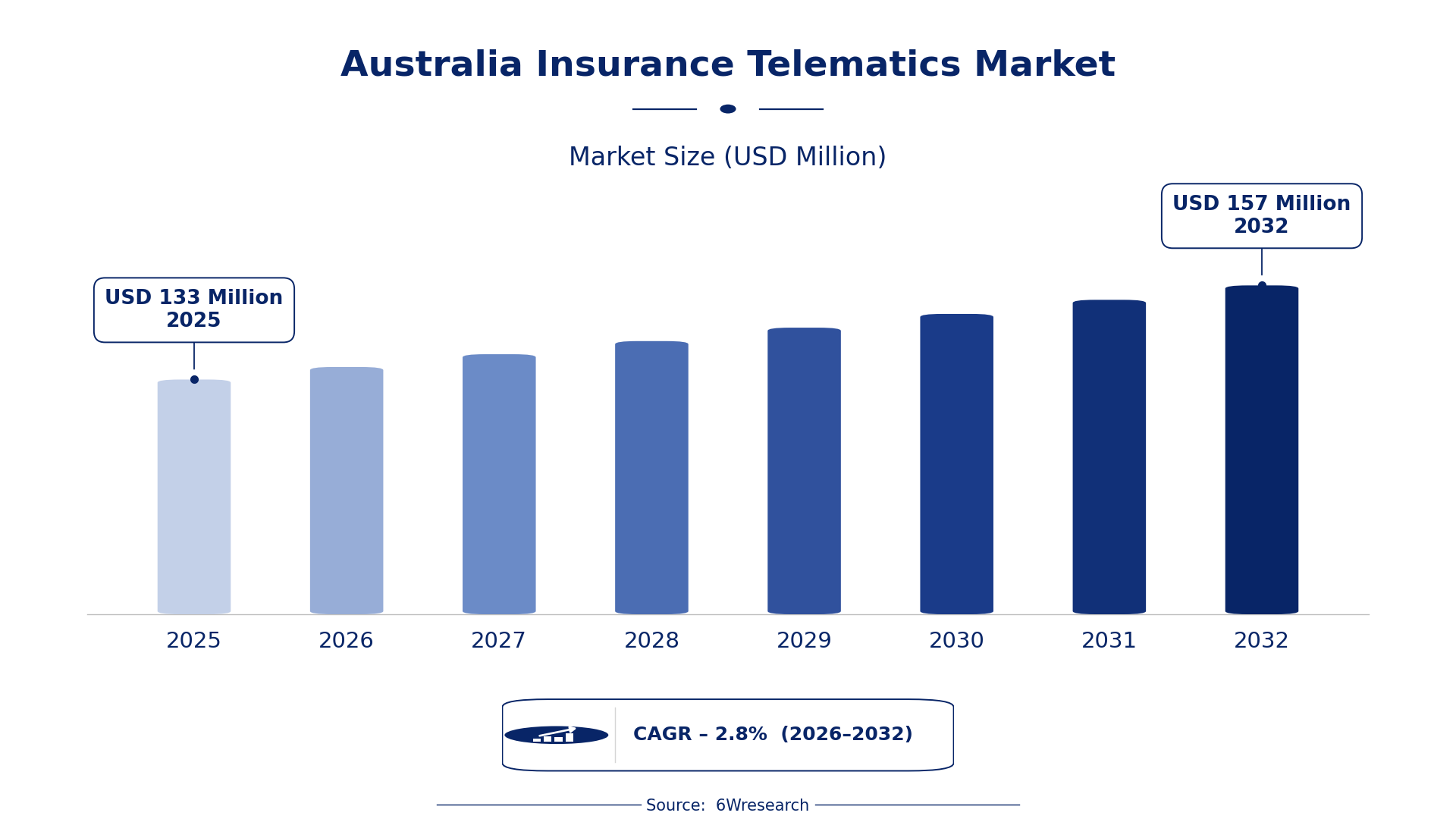
The Australia Insurance Telematics Market was estimated at USD 133 Million in 2025 and is projected to reach USD 157 Million by 2032, growing at a CAGR of 2.8% from 2026 to 2032.
Australia Insurance Telematics Market Synopsis
The Australia Insurance Telematics Market is on a pronounced upward trajectory as insurers increasingly adopt technology-driven solutions. This shift is primarily fueled by the growing demand for usage-based insurance (UBI) and pay-as-you-drive (PAYD) policies, which are reshaping how premiums are calculated and driving customer engagement.
Connected vehicle technologies are at the forefront of this transformation, providing insurers with detailed insights into driving behavior. This data not only helps in assessing risks more accurately but also incentivizes safer driving habits among policyholders, ultimately reducing costs.
Australia Insurance Telematics Market Year-wise Growth Rate and Key Drivers
This graph illustrates the annual growth rates of the Australia Insurance Telematics Market from 2021 to 2032, highlighting a steady upward trajectory and projected expansion over the forecast period.
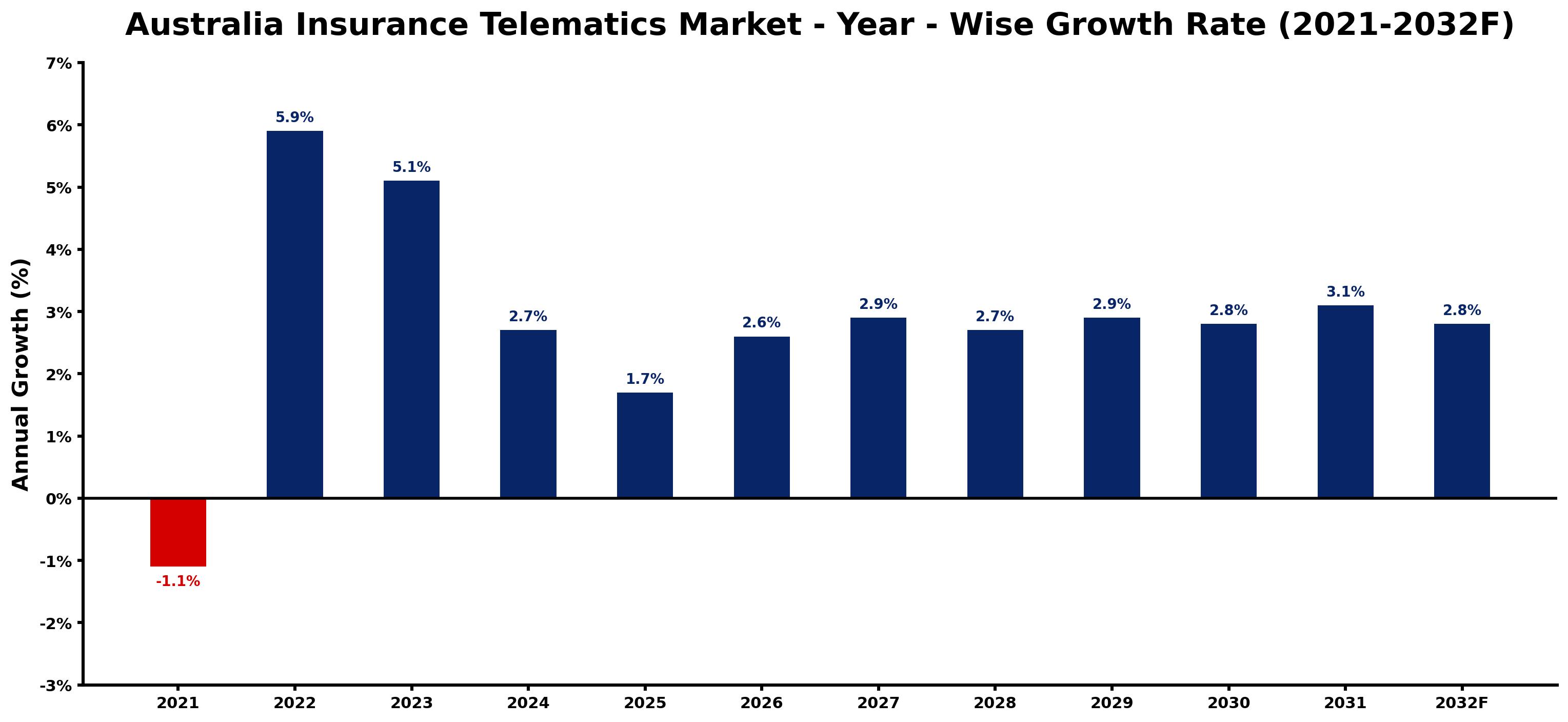
The table below presents the year‑wise growth rates along with the key drivers influencing the market
| Year | Growth Rate | Major Drivers |
| 2021 | -1.1% | Australia's mandatory telematics regulations poorly enforced by APRA. |
| 2022 | 5.9% | Increased consumer demand for personalized insurance premiums |
| 2023 | 5.1% | Government incentives for safer driving technology adoption |
| 2024 | 2.7% | Growth in smartphone penetration enhancing telematics tracking |
| 2025 | 1.7% | Rising interest in usage-based insurance models |
| 2026 | 2.6% | Enhanced focus on driving behavior analytics by insurers |
| 2027 | 2.9% | Development of new telematics partnerships among auto manufacturers |
| 2028 | 2.7% | Policy reforms encouraging technology integration in insurance |
| 2029 | 2.9% | Emergence of data privacy regulations shaping telematics usage |
| 2030 | 2.8% | Increased awareness of risk reduction through telematics |
| 2031 | 3.1% | Adoption of IoT devices improving insurance data accuracy |
| 2032 | 2.8% | Strategic collaborations between insurers and tech firms |
Note: Market size estimations and growth projections presented in this report are based on 6Wresearch's proprietary forecasting methodology, utilizing the latest available industry data, government publications, and primary research inputs.
Australia Insurance Telematics Market Key Takeaways
Below are some of the specific key takeaways from the market, including:
- The market is driven by the demand for personalized insurance premiums based on actual driving behavior.
- Connected car technologies and IoT ecosystems are key factors propelling market growth.
- Data privacy and regulatory compliance present ongoing challenges for insurers.
- Government policies are increasingly focused on consumer protection and promoting telematics adoption.
- Emerging trends include advancements in telematics devices and platforms enhancing customer engagement.
Evaluation of Restraints in Australia Insurance Telematics Market
Despite its promising growth, the Australia Insurance Telematics Market faces several restraints that could hinder its expansion. Data privacy concerns are paramount, as consumers often hesitate to share their driving data due to fears of misuse. This apprehension can slow down the adoption of telematics solutions. Additionally, compliance with stringent regulations surrounding data usage is essential, requiring insurers to invest in systems that ensure ethical data handling. Balancing innovation with consumer trust remains a critical challenge in this evolving sector.
Australia Insurance Telematics Market Trends
Current trends in the Australia Insurance Telematics Market highlight a shift towards advanced data analytics and artificial intelligence. Insurers are leveraging these technologies to enhance risk assessment models and refine pricing strategies. on top of that, integration with mobile applications is becoming common, allowing drivers to monitor their behaviors and receive real-time feedback. The focus on sustainability is also evident, as eco-driving initiatives gain traction, encouraging consumers to adopt safer and more fuel-efficient driving habits.
Australia Insurance Telematics Market Opportunities
The potential for growth in the Australia Insurance Telematics Market is substantial. Opportunities lie in developing innovative telematics solutions that cater to the unique needs of various customer segments. Insurers can explore partnerships with technology firms to enhance data collection and analysis capabilities. Additionally, the increasing prevalence of electric vehicles presents an untapped market, as tailored insurance products can be created to align with the driving patterns of EV users. This convergence of telematics and evolving automotive technology paves the way for significant investment and development.
Government Initiatives in the Australia Insurance Telematics Market
The Australian government is actively shaping the insurance telematics market through targeted policies that emphasize consumer privacy and data security. With a growing focus on innovation, government initiatives aim to facilitate the adoption of telematics technologies, ensuring they align with ethical guidelines while promoting safer driving practices.
- A recently completed initiative aimed at enhancing data protection regulations to safeguard consumer information in telematics applications.
- A current program that promotes partnerships between insurers and tech startups to innovate telematics solutions for personalized insurance offerings.
- Upcoming regulatory frameworks designed to establish clear guidelines for data ownership and consent in telematics programs.
- A public sector effort to improve infrastructure for connected vehicles, ensuring better data transmission and communication.
- Ongoing research initiatives funded by the government to explore the impacts of telematics on road safety and insurance pricing models.
Future Insights of the Australia Insurance Telematics Market
Looking ahead to 2026-2032, the Australia Insurance Telematics Market is set to evolve significantly. As technology continues to advance, insurers will likely adopt even more sophisticated data analytics tools, further personalizing insurance offerings. Enhanced consumer awareness and acceptance of telematics will drive greater adoption rates, supported by government backing for safe driving initiatives. This growth phase will also see insurers increasingly integrating telematics with other emerging technologies, such as blockchain, to improve transparency and security in data handling.
Australia Insurance Telematics Market Latest Developments
Recent developments in the Australia Insurance Telematics Market indicate a dynamic shift towards technological integration and innovation. Over the past year, several initiatives have emerged that reflect the growing importance of telematics in the insurance sector.
- A major technology vendor launched a new telematics platform in Q1 2025, designed to enhance customer engagement through real-time driving feedback.
- An ongoing partnership between insurers and automotive manufacturers, initiated in early 2025, aims to integrate telematics devices into new vehicle models.
- A planned upgrade to existing telematics infrastructure is expected to roll out by mid-2026, enhancing data collection capabilities.
- A completed pilot program in late 2024 tested the effectiveness of gamified insurance incentives to encourage safe driving among young drivers.
- A recently announced initiative seeks to develop a national standard for telematics data sharing among insurers to improve pricing accuracy.
Australia Insurance Telematics Market - Key Attractiveness of the Report
- 10 Years of Market Numbers
- Historical Data Starting from 2022 to 2025
- Base Year: 2025
- Forecast Data until 2032
- Key Performance Indicators Impacting the Market
- Major Upcoming Developments and Projects
What are the government’s priorities in the telematics market?
Key Highlights of the Report:
- Australia Insurance Telematics Market Outlook
- Market Size of Australia Insurance Telematics Market, 2025
- Forecast of Australia Insurance Telematics Market, 2032
- Historical Data and Forecast of Australia Insurance Telematics Revenues & Volume for the Period 2022-2032F
- Australia Insurance Telematics Market Trend Evolution
- Australia Insurance Telematics Market Drivers and Challenges
- Australia Insurance Telematics Price Trends
- Australia Insurance Telematics Porter's Five Forces
- Australia Insurance Telematics Industry Life Cycle
- Historical Data and Forecast of Australia Insurance Telematics Market Revenues & Volume By End User for the Period 2022-2032F
- Historical Data and Forecast of Australia Insurance Telematics Market Revenues & Volume By Small for the Period 2022-2032F
- Historical Data and Forecast of Australia Insurance Telematics Market Revenues & Volume By Medium Enterprises for the Period 2022-2032F
- Historical Data and Forecast of Australia Insurance Telematics Market Revenues & Volume By Large Enterprises for the Period 2022-2032F
- Historical Data and Forecast of Australia Insurance Telematics Market Revenues & Volume By Deployment Type for the Period 2022-2032F
- Historical Data and Forecast of Australia Insurance Telematics Market Revenues & Volume By Cloud for the Period 2022-2032F
- Historical Data and Forecast of Australia Insurance Telematics Market Revenues & Volume By On-Premises for the Period 2022-2032F
- Historical Data and Forecast of Australia Insurance Telematics Market Revenues & Volume By Organization Size for the Period 2022-2032F
- Historical Data and Forecast of Australia Insurance Telematics Market Revenues & Volume By Small and Medium Enterprises (SMEs) for the Period 2022-2032F
- Historical Data and Forecast of Australia Insurance Telematics Market Revenues & Volume By Large Enterprises for the Period 2022-2032F
- Australia Insurance Telematics Import Export Trade Statistics
- Market Opportunity Assessment By End User
- Market Opportunity Assessment By Deployment Type
- Market Opportunity Assessment By Organization Size
- Australia Insurance Telematics Top Companies Market Share
- Australia Insurance Telematics Competitive Benchmarking By Technical and Operational Parameters
- Australia Insurance Telematics Company Profiles
- Australia Insurance Telematics Key Strategic Recommendations






































