Australia Intercoms Systems And Equipment Market Size, Share & Growth Rate
The Australia Intercoms Systems And Equipment Market was estimated at USD 216 Million in 2025 and is projected to reach USD 252 Million by 2032, growing at a CAGR of 2.2% from 2026 to 2032. This growth trajectory is underpinned by a heightened emphasis on security and operational efficiency across various sectors, including residential and commercial real estate. As advanced communication technologies continue to evolve, they are becoming integral to contemporary building management solutions, further fueling the demand for intercom systems.
Australia Intercoms Systems And Equipment Market Year-wise Growth Rate and Key Drivers
This graph highlights how the Australia Intercoms Systems And Equipment Market has steadily grown over the years, supported by major growth factors.
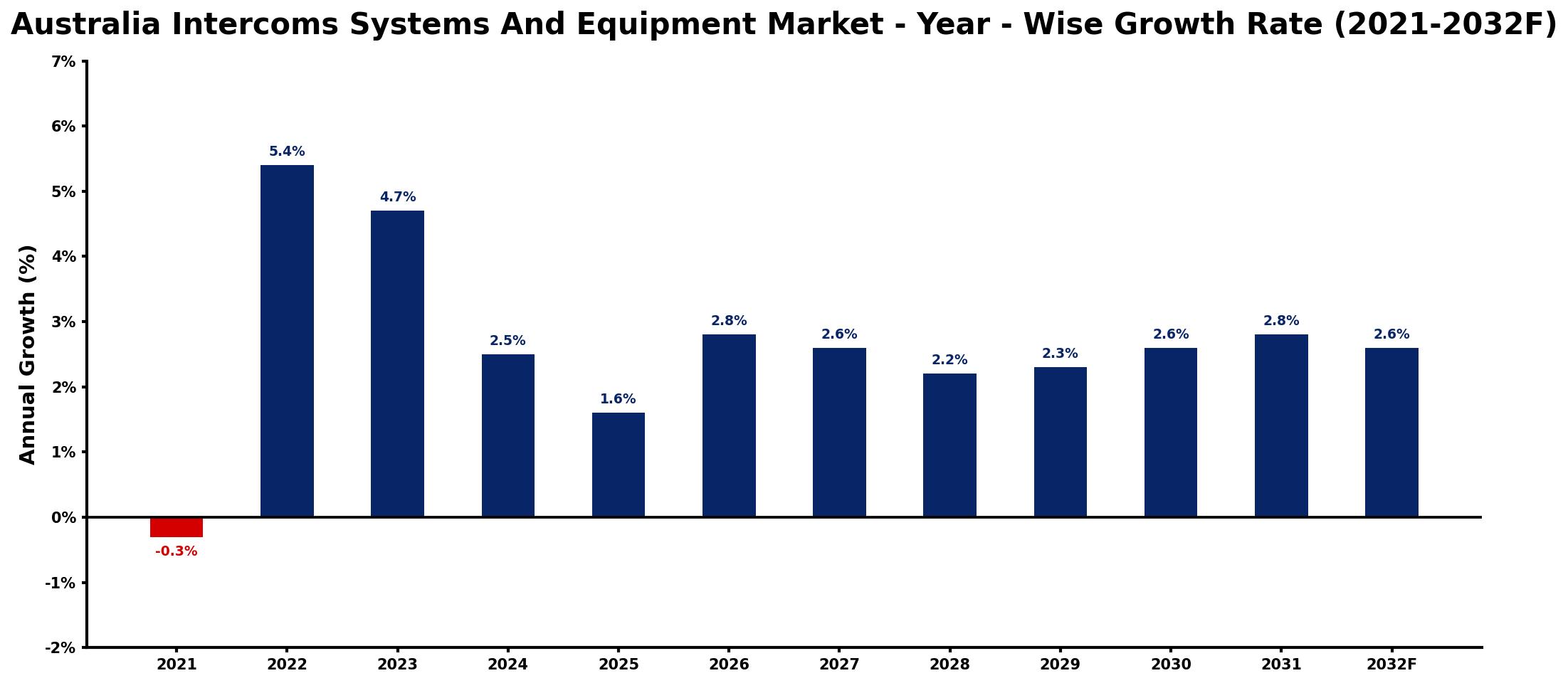
The table below presents the year‑wise growth rates along with the key drivers influencing the market
| Year | Growth Rate | Major Drivers |
| 2021 | -0.3% | decrease in construction projects |
| 2022 | 5.4% | rise in urban development initiatives |
| 2023 | 4.7% | increased demand for smart solutions |
| 2024 | 2.5% | growing focus on safety regulations |
| 2025 | 1.6% | higher investments in infrastructure |
| 2026 | 2.8% | expansion of commercial properties |
| 2027 | 2.6% | increased residential renovation activities |
| 2028 | 2.2% | growing trend of remote communication |
| 2029 | 2.3% | increased integration of IoT technologies |
| 2030 | 2.6% | rising demand for energy efficiency |
| 2031 | 2.8% | enhanced focus on public safety |
| 2032 | 2.6% | growing adoption of automation solutions |
Note: Market size estimations and growth projections presented in this report are based on 6Wresearch's proprietary forecasting methodology, utilizing the latest available industry data, government publications, and primary research inputs.
Australia Intercoms Systems And Equipment Market Synopsis
As Australian buildings increasingly adopt smart technology, the intercom systems market is evolving to meet diverse communication needs. Innovations in audio and video capabilities are not only enhancing convenience but also addressing safety concerns related to access control and visitor management.
The rise in urbanization and the construction of multi-unit dwellings are significant contributors to market growth. Consumers and property developers alike recognize the value of intercom systems in integrating communication with advanced security measures, thus creating a robust environment for growth and investment.
Australia Intercoms Systems And Equipment Market Key Takeaways
- Intercom systems are becoming essential in residential, commercial, and institutional spaces, driven by growing security and communication demands.
- Technological advancements in video surveillance and remote access management are propelling market growth.
- Interoperability among different intercom systems is crucial for enhancing user experience and system efficiency.
- Government initiatives are supporting the adoption of intercom technologies, aiming for improved building safety standards.
- Privacy and compliance with data protection regulations remain pivotal in maintaining consumer trust in intercom solutions.
Evaluation of Restraints in Australia Intercoms Systems And Equipment Market
While the market displays promising growth potential, it faces challenges that inhibit expansion. Achieving seamless interoperability among diverse systems is a notable hurdle, hindering user experience and complicating installations. Moreover, ensuring the reliability of intercoms, particularly in emergencies, raises significant technical concerns for developers and manufacturers. Additionally, stringent privacy regulations and consumer apprehensions regarding data security necessitate careful consideration, complicating product development and market entry strategies.
Australia Intercoms Systems And Equipment Market Trends
The shift towards smart home technologies is influencing intercom system features, with a growing preference for systems integrated into broader home automation frameworks. Touchless access controls are gaining traction, particularly in response to the pandemic, as users prioritize hygiene alongside security. Furthermore, the emergence of cloud-based solutions is transforming intercom systems, enabling remote monitoring and management, thus catering to the evolving demands of modern consumers.
Australia Intercoms Systems And Equipment Market Opportunities
Significant growth opportunities exist in the development of next-generation intercom solutions that prioritize interoperability and enhanced user experience. The demand for smart technologies in residential buildings, particularly in urban centers, presents avenues for innovation. Additionally, investments in retrofitting older systems to align with modern standards are ripe for exploitation, enabling properties to maintain competitive safety and convenience offerings.
Government Initiatives in the Australia Intercoms Systems And Equipment Market
The Australian government actively promotes the deployment of intercom systems through policies aimed at enhancing building safety standards. These initiatives emphasize the importance of interoperability across communication systems, as well as the integration of smart technologies in public and private infrastructure. Public awareness campaigns further support the adoption of intercom solutions, fostering a culture of safety and security in various building types.
Future Insights of the Australia Intercoms Systems And Equipment Market
Looking ahead to 2026-2032, the Australia Intercoms Systems And Equipment Market is poised for steady growth, driven by technological advancements and evolving consumer expectations. As urbanization accelerates, intercom solutions will increasingly serve as essential components of smart living environments. The emphasis on sustainability and energy efficiency will likely influence product design, pushing manufacturers to innovate in line with global environmental standards.
Australia Intercoms Systems And Equipment Market Latest Developments (2025 - 2026)
Recent industry developments indicate a shift towards more integrated intercom systems that combine security with user-friendly features. Companies are increasingly focusing on developing solutions that incorporate artificial intelligence for better visitor management and security alerts. Additionally, partnerships between tech firms and property developers are becoming more common, aiming to create tailored intercom solutions for new residential and commercial projects.
Australia Intercoms Systems And Equipment Market - Key Attractiveness of the Report
- 10 Years of Market Numbers
- Historical Data Starting from 2022 to 2025
- Base Year: 2025
- Forecast Data until 2032
- Key Performance Indicators Impacting the Market
- Major Upcoming Developments and Projects
Key Highlights of the Report:
- Australia Intercoms Systems And Equipment Market Outlook
- Market Size of Australia Intercoms Systems And Equipment Market, 2025
- Forecast of Australia Intercoms Systems And Equipment Market, 2032
- Historical Data and Forecast of Australia Intercoms Systems And Equipment Revenues & Volume for the Period 2022-2032F
- Australia Intercoms Systems And Equipment Market Trend Evolution
- Australia Intercoms Systems And Equipment Market Drivers and Challenges
- Australia Intercoms Systems And Equipment Price Trends
- Australia Intercoms Systems And Equipment Porter's Five Forces
- Australia Intercoms Systems And Equipment Industry Life Cycle
- Historical Data and Forecast of Australia Intercoms Systems And Equipment Market Revenues & Volume By Product Type for the Period 2022-2032F
- Historical Data and Forecast of Australia Intercoms Systems And Equipment Market Revenues & Volume By Audio for the Period 2022-2032F
- Historical Data and Forecast of Australia Intercoms Systems And Equipment Market Revenues & Volume By Video for the Period 2022-2032F
- Historical Data and Forecast of Australia Intercoms Systems And Equipment Market Revenues & Volume By End-User for the Period 2022-2032F
- Historical Data and Forecast of Australia Intercoms Systems And Equipment Market Revenues & Volume By Government for the Period 2022-2032F
- Historical Data and Forecast of Australia Intercoms Systems And Equipment Market Revenues & Volume By Residential for the Period 2022-2032F
- Historical Data and Forecast of Australia Intercoms Systems And Equipment Market Revenues & Volume By Commercial for the Period 2022-2032F
- Historical Data and Forecast of Australia Intercoms Systems And Equipment Market Revenues & Volume By Technology for the Period 2022-2032F
- Historical Data and Forecast of Australia Intercoms Systems And Equipment Market Revenues & Volume By IP Based for the Period 2022-2032F
- Historical Data and Forecast of Australia Intercoms Systems And Equipment Market Revenues & Volume By Analog Based for the Period 2022-2032F
- Australia Intercoms Systems And Equipment Import Export Trade Statistics
- Market Opportunity Assessment By Product Type
- Market Opportunity Assessment By End-User
- Market Opportunity Assessment By Technology
- Australia Intercoms Systems And Equipment Top Companies Market Share
- Australia Intercoms Systems And Equipment Competitive Benchmarking By Technical and Operational Parameters
- Australia Intercoms Systems And Equipment Company Profiles
- Australia Intercoms Systems And Equipment Key Strategic Recommendations






































