Australia Iodine Market: Import Trend Analysis
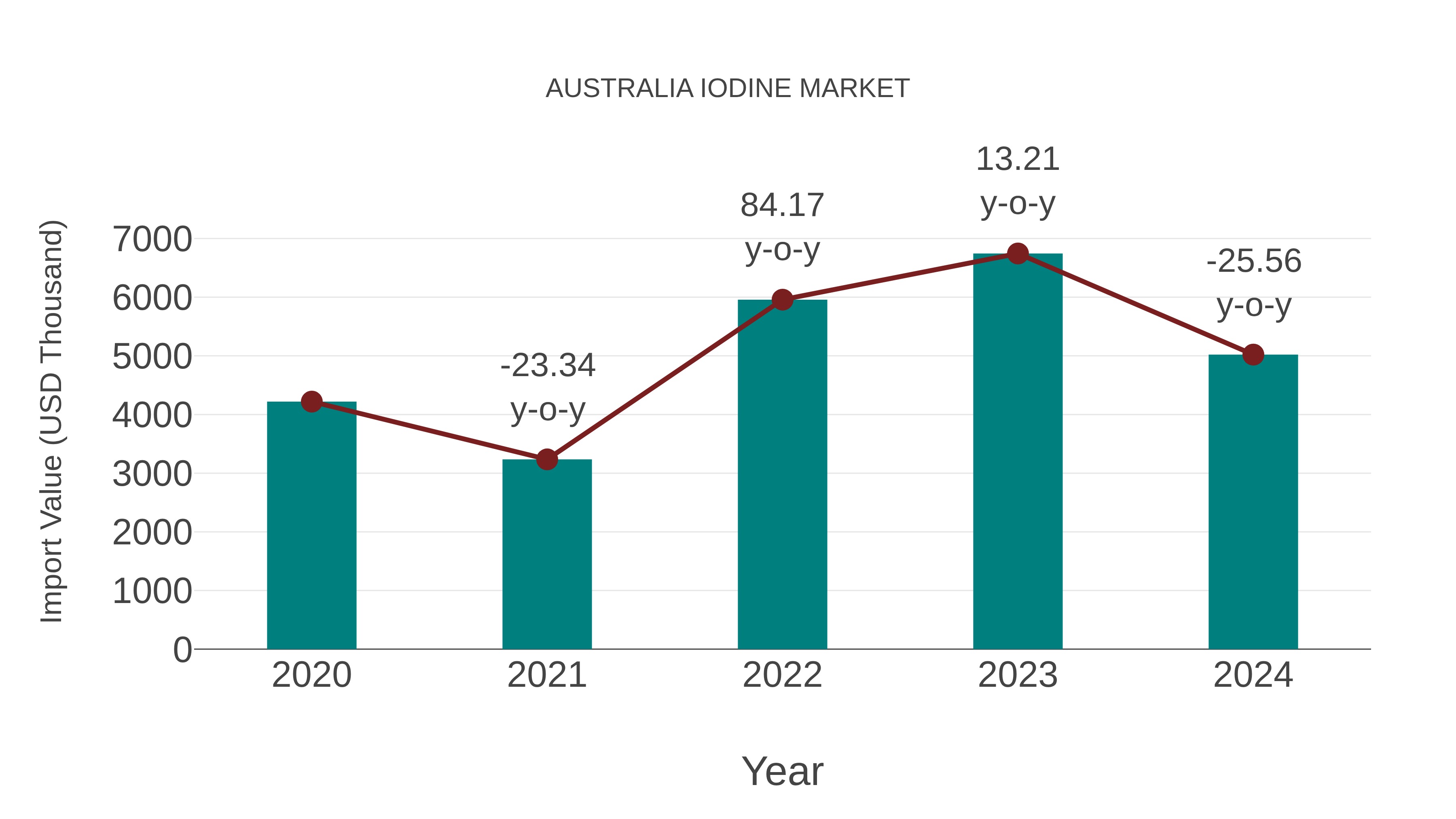
Australia`s iodine market witnessed a notable import trend, with a growth rate of -25.56% from 2023 to 2024. The compound annual growth rate (CAGR) for imports from 2020 to 2024 stood at 4.44%. This decline in import momentum in 2024 could be attributed to shifting demand patterns or changes in global trade dynamics impacting market stability.
Australia Iodine Market Highlights
| Report Name | Australia Iodine Market |
| Forecast period | 2025-2031 |
| CAGR | 5% |
| Growing Sector | Healthcare |
Topics Covered in the Australia Iodine Market Report
Australia Iodine Market report thoroughly covers the market by source, form and application. The market outlook report provides an unbiased and detailed analysis of the ongoing market trends, opportunities/high growth areas, and market drivers which would help the stakeholders to devise and align their market strategies according to the current and future market dynamics.
Australia Iodine Market Synopsis
Australia Iodine Market is a dynamic entity characterized by its innovative extraction techniques and the diverse sources of iodine, notably underground brines. This sector is expected to witness substantial growth driven by advanced technological methodologies that enhance efficiency and sustainability in iodine extraction. The market benefits from the significant role played by leading companies that prioritize environmentally friendly processes. With a keen focus on sustainable practices and the optimization of local resources such as caliche ore and seaweeds, alongside recycling efforts, the industry is set to meet the increasing global demand. The significance of underground brines cannot be understated, as their expansive reserves and cost-efficiency position them as a central pillar for future expansion. The adaptation to stringent environmental regulations and the commitment to innovation underscore the market's potential for continued growth amidst global economic challenges.
According to 6Wresearch, the Australia Iodine Market size is projected to grow at the CAGR of 5% during the forecast period of 2025-2031. The trajectory of the iodine market in Australia is significantly influenced by a myriad of factors that serve as catalysts for growth. One of the primary drivers is the innovative approaches adopted in the extraction of iodine, particularly from underground brines. This method not only ensures a steady supply of iodine but also aligns with the global shift towards sustainability by minimizing environmental impacts. Furthermore, the increasing demand for iodine across various sectors—including healthcare, nutrition, and industrial processes—acts as a substantial growth propellant. In healthcare, iodine's antiseptic properties make it invaluable, while its role in manufacturing processes underscores its industrial importance. Additionally, the evolving regulatory landscape, which promotes environmental sustainability and safety, encourages market players to invest in research and development, fostering further innovation. These combined efforts contribute significantly to the Australia Iodine Market Growth. However, the path to sustained growth is not without its challenges. One of the most pressing concerns is the environmental impact associated with iodine extraction processes, especially from mining activities. Despite advancements in technology, ensuring that these processes are eco-friendly remains a significant challenge, reflecting the broader tension between industrial development and environmental preservation. Regulatory compliance presents another hurdle, as the industry must constantly adapt to changing laws and standards aimed at protecting the environment and ensuring safety in iodine applications. Additionally, the market faces the threat of fluctuating iodine prices, which can impact profitability and investment in research and development. Supply chain disruptions, often exacerbated by global events, further complicate the market’s stability. Navigating these challenges requires ongoing innovation, commitment to sustainability, and flexibility in operations, all of which are essential for the Australia iodine market to thrive in the face of these obstacles.
Government policies and schemes introduced in the Australia Iodine Market
The Australian government has introduced several policies aiming to bolster the iodine market, including stringent regulations for iodine fortification in bread and guidelines to ensure that iodine deficiencies are addressed in the population. These moves, aimed at improving public health, have also created a stable market for iodine producers and suppliers. Additionally, the government has also invested in research and development initiatives to explore new sources of iodine and improve production efficiency. Overall, these policies have contributed to the growth of the Australia iodine market and helped it become one of the leading suppliers of this essential nutrient globally.
Leading players in the Australia Iodine Market
Key players in the Australia iodine Industry include Calix Ltd, which focuses on environmentally sustainable processes, and Iofina plc, which leverages proprietary technology for iodine extraction. These companies, among others, are at the forefront of innovation, driving both market growth and meeting regulatory compliance standards.
Future Insight of the Australia Iodine Market
The future of the Iodine market in Australia appears robust, with projections leaning towards growth driven by increased demand in healthcare applications, dietary supplements, and the pharmaceutical sector. Additionally, technological advancements in extraction and processing are expected to enhance production efficiency, further solidifying Australia's position in the global iodine market. As the population continues to grow and awareness about iodine deficiencies rises, the demand for this essential nutrient is expected to increase, offering promising growth opportunities for players in the Australia iodine market.
Market analysis by source
According to Dhaval, Research Manager, 6Wresearch, the underground brines segment is expected to grow due to the abundance of this source in Australia and its cost-effectiveness compared to other sources. Additionally, technological advancements have made it easier to extract iodine from underground brines, making it a popular choice for market players.
Market analysis by Form
The segment of organic compounds is expected to grow in the Australia iodine market due to increasing demand for natural and organic products in various industries, including food and healthcare. These compounds are derived from natural sources such as seaweeds and have gained popularity due to their eco-friendliness and potential health benefits.
Key attractiveness of the report
- 10 Years Market Numbers.
- Historical Data Starting from 2021 to 2024.
- Base Year: 2024.
- Forecast Data until 2031.
- Key Performance Indicators Impacting the Market.
- Major Upcoming Developments and Projects.
Key Highlights of the Report:
- Australia Iodine Market Outlook
- Market Size of Australia Iodine Market, 2025
- Forecast of Australia Iodine Market, 2032
- Historical Data and Forecast of Australia Iodine Revenues & Volume for the Period 2022-2032F
- Australia Iodine Market Trend Evolution
- Australia Iodine Market Drivers and Challenges
- Australia Iodine Price Trends
- Australia Iodine Porter's Five Forces
- Australia Iodine Industry Life Cycle
- Historical Data and Forecast of Australia Iodine Market Revenues & Volume By Source for the Period 2022-2032F
- Historical Data and Forecast of Australia Iodine Market Revenues & Volume By Caliche Ore for the Period 2022-2032F
- Historical Data and Forecast of Australia Iodine Market Revenues & Volume By Underground Brines for the Period 2022-2032F
- Historical Data and Forecast of Australia Iodine Market Revenues & Volume By Recycling for the Period 2022-2032F
- Historical Data and Forecast of Australia Iodine Market Revenues & Volume By Seaweeds for the Period 2022-2032F
- Historical Data and Forecast of Australia Iodine Market Revenues & Volume By Form for the Period 2022-2032F
- Historical Data and Forecast of Australia Iodine Market Revenues & Volume By Organic Compounds for the Period 2022-2032F
- Historical Data and Forecast of Australia Iodine Market Revenues & Volume By Inorganic Salts & Complexes for the Period 2022-2032F
- Historical Data and Forecast of Australia Iodine Market Revenues & Volume By Elemental & Isotopes for the Period 2022-2032F
- Historical Data and Forecast of Australia Iodine Market Revenues & Volume By Application for the Period 2022-2032F
- Historical Data and Forecast of Australia Iodine Market Revenues & Volume By X-Ray Contrast Media for the Period 2022-2032F
- Historical Data and Forecast of Australia Iodine Market Revenues & Volume By Pharmaceuticals for the Period 2022-2032F
- Historical Data and Forecast of Australia Iodine Market Revenues & Volume By Optical Polarizing Films for the Period 2022-2032F
- Historical Data and Forecast of Australia Iodine Market Revenues & Volume By Catalyst in Polymer Processing for the Period 2022-2032F
- Historical Data and Forecast of Australia Iodine Market Revenues & Volume By Animal Feed for the Period 2022-2032F
- Historical Data and Forecast of Australia Iodine Market Revenues & Volume By Fluorochemicals for the Period 2022-2032F
- Historical Data and Forecast of Australia Iodine Market Revenues & Volume By Human Nutrition for the Period 2022-2032F
- Historical Data and Forecast of Australia Iodine Market Revenues & Volume By Others‚ for the Period 2022-2032F
- Australia Iodine Import Export Trade Statistics
- Market Opportunity Assessment By Source
- Market Opportunity Assessment By Form
- Market Opportunity Assessment By Application
- Australia Iodine Top Companies Market Share
- Australia Iodine Competitive Benchmarking By Technical and Operational Parameters
- Australia Iodine Company Profiles
- Australia Iodine Key Strategic Recommendations
Market Covered
The report offers a comprehensive study of the subsequent market segments:
By Source
- Caliche Ore
- Underground Brines
- Recycling
- Seaweeds
By Form
- Organic Compounds
- Inorganic Salts & Complexes
- Elemental & Isotopes
By Application
- X-Ray Contrast Media
- Pharmaceuticals
- Optical Polarizing Films
- Catalyst In Polymer Processing
- Animal Feed
- Fluorochemicals
- Human Nutrition
- Others






































