Australia Kegs Market: Import Trend Analysis
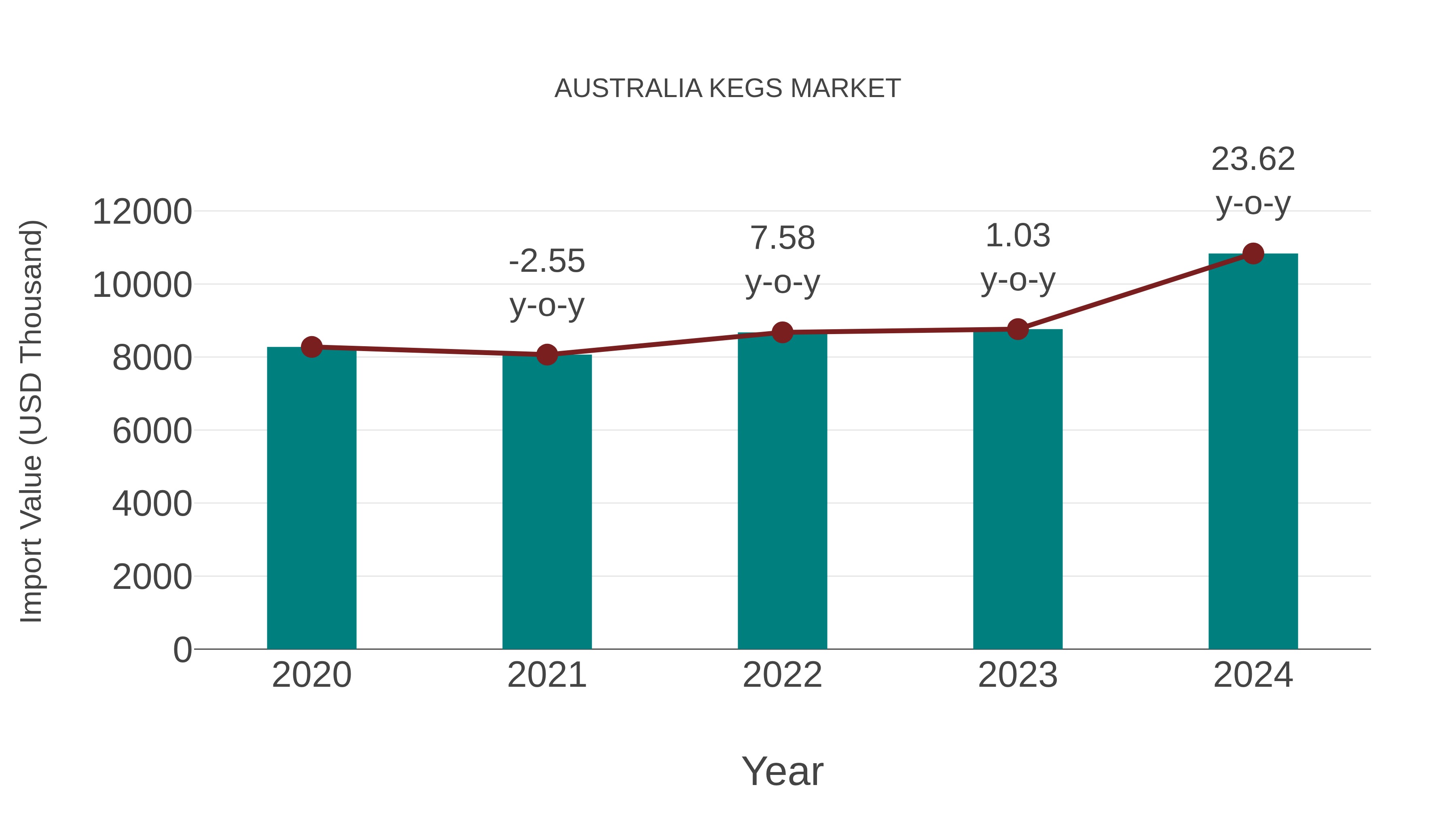
In the Australia kegs market, the import trend showed a significant growth rate of 23.62% from 2023 to 2024, with a compound annual growth rate (CAGR) of 6.97% for the period 2020-2024. This uptrend in imports can be attributed to a notable demand shift towards imported kegs due to evolving consumer preferences and increased market stability.
Australia Kegs Market Overview
Australia kegs market serves the beverage industry by supplying containers for storing and dispensing beer, cider, and other beverages. Kegs offer advantages such as durability, recyclability, and product integrity, making them a preferred choice for breweries, bars, and restaurants seeking efficient and sustainable packaging solutions.
Drivers of the market
The Australia kegs market is primarily driven by factors such as the growth of the beer industry, the increasing popularity of craft breweries and microbreweries, and the demand for eco-friendly packaging solutions. Kegs, commonly used for storing and dispensing beer and other beverages, offer advantages such as freshness, quality preservation, and reduced environmental impact compared to single-use containers. With the rising consumption of craft beer and the expansion of the brewing industry in Australia, there`s a growing demand for kegs among breweries, bars, and restaurants. Additionally, the sustainability initiatives of beverage companies and the preference for reusable packaging further stimulate market growth in Australia.
Challenges of the market
Australia kegs market faces several challenges as breweries, beverage companies, and hospitality establishments seek efficient and sustainable solutions for storing and dispensing draft beverages. One key challenge is managing keg logistics and reverse logistics to ensure timely delivery, maintenance, and return of kegs in the supply chain. Additionally, addressing concerns related to keg hygiene, cleanliness, and quality assurance poses challenges for keg manufacturers and beverage distributors. Moreover, managing market competition and pricing pressures presents commercial challenges for companies operating in the market. Overcoming these challenges demands collaboration between industry stakeholders, logistics providers, and regulatory authorities to develop best practices, enhance traceability systems, and promote sustainability in the kegs market.
Government Policy of the market
The kegs market plays a vital role in the beverage industry, particularly for the distribution of beer and other beverages. The Australia government supports the kegs market through policies aimed at promoting responsible alcohol consumption, ensuring keg safety standards, and facilitating market access for keg manufacturers. Initiatives focus on licensing requirements for keg suppliers, quality control standards for beverage containers, and industry collaboration to address keg recycling and sustainability.
Key Highlights of the Report:
- Australia Kegs Market Outlook
- Market Size of Australia Kegs Market, 2024
- Forecast of Australia Kegs Market, 2031
- Historical Data and Forecast of Australia Kegs Revenues & Volume for the Period 2018 - 2031
- Australia Kegs Market Trend Evolution
- Australia Kegs Market Drivers and Challenges
- Australia Kegs Price Trends
- Australia Kegs Porter's Five Forces
- Australia Kegs Industry Life Cycle
- Historical Data and Forecast of Australia Kegs Market Revenues & Volume By Material for the Period 2018 - 2031
- Historical Data and Forecast of Australia Kegs Market Revenues & Volume By Plastic for the Period 2018 - 2031
- Historical Data and Forecast of Australia Kegs Market Revenues & Volume By Tin for the Period 2018 - 2031
- Historical Data and Forecast of Australia Kegs Market Revenues & Volume By Stainless Steel for the Period 2018 - 2031
- Historical Data and Forecast of Australia Kegs Market Revenues & Volume By Capacity for the Period 2018 - 2031
- Historical Data and Forecast of Australia Kegs Market Revenues & Volume By Up to 20 Liter for the Period 2018 - 2031
- Historical Data and Forecast of Australia Kegs Market Revenues & Volume By 20 Liter to 40 Liter for the Period 2018 - 2031
- Historical Data and Forecast of Australia Kegs Market Revenues & Volume By 40 Liter to 60 Liter for the Period 2018 - 2031
- Historical Data and Forecast of Australia Kegs Market Revenues & Volume By Above 60 Liter for the Period 2018 - 2031
- Historical Data and Forecast of Australia Kegs Market Revenues & Volume By End Use for the Period 2018 - 2031
- Historical Data and Forecast of Australia Kegs Market Revenues & Volume By Alcoholic Beverages for the Period 2018 - 2031
- Historical Data and Forecast of Australia Kegs Market Revenues & Volume By Non-Alcoholic Beverages for the Period 2018 - 2031
- Historical Data and Forecast of Australia Kegs Market Revenues & Volume By Cooking Oil for the Period 2018 - 2031
- Historical Data and Forecast of Australia Kegs Market Revenues & Volume By Chemicals for the Period 2018 - 2031
- Historical Data and Forecast of Australia Kegs Market Revenues & Volume By Others for the Period 2018 - 2031
- Historical Data and Forecast of Australia Kegs Market Revenues & Volume By Distribution Channel for the Period 2018 - 2031
- Historical Data and Forecast of Australia Kegs Market Revenues & Volume By Supermarket/Hypermarket for the Period 2018 - 2031
- Historical Data and Forecast of Australia Kegs Market Revenues & Volume By Commercial Liquor Store for the Period 2018 - 2031
- Historical Data and Forecast of Australia Kegs Market Revenues & Volume By Others for the Period 2018 - 2031
- Australia Kegs Import Export Trade Statistics
- Market Opportunity Assessment By Material
- Market Opportunity Assessment By Capacity
- Market Opportunity Assessment By End Use
- Market Opportunity Assessment By Distribution Channel
- Australia Kegs Top Companies Market Share
- Australia Kegs Competitive Benchmarking By Technical and Operational Parameters
- Australia Kegs Company Profiles
- Australia Kegs Key Strategic Recommendations






































