Australia LED Traffic Signs and Signals Market Size, Share & Growth Rate
The Australia LED Traffic Signs and Signals Market was estimated at USD 151 Million in 2025 and is projected to reach USD 177 Million by 2032, growing at a CAGR of 2.3% from 2026 to 2032. This growth is propelled by a significant emphasis on improving road safety and managing traffic more effectively as urbanization accelerates. Additionally, the widespread adoption of LED technology in traffic systems underpins this trajectory, as municipalities strive for more reliable and efficient traffic management solutions.
Australia LED Traffic Signs and Signals Market Year-wise Growth Rate and Key Drivers
This graph highlights how the Australia LED Traffic Signs and Signals Market has steadily grown over the years, supported by major growth factors.
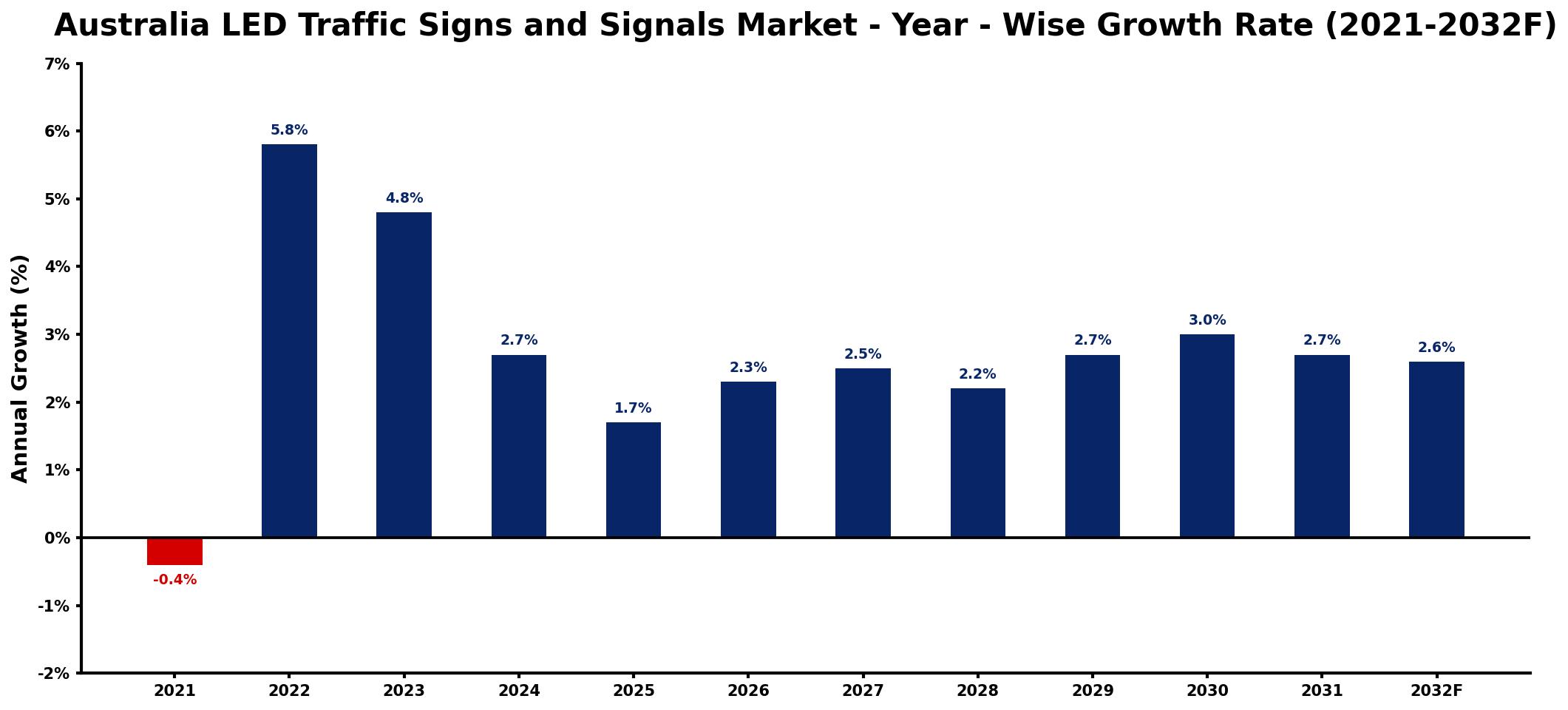
The table below presents the year‑wise growth rates along with the key drivers influencing the market
| Year | Growth Rate | Major Drivers |
| 2021 | -0.4% | decreased public sector investments |
| 2022 | 5.8% | increased urban infrastructure projects |
| 2023 | 4.8% | growing demand for smart cities |
| 2024 | 2.7% | expansion of renewable energy initiatives |
| 2025 | 1.7% | rising focus on road safety |
| 2026 | 2.3% | improved government funding allocations |
| 2027 | 2.5% | surge in eco-friendly technologies |
| 2028 | 2.2% | enhanced public transportation systems |
| 2029 | 2.7% | growing private sector partnerships |
| 2030 | 3.0% | increased adoption of automation |
| 2031 | 2.7% | rising demand from electronics |
| 2032 | 2.6% | growing investment in innovation |
Note: Market size estimations and growth projections presented in this report are based on 6Wresearch's proprietary forecasting methodology, utilizing the latest available industry data, government publications, and primary research inputs.
Australia LED Traffic Signs and Signals Market Synopsis
In recent years, Australia has witnessed a rapid shift towards LED technology for traffic signage and signaling. Municipalities are increasingly recognizing the importance of enhanced visibility, energy efficiency, and longevity that LED solutions offer compared to traditional lighting. This shift is part of broader road safety initiatives aimed at reducing accidents and improving urban infrastructure.
Moreover, government initiatives promoting smart transportation technologies further fuel the adoption of LED traffic signs and signals. As urban areas expand and populations grow, the need for advanced traffic management solutions becomes more pressing, creating a fertile environment for the LED market to thrive.
Australia LED Traffic Signs and Signals Market Key Takeaways
- LED traffic signs are increasingly prioritized for their durability and energy efficiency, aligning with national safety and sustainability goals.
- Government policies are actively promoting the upgrade of transportation infrastructure, creating steady demand for innovative traffic solutions.
- Advancements in LED technology, such as intelligent signaling systems, enhance the functionality of traffic management systems.
- The expansion of urban areas and transportation networks drives the need for reliable and efficient traffic management solutions.
- Compliance with evolving regulatory standards poses both a challenge and an opportunity for continuous innovation in LED traffic signage.
Evaluation of Restraints in Australia LED Traffic Signs and Signals Market
Despite the positive outlook, the Australia LED traffic signs and signals market faces certain restraints that could hinder growth. Regulatory compliance remains a complex landscape, as manufacturers must navigate standards related to visibility, color accuracy, and power consumption. Additionally, the competition from traditional signage and emerging technologies means that companies must continuously innovate to stay relevant. Moreover, varying adoption rates across different regions may also limit overall market expansion, as some areas may be slower to integrate these advanced solutions.
Australia LED Traffic Signs and Signals Market Trends
The market is currently witnessing several trends that shape its future direction. One significant trend is the integration of smart technologies into traffic systems, enabling features like remote monitoring and adaptive signaling. This push for intelligent transportation systems not only enhances traffic flow but also optimizes energy use. Additionally, the growing trend towards sustainable urban development is influencing the choice of materials and technologies used in traffic signage, further boosting the LED market.
Australia LED Traffic Signs and Signals Market Opportunities
A wealth of opportunities lies ahead for stakeholders in the Australia LED traffic signs and signals market. The ongoing urban expansion and infrastructure upgrades present a prime opportunity for investment. Furthermore, as the demand for intelligent transportation solutions escalates, companies offering advanced LED systems are likely to capture significant market share. Public-private partnerships aimed at infrastructure development can also pave the way for new projects, driving further demand for innovative traffic management solutions.
Government Initiatives in the Australia LED Traffic Signs and Signals Market
Australian government policies are increasingly oriented towards enhancing road safety and efficiency through the adoption of LED traffic signs and signals. Regulatory frameworks are being established to standardize sign design, illumination levels, and maintenance protocols, promoting best practices across municipalities. Investment in smart transportation infrastructure is also a key focus, encouraging local authorities to upgrade their systems in alignment with national objectives aimed at improving traffic management and sustainability.
Future Insights of the Australia LED Traffic Signs and Signals Market
Looking ahead to 2026-2032, the Australia LED traffic signs and signals market is poised for continued growth. As urbanization accelerates and populations rise, the need for effective traffic management will become even more crucial. Innovations in LED technology will likely drive enhancements in functionality, responsiveness, and integration with smart city initiatives. The trend towards greener solutions will also encourage broader adoption, ensuring that LED technology remains at the forefront of traffic management in Australia.
Australia LED Traffic Signs and Signals Market Latest Developments (2025 - 2026)
The industry is currently adapting to a wave of innovations focused on increasing the responsiveness and efficiency of traffic management systems. Developments in smart signaling technologies have gained traction, enhancing real-time communication capabilities between vehicles and traffic systems. Moreover, municipalities are actively seeking solutions that comply with evolving regulations while maintaining cost-effectiveness, leading to an influx of innovative designs in the LED traffic signs sector.
Australia LED Traffic Signs and Signals Market - Key Attractiveness of the Report
- 10 Years of Market Numbers
- Historical Data Starting from 2022 to 2025
- Base Year: 2025
- Forecast Data until 2032
- Key Performance Indicators Impacting the Market
- Major Upcoming Developments and Projects
Key Highlights of the Report:
- Australia LED Traffic Signs and Signals Market Outlook
- Market Size of Australia LED Traffic Signs and Signals Market, 2025
- Forecast of Australia LED Traffic Signs and Signals Market, 2032
- Historical Data and Forecast of Australia LED Traffic Signs and Signals Revenues & Volume for the Period 2022-2032F
- Australia LED Traffic Signs and Signals Market Trend Evolution
- Australia LED Traffic Signs and Signals Market Drivers and Challenges
- Australia LED Traffic Signs and Signals Price Trends
- Australia LED Traffic Signs and Signals Porter's Five Forces
- Australia LED Traffic Signs and Signals Industry Life Cycle
- Historical Data and Forecast of Australia LED Traffic Signs and Signals Market Revenues & Volume By Product for the Period 2022-2032F
- Historical Data and Forecast of Australia LED Traffic Signs and Signals Market Revenues & Volume By LED Traffic Signals for the Period 2022-2032F
- Historical Data and Forecast of Australia LED Traffic Signs and Signals Market Revenues & Volume By LED Traffic Signs for the Period 2022-2032F
- Australia LED Traffic Signs and Signals Import Export Trade Statistics
- Market Opportunity Assessment By Product
- Australia LED Traffic Signs and Signals Top Companies Market Share
- Australia LED Traffic Signs and Signals Competitive Benchmarking By Technical and Operational Parameters
- Australia LED Traffic Signs and Signals Company Profiles
- Australia LED Traffic Signs and Signals Key Strategic Recommendations






































