Australia Log Management Market Size & Growth Rate (2026-2032)
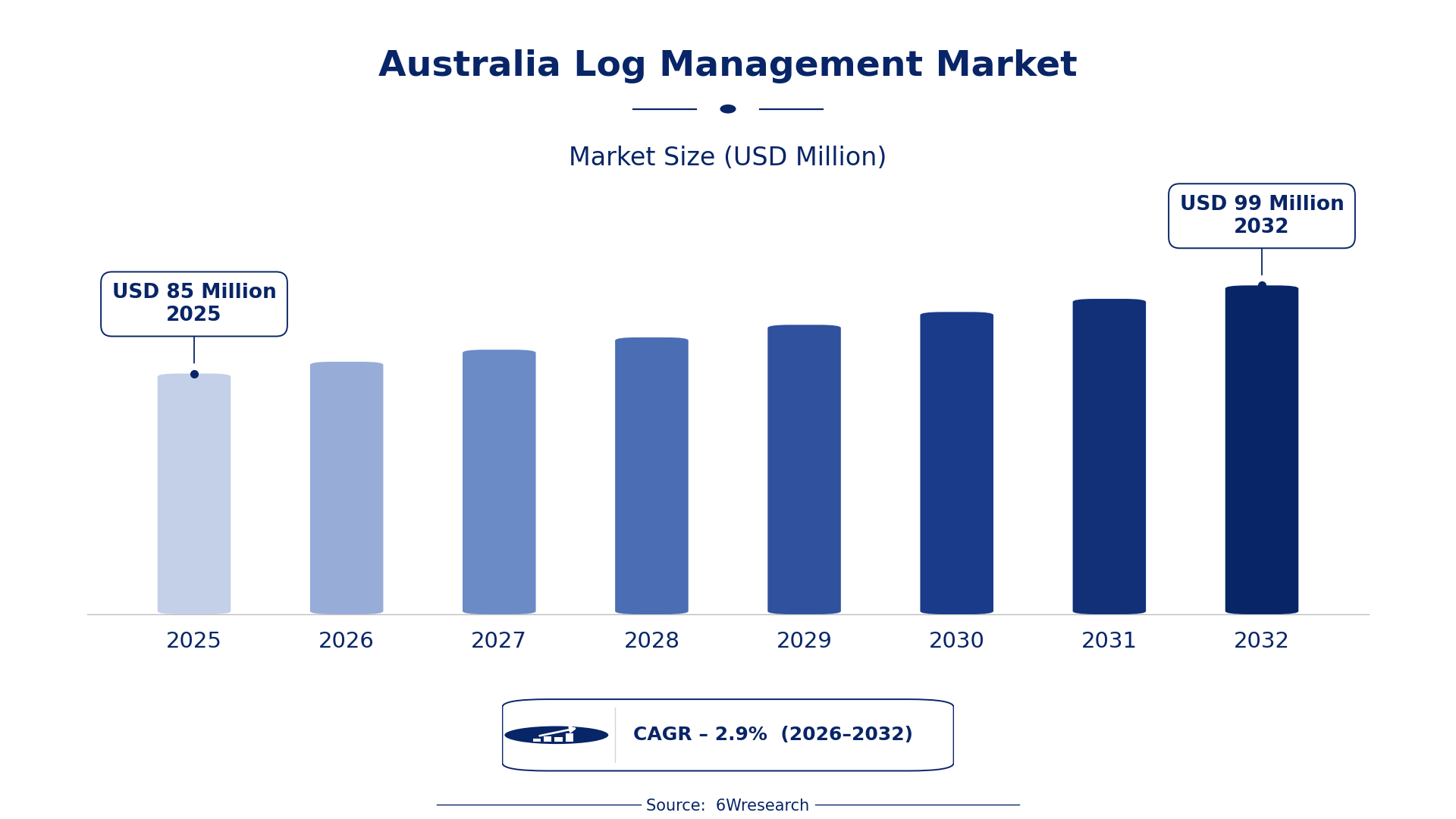
The Australia Log Management Market was estimated at USD 85 Million in 2025 and is projected to reach USD 99 Million by 2032, growing at a CAGR of 2.9% from 2026 to 2032.
Australia Log Management Market Synopsis
In Australia, the increasing volume of digital data generated across sectors has emerged as the strongest force driving the log management market. As organizations evolve, the ability to effectively gather and analyze this data is crucial for maintaining security and operational efficiency.
Heightened concerns around cybersecurity incidents further fuel demand for log management solutions. With regulatory compliance requirements tightening, companies are under pressure to implement robust log management systems that ensure data integrity and facilitate real-time monitoring.
Australia Log Management Market Year-wise Growth Rate and Key Drivers
This graph illustrates the annual growth rates of the Australia Log Management Market from 2021 to 2032, highlighting a steady upward trajectory and projected expansion over the forecast period.
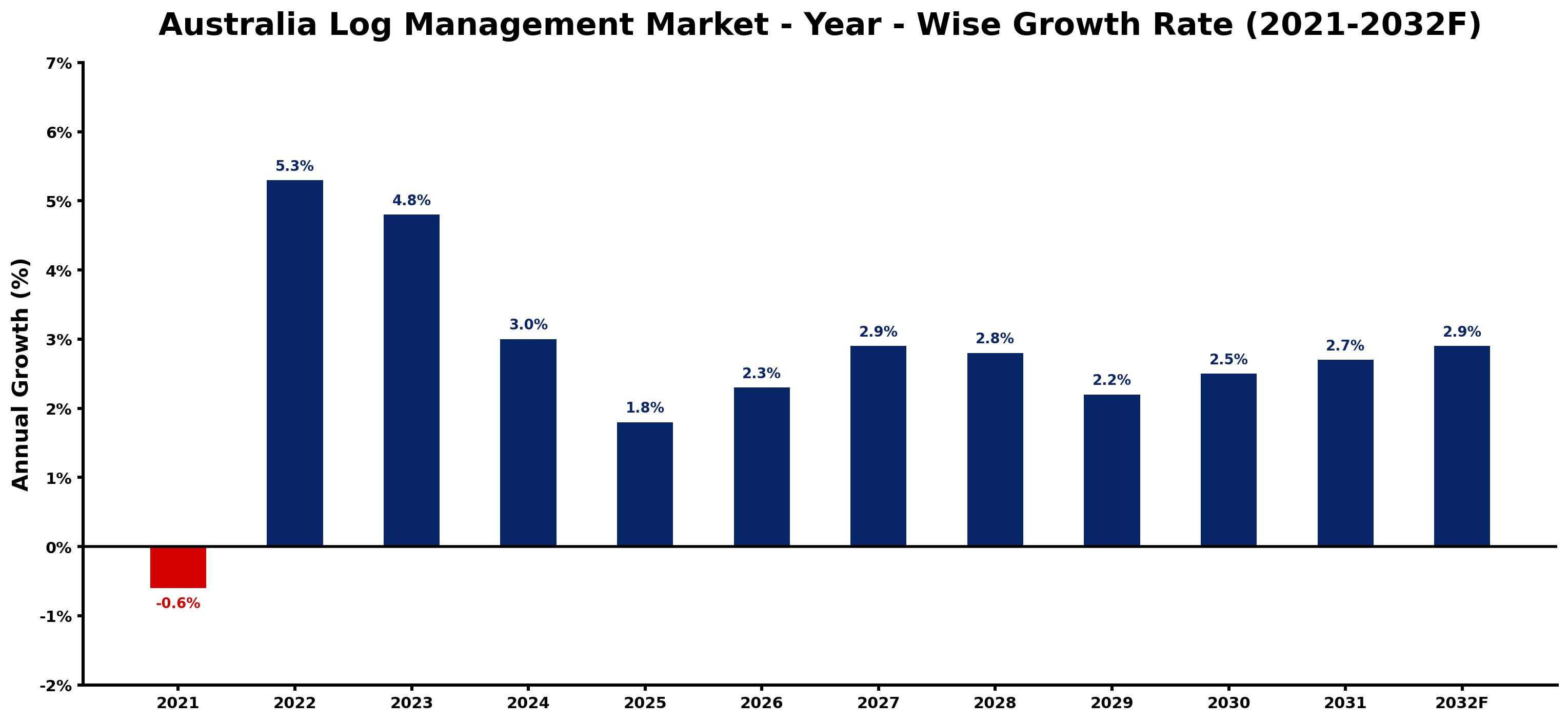
The table below presents the year‑wise growth rates along with the key drivers influencing the market
| Year | Growth Rate | Major Drivers |
| 2021 | -0.6% | Reduced investment in cybersecurity by Australian enterprises. |
| 2022 | 5.3% | Increased cybersecurity threats prompting better log management solutions |
| 2023 | 4.8% | Adoption of Australian Data Strategy promoting data governance |
| 2024 | 3.0% | Local businesses enhancing compliance with ATO reporting requirements |
| 2025 | 1.8% | Government initiatives encouraging digital transformation in enterprises |
| 2026 | 2.3% | Rising awareness of data breach consequences among companies |
| 2027 | 2.9% | Growth of cloud adoption driving log analytics demand |
| 2028 | 2.8% | Emergence of IoT devices creating more log data |
| 2029 | 2.2% | Heightened focus on environmental regulations requiring compliance logs |
| 2030 | 2.5% | Investment in AI to optimize log data processing |
| 2031 | 2.7% | Increasing digital identity initiatives boosting log security needs |
| 2032 | 2.9% | Growing SME sector requiring affordable log management solutions |
Note: Market size estimations and growth projections presented in this report are based on 6Wresearch's proprietary forecasting methodology, utilizing the latest available industry data, government publications, and primary research inputs.
Australia Log Management Market Key Takeaways
Below are some of the specific key takeaways from the market, including:
- The rising sophistication of cyber threats is a primary catalyst for growth in log management solutions.
- Regulatory mandates push organizations to adopt advanced log management practices.
- Cloud-based solutions are gaining traction due to their scalability and flexibility.
- Machine learning and automation are enhancing the efficiency of log analysis.
- Collaborative efforts among tech vendors and regulatory bodies foster innovation in the market.
Evaluation of Restraints in Australia Log Management Market
Despite the optimistic outlook, the Australia log management market faces significant challenges. Data security remains a pressing concern as the volume of log data continues to grow. Companies must invest in sophisticated systems capable of managing this data while ensuring compliance with stringent regulatory frameworks. This necessity places a financial burden on smaller organizations, limiting their ability to adopt comprehensive log management solutions. Additionally, scalability issues arise when trying to integrate log management across various IT environments, leading to potential gaps in security and oversight.
Australia Log Management Market Trends
Several trends are shaping the future of log management in Australia. Notably, the shift towards cloud computing has prompted businesses to seek flexible log management solutions that can scale with their needs. Increased adoption of artificial intelligence and machine learning technologies is driving advancements in predictive analytics, enabling organizations to foresee potential issues before they escalate into significant threats. on top of that, integration with existing cybersecurity tools is becoming standard practice as businesses strive for a more unified approach to data security.
Australia Log Management Market Opportunities
Investment opportunities within the Australia log management market are robust. As organizations look to enhance their security posture, there's significant demand for innovative log management solutions that provide real-time insights. Emerging technologies like AI and automation open avenues for companies to develop advanced log management tools that can not only analyze data but also respond autonomously to threats. Additionally, as small to medium-sized enterprises (SMEs) increasingly recognize the value of log management, there is a ripe market for tailored solutions designed specifically for their unique challenges.
Government Initiatives in the Australia Log Management Market
The Australian government plays an instrumental role in shaping the log management market through various initiatives aimed at bolstering cybersecurity and data protection. Government policies focus on fostering a secure digital environment by setting standards for logging practices and compliance mandates. This emphasis on regulation not only helps mitigate risks associated with cyber threats but also encourages organizations to invest in effective log management strategies.
- A regulatory framework introduced in 2025 mandating enhanced logging practices for critical infrastructure operators.
- An ongoing initiative supporting cybersecurity training and awareness programs across public and private sectors.
- A national digital infrastructure upgrade program now in its rollout phase, focusing on improving data management practices.
- Planned revisions to data retention requirements expected to take effect by 2027, ensuring better protection of log data.
Future Insights of the Australia Log Management Market
Looking ahead to 2026-2032, the Australia log management market is set to grow as businesses increasingly recognize the importance of data security. With regulatory pressures intensifying and cyber threats becoming more sophisticated, organizations will prioritize investments in log management solutions. The integration of advanced technologies, particularly AI and cloud services, will transform log management practices, making them more proactive and efficient. In this evolving landscape, companies that adapt quickly and effectively will find themselves better positioned to safeguard their operations.
Australia Log Management Market Latest Developments
In the past year, the Australia log management market has experienced a flurry of activity as organizations scramble to enhance their cybersecurity measures. Numerous initiatives have emerged that showcase a strong commitment to improving log management practices across various sectors. The trends indicate a shift towards smarter and more integrated log management solutions that cater to the specific needs of Australian businesses.
- A major technology vendor announced a new log management product in early 2025 aimed at streamlining log data analysis for SMEs.
- An initiative that began in mid-2025 focuses on developing a centralized log management platform for government agencies.
- A rollout expected to begin in the second half of 2026 will enhance existing log management solutions with AI-driven predictive analytics.
- Recently, a collaborative partnership was formed between tech firms and educational institutions to promote cybersecurity training tailored to log management practices.
Australia Log Management Market - Key Attractiveness of the Report
- 10 Years of Market Numbers
- Historical Data Starting from 2022 to 2025
- Base Year: 2025
- Forecast Data until 2032
- Key Performance Indicators Impacting the Market
- Major Upcoming Developments and Projects
Key Highlights of the Report:
- Australia Log Management Market Outlook
- Market Size of Australia Log Management Market, 2025
- Forecast of Australia Log Management Market, 2032
- Historical Data and Forecast of Australia Log Management Revenues & Volume for the Period 2022-2032F
- Australia Log Management Market Trend Evolution
- Australia Log Management Market Drivers and Challenges
- Australia Log Management Price Trends
- Australia Log Management Porter's Five Forces
- Australia Log Management Industry Life Cycle
- Historical Data and Forecast of Australia Log Management Market Revenues & Volume By Component for the Period 2022-2032F
- Historical Data and Forecast of Australia Log Management Market Revenues & Volume By Solution for the Period 2022-2032F
- Historical Data and Forecast of Australia Log Management Market Revenues & Volume By Services for the Period 2022-2032F
- Historical Data and Forecast of Australia Log Management Market Revenues & Volume By Organization Size for the Period 2022-2032F
- Historical Data and Forecast of Australia Log Management Market Revenues & Volume By Large Enterprises for the Period 2022-2032F
- Historical Data and Forecast of Australia Log Management Market Revenues & Volume By SMEs for the Period 2022-2032F
- Historical Data and Forecast of Australia Log Management Market Revenues & Volume By Deployment Mode for the Period 2022-2032F
- Historical Data and Forecast of Australia Log Management Market Revenues & Volume By Cloud for the Period 2022-2032F
- Historical Data and Forecast of Australia Log Management Market Revenues & Volume By On-premises for the Period 2022-2032F
- Historical Data and Forecast of Australia Log Management Market Revenues & Volume By Vertical for the Period 2022-2032F
- Historical Data and Forecast of Australia Log Management Market Revenues & Volume By IT and ITeS for the Period 2022-2032F
- Historical Data and Forecast of Australia Log Management Market Revenues & Volume By BFSI for the Period 2022-2032F
- Historical Data and Forecast of Australia Log Management Market Revenues & Volume By Healthcare for the Period 2022-2032F
- Historical Data and Forecast of Australia Log Management Market Revenues & Volume By Telecom, and Education for the Period 2022-2032F
- Australia Log Management Import Export Trade Statistics
- Market Opportunity Assessment By Component
- Market Opportunity Assessment By Organization Size
- Market Opportunity Assessment By Deployment Mode
- Market Opportunity Assessment By Vertical
- Australia Log Management Top Companies Market Share
- Australia Log Management Competitive Benchmarking By Technical and Operational Parameters
- Australia Log Management Company Profiles
- Australia Log Management Key Strategic Recommendations






































