Australia Loudspeakers Market Summary
The australia loudspeakers market was estimated at USD 116 Million in 2025 and is projected to reach USD 136 Million by 2032, growing at a CAGR of 2.5% from 2026 to 2032.
Australia Loudspeakers Market Year-wise Growth Rate and Key Drivers
This graph highlights how the Australia Loudspeakers Market has steadily grown over the past five years, supported by major growth factors.
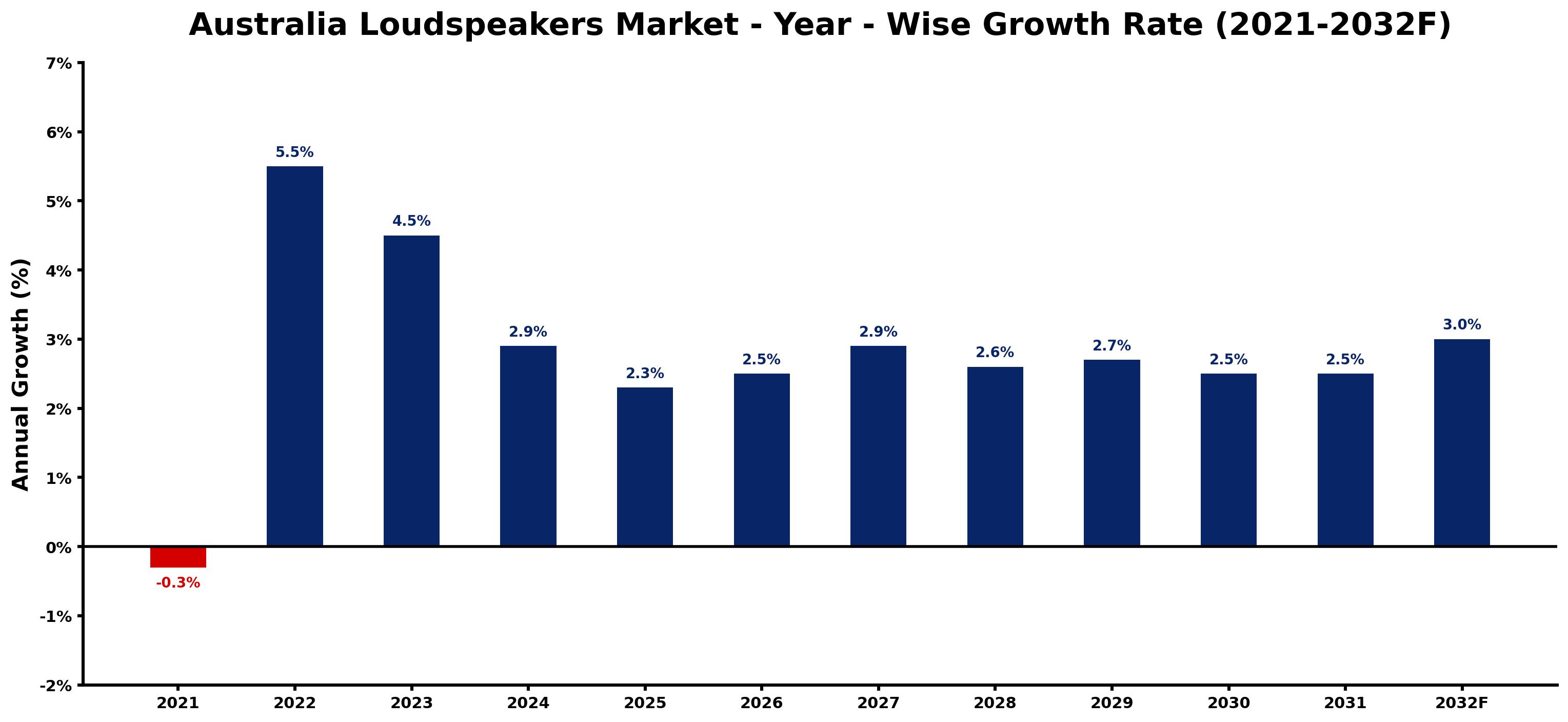
The table below presents the year wise growth rates along with the key drivers influencing the market
| Year | Growth Rate | Major Drivers |
| 2021 | -0.3% | Increased competition from emerging technologies diminished the appeal of traditional loudspeakers among consumers. |
| 2022 | 5.5% | A shift towards home entertainment systems reflected evolving consumer lifestyle preferences. |
| 2023 | 4.5% | Technological innovations in wireless sound systems captivated audiophiles in urban areas. |
| 2024 | 2.9% | Corporate events and live performances led to increased demand for portable loudspeakers. |
| 2025 | 2.3% | Emerging trends in smart home integration enhanced market appeal of connected audio devices. |
| 2026 | 2.5% | Urban expansions prompted the need for public address systems in growing metropolitan areas. |
| 2027 | 2.9% | Increased disposable income encouraged consumers to invest in premium sound experiences. |
| 2028 | 2.6% | The rise of streaming services fueled demand for high-fidelity audio solutions. |
| 2029 | 2.7% | Educational institutions upgraded audio technology, increasing installations in classrooms and auditoriums. |
| 2030 | 2.5% | Collaboration with local artists stimulated the live event sector, enhancing speaker usage. |
| 2031 | 2.5% | Sustainability initiatives prompted manufacturers to explore eco-friendly materials for loudspeakers. |
| 2032 | 3.0% | Global brands entered the market, intensifying competition and driving product innovation. |
Note - Market size estimations and growth projections presented in this report are based on 6Wresearch's advanced forecasting approach, validated with industry datasets as of June 2026.
Australia Loudspeakers Market Synopsis
The Australia Loudspeakers Market is projected to reach 2.5% and witness significant growth during the forecast period (2026-2032). This market encompasses a diverse range of audio reproduction devices tailored for consumer electronics, professional audio, and entertainment industries. Loudspeakers are crucial for amplifying sound in various environments, including homes, concert venues, theaters, and public spaces. The evolution of this sector is closely linked to the increasing demand for high-quality audio experiences, advancements in audio technology, and a booming home entertainment culture in Australia.
Australia Loudspeakers Market Growth Drivers
The Australia Loudspeakers Market is propelled by several key growth drivers that significantly contribute to its dynamics. Firstly, the shift in consumer preferences towards immersive audio experiences has led to a surge in demand for loudspeakers that provide high-fidelity sound reproduction. Additionally, advancements in technology, particularly in wireless connectivity and smart features, have enhanced the appeal of modern loudspeakers, making them compatible with a variety of multimedia devices. Furthermore, the increasing popularity of home entertainment systems has stimulated market growth, as consumers invest in audio solutions to enhance their viewing experiences.
- Growing interest in high-quality audio reproduction is encouraging consumers to invest in premium loudspeakers designed for performance. This demand is reflected across various sectors, including home theaters and personal audio systems.
- Technological innovations, such as improved driver materials and advanced digital signal processing, play a crucial role in enhancing audio quality and performance. These technologies contribute to the overall appeal of modern loudspeakers.
- The expansion of live events, concerts, and entertainment activities fosters a consistent demand for professional-grade loudspeakers, particularly within the entertainment industry.
- Increased penetration of streaming services and digital content consumption drives demand for loudspeakers that offer rich soundscapes, encouraging manufacturers to develop products tailored to modern listening habits.
- Collaborations among audio engineers, content creators, and loudspeaker manufacturers result in innovative products that enhance user experiences and foster market growth within the Australia Loudspeakers Market.
Australia Loudspeakers Market Challenges and Restraints
Despite the promising growth prospects, the Australia Loudspeakers Market faces several challenges that may impede its progress. One significant concern is the rapid pace of technological obsolescence, which compels manufacturers to continuously innovate. Failure to keep up with technological advancements may result in diminished consumer interest and market share. Furthermore, pricing pressures stemming from competition and the presence of alternative audio solutions place constraints on profit margins, prompting companies to strategize effectively. Manufacturers must also ensure their products meet evolving consumer expectations for high-performance, aesthetically pleasing designs that seamlessly integrate into modern audio systems.
Australia Loudspeakers Market Government Investment and Initiatives
The government policies affecting the Australia Loudspeakers Market focus on ensuring product safety, promoting environmental sustainability, and fostering technological innovation. Regulatory frameworks are in place to establish standards for electromagnetic compatibility and minimize any potential environmental impacts associated with loudspeaker manufacturing. These initiatives are designed to enhance the quality and reliability of audio devices, which can positively influence consumer confidence. Additionally, public spending on cultural and entertainment projects facilitates broader access to high-quality audio experiences, thus indirectly supporting the loudspeakers market through infrastructural enhancements in public venues.
Australia Loudspeakers Market Latest Developments (May 2025 - June 2026)
Recent developments in the Australia Loudspeakers Market reflect a strong trend towards integrating advanced technologies into audio devices. The emergence of new wireless speaker models with enhanced functionalities, including voice control and smart home integration, has captured consumer interest and prompted ongoing innovations. Additionally, industry players are increasingly focused on sustainability initiatives, emphasizing eco-friendly materials and energy-efficient designs. Market participants are also exploring collaborations with streaming services to create tailored audio solutions that enhance the listening experience. This continuous evolution in product offerings aims to cater to diverse consumer preferences while ensuring alignment with technological advancements.
Australia Loudspeakers Market - Key Attractiveness of the Report
- 10 Years of Market Numbers
- Historical Data Starting from 2022 to 2025
- Base Year: 2025
- Forecast Data until 2032
- Key Performance Indicators Impacting the Market
- Major Upcoming Developments and Projects
Key Highlights of the Report:
- Australia Loudspeakers Market Outlook
- Market Size of Australia Loudspeakers Market, 2025
- Forecast of Australia Loudspeakers Market, 2032
- Historical Data and Forecast of Australia Loudspeakers Revenues & Volume for the Period 2022-2032F
- Australia Loudspeakers Market Trend Evolution
- Australia Loudspeakers Market Drivers and Challenges
- Australia Loudspeakers Price Trends
- Australia Loudspeakers Porter's Five Forces
- Australia Loudspeakers Industry Life Cycle
- Historical Data and Forecast of Australia Loudspeakers Market Revenues & Volume By Type for the Period 2022-2032F
- Historical Data and Forecast of Australia Loudspeakers Market Revenues & Volume By Electric Loudspeaker for the Period 2022-2032F
- Historical Data and Forecast of Australia Loudspeakers Market Revenues & Volume By Capacitive Loudspeaker for the Period 2022-2032F
- Historical Data and Forecast of Australia Loudspeakers Market Revenues & Volume By Electromagnetic Loudspeaker for the Period 2022-2032F
- Historical Data and Forecast of Australia Loudspeakers Market Revenues & Volume By Piezoelectric Loudspeaker for the Period 2022-2032F
- Historical Data and Forecast of Australia Loudspeakers Market Revenues & Volume By Mounting for the Period 2022-2032F
- Historical Data and Forecast of Australia Loudspeakers Market Revenues & Volume By Wall-mounted for the Period 2022-2032F
- Historical Data and Forecast of Australia Loudspeakers Market Revenues & Volume By Portable for the Period 2022-2032F
- Historical Data and Forecast of Australia Loudspeakers Market Revenues & Volume By Ceiling for the Period 2022-2032F
- Historical Data and Forecast of Australia Loudspeakers Market Revenues & Volume By Bracket-mounted for the Period 2022-2032F
- Historical Data and Forecast of Australia Loudspeakers Market Revenues & Volume By Flush-mounted for the Period 2022-2032F
- Historical Data and Forecast of Australia Loudspeakers Market Revenues & Volume By Sound Level for the Period 2022-2032F
- Historical Data and Forecast of Australia Loudspeakers Market Revenues & Volume By < 50dB for the Period 2022-2032F
- Historical Data and Forecast of Australia Loudspeakers Market Revenues & Volume By 51 ? 80dB for the Period 2022-2032F
- Historical Data and Forecast of Australia Loudspeakers Market Revenues & Volume By >81dB for the Period 2022-2032F
- Historical Data and Forecast of Australia Loudspeakers Market Revenues & Volume By Applications for the Period 2022-2032F
- Historical Data and Forecast of Australia Loudspeakers Market Revenues & Volume By Commercial for the Period 2022-2032F
- Historical Data and Forecast of Australia Loudspeakers Market Revenues & Volume By Agricultural for the Period 2022-2032F
- Historical Data and Forecast of Australia Loudspeakers Market Revenues & Volume By Educational Institutions for the Period 2022-2032F
- Australia Loudspeakers Import Export Trade Statistics
- Market Opportunity Assessment By Type
- Market Opportunity Assessment By Mounting
- Market Opportunity Assessment By Sound Level
- Market Opportunity Assessment By Applications
- Australia Loudspeakers Top Companies Market Share
- Australia Loudspeakers Competitive Benchmarking By Technical and Operational Parameters
- Australia Loudspeakers Company Profiles
- Australia Loudspeakers Key Strategic Recommendations






































