Australia Manual Pruning Shears Market Size, Share & Growth Rate
The Australia Manual Pruning Shears Market was estimated at USD 243 Million in 2025 and is projected to reach USD 285 Million by 2032, growing at a CAGR of 2.3% from 2026 to 2032. This steady growth is driven primarily by the expansion of the horticulture and landscaping sectors, which continue to flourish in urban environments. Additionally, the increasing popularity of gardening as a leisure activity is enhancing the demand for high-quality manual pruning tools, while innovations in ergonomics and material durability further support this positive trajectory.
Australia Manual Pruning Shears Market Year-wise Growth Rate and Key Drivers
This graph highlights how the Australia Manual Pruning Shears Market has steadily grown over the years, supported by major growth factors.
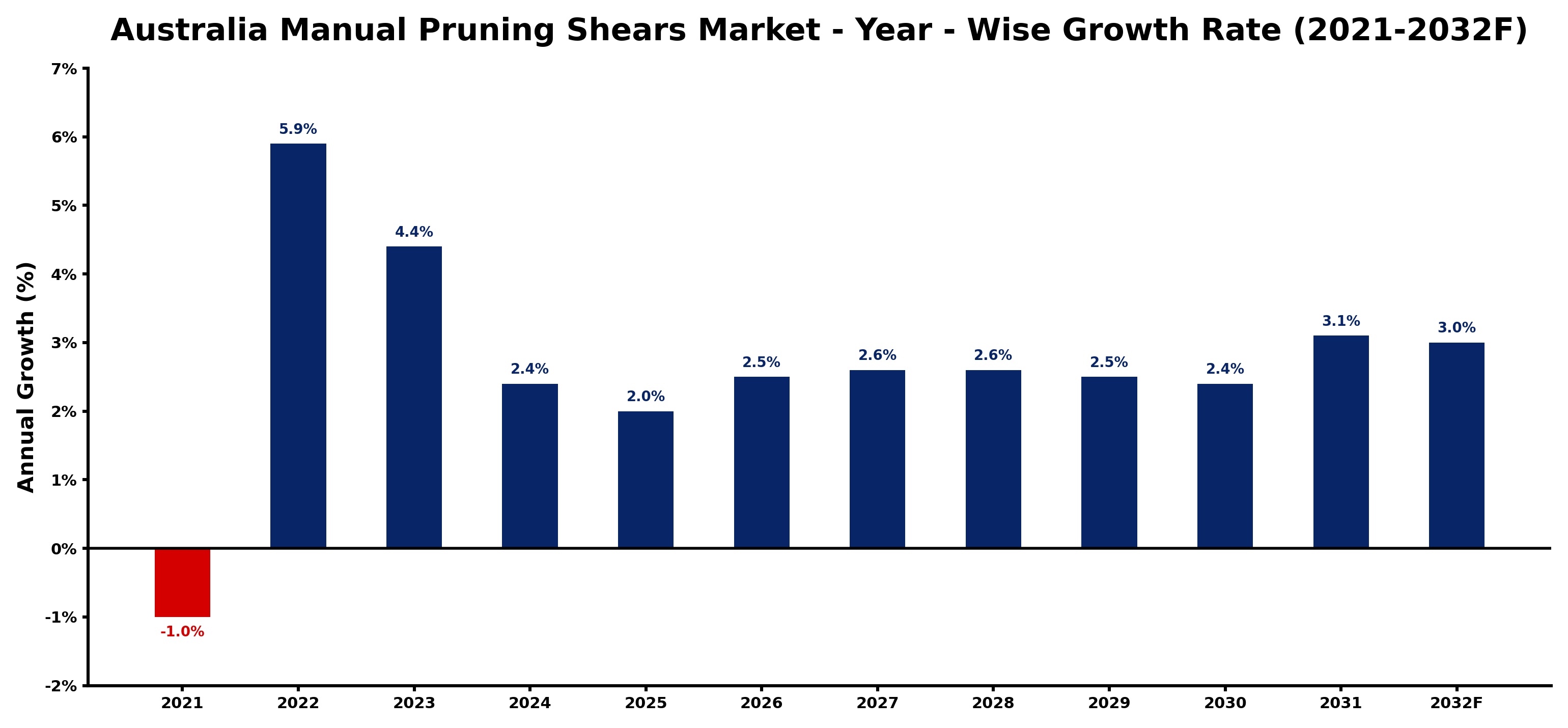
The table below presents the year‑wise growth rates along with the key drivers influencing the market
| Year | Growth Rate | Major Drivers |
| 2021 | -1.0% | Growing urbanization and commercial development |
| 2022 | 5.9% | Increasing adoption of advanced technologies |
| 2023 | 4.4% | Growing urbanization and commercial development |
| 2024 | 2.4% | Increasing industrial infrastructure investments |
| 2025 | 2.0% | Rapid growth in telecom and data center sectors |
| 2026 | 2.5% | Expansion of commercial construction activities |
| 2027 | 2.6% | Increasing smart city development projects |
| 2028 | 2.6% | Growing urbanization and commercial development |
| 2029 | 2.5% | Rapid growth in telecom and data center sectors |
| 2030 | 2.4% | Expansion of transportation and logistics networks |
| 2031 | 3.1% | Growing renewable energy integration projects |
| 2032 | 3.0% | Expansion of manufacturing activities |
Note - Market size estimations and growth projections presented in this report are based on 6Wresearch’s advanced forecasting approach, validated with industry datasets as of June 2026.
Australia Manual Pruning Shears Market Synopsis
In recent years, the Australia Manual Pruning Shears Market has witnessed a noticeable surge, attributed to the robust growth in urban gardening and landscaping. Looking ahead, the market is set to continue this upward momentum as sustainability trends and outdoor living spaces become more prioritized in consumer preferences.
However, the market faces evolving dynamics as mechanized alternatives gain traction. As such, manufacturers must adapt their strategies to emphasize the unique benefits of manual tools, ensuring they cater to the needs of both professional landscapers and enthusiastic home gardeners.
Australia Manual Pruning Shears Market Key Takeaways
- Growing interest in gardening and landscaping boosts manual pruning shears demand.
- Urban gardening trends emphasize the need for efficient and ergonomically designed tools.
- Technological advancements are enhancing product durability and user-friendliness.
- Competition from mechanized tools necessitates innovative marketing and quality differentiation.
- Government regulations impact safety standards and sustainability practices in tool manufacturing.
Evaluation of Restraints in Australia Manual Pruning Shears Market
The manual pruning shears market is currently facing significant constraints stemming from competition with automated and mechanized alternatives. As technology advances, power tools are becoming increasingly affordable and efficient, drawing the attention of both professional landscapers and homeowners. This shift poses a challenge for traditional manual tools, which need to assert their value proposition. Manufacturers must innovate to create products that not only meet ergonomic and durability standards but also resonate with consumer values of sustainability and quality craftsmanship.
Australia Manual Pruning Shears Market Trends
A growing trend within the Australia Manual Pruning Shears Market is the shift towards ergonomic designs. As more users prioritize comfort during extended use, manufacturers are responding with tools that reduce strain and enhance efficiency. Additionally, sustainable materials and production methods are gaining traction, appealing to environmentally conscious consumers. Digital marketing strategies are also evolving, leveraging social media platforms to reach new gardening enthusiasts and showcase innovative product features.
Australia Manual Pruning Shears Market Opportunities
The Australia Manual Pruning Shears Market presents various opportunities for growth, particularly in segments emphasizing sustainable gardening practices. As consumers become more eco-aware, there is a rising demand for tools that adhere to these principles. Additionally, targeted marketing campaigns aimed at urban dwellers can further capture market share. Collaborations with gardening influencers or sustainable lifestyle brands could also be lucrative, enhancing visibility and consumer interest in manual pruning tools.
Government Initiatives in the Australia Manual Pruning Shears Market
Government policies in Australia significantly influence the manual pruning shears market. Regulations established by bodies like Safe Work Australia ensure that safety standards for hand tools are upheld, which can affect manufacturing processes and product offerings. Furthermore, initiatives promoting sustainable agricultural practices encourage the development of tools that enhance efficiency and minimize environmental impact, thereby creating a favorable climate for innovative manual pruning shears.
Future Insights of the Australia Manual Pruning Shears Market
From 2026 to 2032, the Australia Manual Pruning Shears Market is anticipated to evolve significantly, driven by changing consumer habits and increased focus on home gardening. The push for sustainable practices will likely propel product innovation, with manufacturers adopting greener materials and production methods. Additionally, as more Australians embrace outdoor living, the demand for reliable manual tools will persist, solidifying their role in landscape maintenance and gardening.
Australia Manual Pruning Shears Market Latest Developments (May 2025 - June 2026)
Recent developments within the Australia Manual Pruning Shears Market indicate a growing emphasis on product innovation. Companies are exploring new materials to enhance durability while minimizing weight, ensuring tools are user-friendly. Furthermore, there is an observable trend toward collaborative marketing efforts, engaging consumers through community gardening initiatives and workshops. Such strategies not only educate potential buyers but also foster a sense of community around gardening practices.
Australia Manual Pruning Shears Market - Key Attractiveness of the Report
- 10 Years of Market Numbers
- Historical Data Starting from 2022 to 2025
- Base Year: 2025
- Forecast Data until 2032
- Key Performance Indicators Impacting the Market
- Major Upcoming Developments and Projects
Key Highlights of the Report:
- Australia Manual Pruning Shears Market Outlook
- Market Size of Australia Manual Pruning Shears Market, 2025
- Forecast of Australia Manual Pruning Shears Market, 2032
- Historical Data and Forecast of Australia Manual Pruning Shears Revenues & Volume for the Period 2022-2032F
- Australia Manual Pruning Shears Market Trend Evolution
- Australia Manual Pruning Shears Market Drivers and Challenges
- Australia Manual Pruning Shears Price Trends
- Australia Manual Pruning Shears Porter's Five Forces
- Australia Manual Pruning Shears Industry Life Cycle
- Historical Data and Forecast of Australia Manual Pruning Shears Market Revenues & Volume By Type for the Period 2022-2032F
- Historical Data and Forecast of Australia Manual Pruning Shears Market Revenues & Volume By Pruning Shears for the Period 2022-2032F
- Historical Data and Forecast of Australia Manual Pruning Shears Market Revenues & Volume By Hedge Shears for the Period 2022-2032F
- Historical Data and Forecast of Australia Manual Pruning Shears Market Revenues & Volume By Lopping Shears for the Period 2022-2032F
- Historical Data and Forecast of Australia Manual Pruning Shears Market Revenues & Volume By Long Reach Pruners for the Period 2022-2032F
- Historical Data and Forecast of Australia Manual Pruning Shears Market Revenues & Volume By Application for the Period 2022-2032F
- Historical Data and Forecast of Australia Manual Pruning Shears Market Revenues & Volume By Household for the Period 2022-2032F
- Historical Data and Forecast of Australia Manual Pruning Shears Market Revenues & Volume By Commercial Use for the Period 2022-2032F
- Australia Manual Pruning Shears Import Export Trade Statistics
- Market Opportunity Assessment By Type
- Market Opportunity Assessment By Application
- Australia Manual Pruning Shears Top Companies Market Share
- Australia Manual Pruning Shears Competitive Benchmarking By Technical and Operational Parameters
- Australia Manual Pruning Shears Company Profiles
- Australia Manual Pruning Shears Key Strategic Recommendations






































