Australia Meat Packaging Market Summary
The australia meat packaging market was estimated at USD 171 Million in 2025 and is projected to reach USD 201 Million by 2032, growing at a CAGR of 2.7% from 2026 to 2032.
Australia Meat Packaging Market Year-wise Growth Rate and Key Drivers
This graph highlights how the Australia Meat Packaging Market has steadily grown over the past five years, supported by major growth factors.
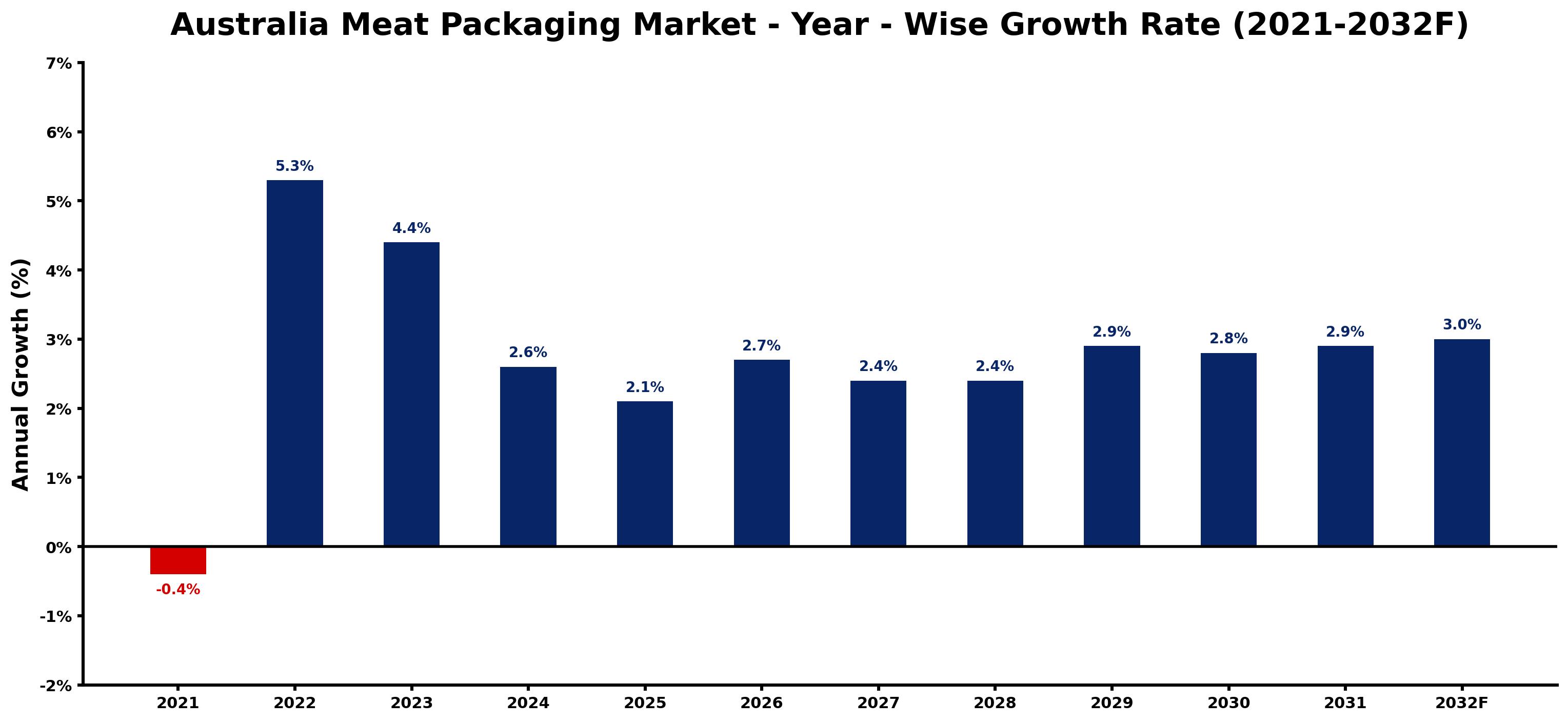
The table below presents the year wise growth rates along with the key drivers influencing the market
| Year | Growth Rate | Major Drivers |
| 2021 | -0.4% | Supply chain disruptions due to COVID19 restrictions hindered meat packaging operations and decreased overall market activity. |
| 2022 | 5.3% | Local manufacturers invested in technology to enhance packaging efficiency and shelf life. |
| 2023 | 4.4% | Retail chains expanded their private label meat brands, increasing packaging demand significantly. |
| 2024 | 2.6% | Emerging e-commerce platforms facilitated convenient meat purchases with improved packaging solutions. |
| 2025 | 2.1% | Health-conscious trends encouraged demand for transparent labeling and innovative packaging formats. |
| 2026 | 2.7% | Sustainability benchmarks pushed companies toward biodegradable and environmentally friendly materials. |
| 2027 | 2.4% | Food safety concerns necessitated advanced packaging technologies to ensure product integrity. |
| 2028 | 2.4% | Rural distribution networks thrived, increasing the need for reliable and durable packaging options. |
| 2029 | 2.9% | Urbanization trends drove packaged meat consumption, influencing market dynamics favorably. |
| 2030 | 2.8% | Technological integration allowed smart packaging solutions to track supply chain efficiency. |
| 2031 | 2.9% | Continued investment in local processing facilities supported regional meat packaging growth. |
| 2032 | 3.0% | Consumer awareness about food waste highlighted the importance of effective packaging innovations. |
Note - Market size estimations and growth projections presented in this report are based on 6Wresearch's advanced forecasting approach, validated with industry datasets as of June 2026.
Australia Meat Packaging Market Synopsis
The Australia Meat Packaging Market is projected to reach 2.7% and witness significant growth during the forecast period (2026-2032). The market encompasses a wide range of packaging solutions designed for both fresh and processed meat products, playing a crucial role in enhancing quality, safety, and shelf life. With a diverse array of packaging formats including trays, films, vacuum bags, and modified atmosphere packaging (MAP), the industry adapts to the unique requirements of different types of meat and cuts, ensuring optimal protection and preservation throughout the supply chain.
Australia Meat Packaging Market Growth Drivers
The growth of the Australia Meat Packaging Market is driven by several interrelated factors:
- The rising demand for packaged and processed meat products reflects changing consumer preferences, where convenience and ready-to-eat meals are increasingly favored.
- Advancements in packaging materials and technologies improve product protection, extending shelf life while maintaining freshness and quality.
- A greater emphasis on food safety, supported by stringent regulations, mandates robust packaging solutions that meet hygiene standards and protect against contamination.
- Growing awareness among consumers regarding sustainability promotes the development of eco-friendly packaging materials and formats that address environmental concerns.
- The increase in the meat processing industry, alongside the adoption of innovative packaging solutions, fuels demand and supports overall market expansion.
Australia Meat Packaging Market Challenges and Restraints
Despite its growth potential, the Australia Meat Packaging Market grapples with several challenges:
- Sustainability concerns are paramount, as companies must balance product protection with a commitment to reducing environmental impact, particularly with respect to plastic waste.
- Consumer preferences are shifting towards environmentally-friendly packaging, pressuring manufacturers to innovate while also meeting cost and performance criteria.
- Limitations in material availability or technological advancements can hinder the development of packaging solutions that extend shelf life effectively.
- Regulatory compliance requires ongoing investment and adaptation from manufacturers to meet evolving food safety and labeling standards.
- Market competition is intensifying, necessitating a greater focus on innovation and efficiency to maintain profitability and market share.
Australia Meat Packaging Market Government Investment and Initiatives
The government plays a pivotal role in shaping the landscape of the Australia Meat Packaging Market through various investments and initiatives:
- Regulatory frameworks established by agencies such as Food Standards Australia New Zealand (FSANZ) aim to ensure food safety and integrity in meat packaging practices.
- Public funding initiatives support research and development of sustainable packaging solutions, fostering innovation within local businesses.
- The Australia Packaging Covenant Organisation (APCO) promotes environmentally responsible packaging practices, encouraging collaboration across the industry.
- Government policies advocate for improved hygiene standards and traceability systems, enhancing consumer trust in packaged meat products.
- Economic incentives for businesses investing in sustainable technologies and materials further drive advancements in the meat packaging sector.
Australia Meat Packaging Market Latest Developments (May 2025 - June 2026)
In the period from May 2025 to June 2026, the Australia Meat Packaging Market has experienced notable advancements:
- Innovative packaging designs focusing on sustainability have gained traction, reflecting a shifting industry priority towards eco-friendly materials.
- The adaptation of MAP technologies has improved preservation methods, resulting in superior quality and extended shelf life for meat products.
- Enhanced regulatory compliance measures have been established, requiring manufacturers to implement rigorous hygiene protocols and labeling accuracy.
- Consumer education campaigns have emerged, highlighting the benefits of proper meat packaging practices to reduce food waste.
- Collaborations between packaging developers and meat processors have intensified, leading to tailored solutions that address specific product preservation challenges.
Australia Meat Packaging Market - Key Attractiveness of the Report
- 10 Years of Market Numbers
- Historical Data Starting from 2022 to 2025
- Base Year: 2025
- Forecast Data until 2032
- Key Performance Indicators Impacting the Market
- Major Upcoming Developments and Projects
Key Highlights of the Report:
- Australia Meat Packaging Market Outlook
- Market Size of Australia Meat Packaging Market, 2025
- Forecast of Australia Meat Packaging Market, 2032
- Historical Data and Forecast of Australia Meat Packaging Revenues & Volume for the Period 2022-2032F
- Australia Meat Packaging Market Trend Evolution
- Australia Meat Packaging Market Drivers and Challenges
- Australia Meat Packaging Price Trends
- Australia Meat Packaging Porter's Five Forces
- Australia Meat Packaging Industry Life Cycle
- Historical Data and Forecast of Australia Meat Packaging Market Revenues & Volume By Material Type for the Period 2022-2032F
- Historical Data and Forecast of Australia Meat Packaging Market Revenues & Volume By Plastic for the Period 2022-2032F
- Historical Data and Forecast of Australia Meat Packaging Market Revenues & Volume By Rigid? for the Period 2022-2032F
- Historical Data and Forecast of Australia Meat Packaging Market Revenues & Volume By Metal for the Period 2022-2032F
- Historical Data and Forecast of Australia Meat Packaging Market Revenues & Volume By Meat Type for the Period 2022-2032F
- Historical Data and Forecast of Australia Meat Packaging Market Revenues & Volume By Fresh and Frozen for the Period 2022-2032F
- Historical Data and Forecast of Australia Meat Packaging Market Revenues & Volume By Processed for the Period 2022-2032F
- Historical Data and Forecast of Australia Meat Packaging Market Revenues & Volume By Ready to Eat for the Period 2022-2032F
- Australia Meat Packaging Import Export Trade Statistics
- Market Opportunity Assessment By Material Type
- Market Opportunity Assessment By Meat Type
- Australia Meat Packaging Top Companies Market Share
- Australia Meat Packaging Competitive Benchmarking By Technical and Operational Parameters
- Australia Meat Packaging Company Profiles
- Australia Meat Packaging Key Strategic Recommendations






































