Australia Medical Tubing Market: Import Trend Analysis
In the Australia medical tubing market, the import trend from 2023 to 2024 experienced a decline of -6.58%, while the compound annual growth rate (CAGR) for the period 2020-2024 stood at 1.65%. This negative import momentum in 2024 could be attributed to shifts in demand dynamics or changes in trade policies impacting market stability.
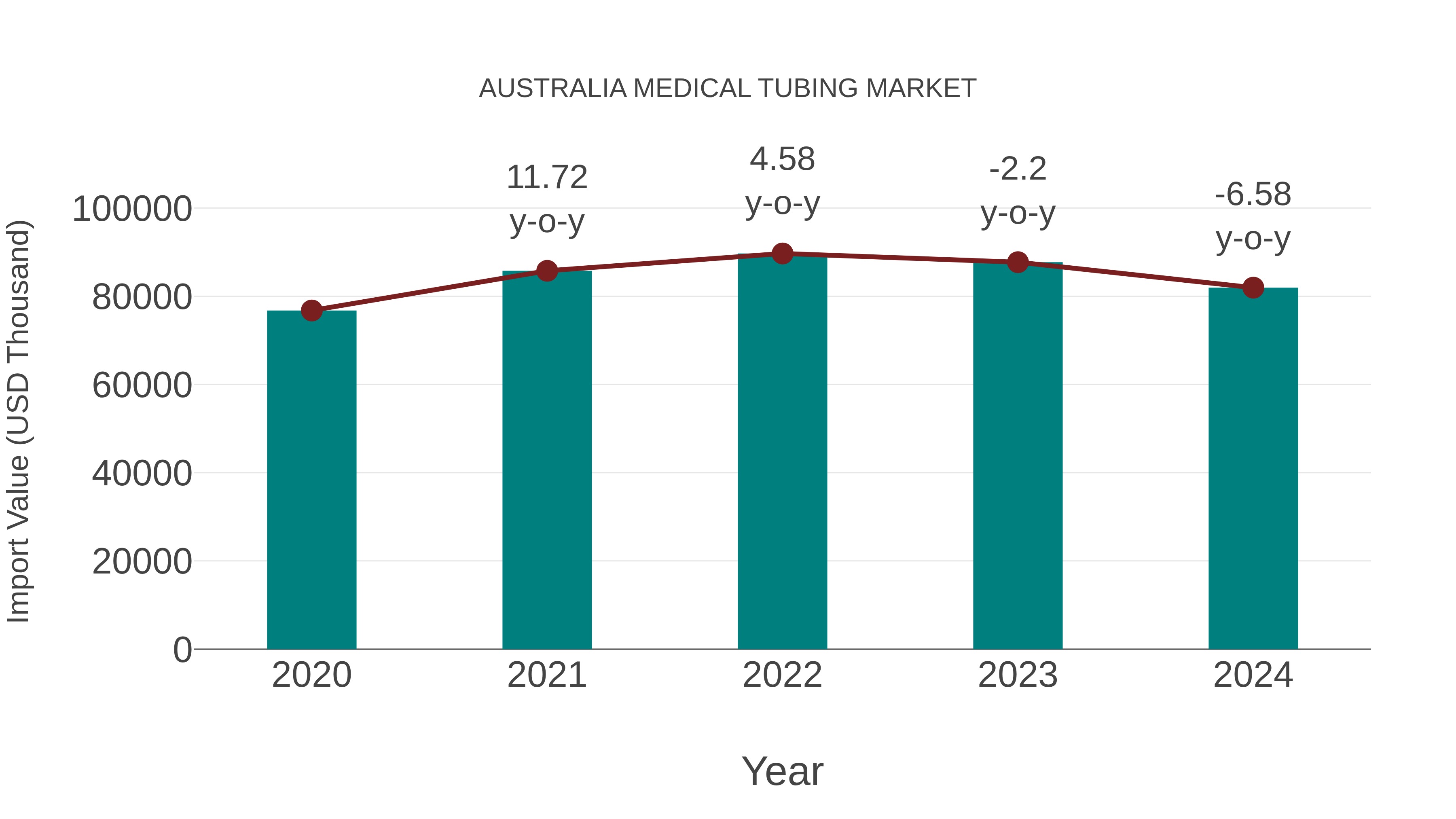
Australia Medical Tubing Market Overview
Australia medical tubing market supplies flexible tubing used in medical devices, catheters, IV sets, and fluid delivery systems. Medical tubing provides compatibility with various fluids and medications, ensuring safe and reliable delivery in clinical settings.
Drivers of the market
In Australia, the medical tubing market is influenced by factors such as the increasing demand for flexible and sterile tubing solutions in medical devices and fluid management systems, advancements in tubing materials and manufacturing technologies, and the expanding healthcare sector. Medical tubing is used in various medical applications such as catheters, intravenous (IV) lines, and surgical instruments. The rising demand for minimally invasive procedures and patient comfort drives market growth. Moreover, the development of antimicrobial and biocompatible tubing materials further stimulates market expansion.
Challenges of the market
Challenges in the medical tubing market include ensuring biocompatibility, sterilization compatibility, and dimensional stability. Manufacturers must develop tubing that offers flexibility, durability, and resistance to kinking and collapse for various medical applications such as fluid management, catheterization, and drainage. Moreover, addressing concerns about tubing material selection, extrusion processes, and regulatory compliance poses ongoing challenges in the market.
Government Policy of the market
The Australia government regulates the medical tubing market to ensure product safety, quality, and compliance with industry standards. Policies involve oversight by regulatory bodies such as the Therapeutic Goods Administration (TGA) and the Australia Competition and Consumer Commission (ACCC). Government initiatives may include setting standards for tubing materials and manufacturing processes, providing industry guidance on regulatory compliance, and promoting research and development in tubing technology to improve performance and usability in medical applications.
Key Highlights of the Report:
- Australia Medical Tubing Market Outlook
- Market Size of Australia Medical Tubing Market, 2025
- Forecast of Australia Medical Tubing Market, 2032
- Historical Data and Forecast of Australia Medical Tubing Revenues & Volume for the Period 2022-2032F
- Australia Medical Tubing Market Trend Evolution
- Australia Medical Tubing Market Drivers and Challenges
- Australia Medical Tubing Price Trends
- Australia Medical Tubing Porter's Five Forces
- Australia Medical Tubing Industry Life Cycle
- Historical Data and Forecast of Australia Medical Tubing Market Revenues & Volume By Material for the Period 2022-2032F
- Historical Data and Forecast of Australia Medical Tubing Market Revenues & Volume By Plastics for the Period 2022-2032F
- Historical Data and Forecast of Australia Medical Tubing Market Revenues & Volume By Rubbers for the Period 2022-2032F
- Historical Data and Forecast of Australia Medical Tubing Market Revenues & Volume By Specialty Polymers for the Period 2022-2032F
- Historical Data and Forecast of Australia Medical Tubing Market Revenues & Volume By Structure for the Period 2022-2032F
- Historical Data and Forecast of Australia Medical Tubing Market Revenues & Volume By Single-lumen for the Period 2022-2032F
- Historical Data and Forecast of Australia Medical Tubing Market Revenues & Volume By Co-extruded for the Period 2022-2032F
- Historical Data and Forecast of Australia Medical Tubing Market Revenues & Volume By Multi-lumen for the Period 2022-2032F
- Historical Data and Forecast of Australia Medical Tubing Market Revenues & Volume By Tapered Or Bump Tubing for the Period 2022-2032F
- Historical Data and Forecast of Australia Medical Tubing Market Revenues & Volume By Braided Tubing for the Period 2022-2032F
- Historical Data and Forecast of Australia Medical Tubing Market Revenues & Volume By Application for the Period 2022-2032F
- Historical Data and Forecast of Australia Medical Tubing Market Revenues & Volume By Bulk Disposable Tubing for the Period 2022-2032F
- Historical Data and Forecast of Australia Medical Tubing Market Revenues & Volume By Catheters & Cannulas for the Period 2022-2032F
- Historical Data and Forecast of Australia Medical Tubing Market Revenues & Volume By Drug Delivery System for the Period 2022-2032F
- Historical Data and Forecast of Australia Medical Tubing Market Revenues & Volume By Special Applications for the Period 2022-2032F
- Australia Medical Tubing Import Export Trade Statistics
- Market Opportunity Assessment By Material
- Market Opportunity Assessment By Structure
- Market Opportunity Assessment By Application
- Australia Medical Tubing Top Companies Market Share
- Australia Medical Tubing Competitive Benchmarking By Technical and Operational Parameters
- Australia Medical Tubing Company Profiles
- Australia Medical Tubing Key Strategic Recommendations






































