Australia Metal Pails Market: Import Trend Analysis
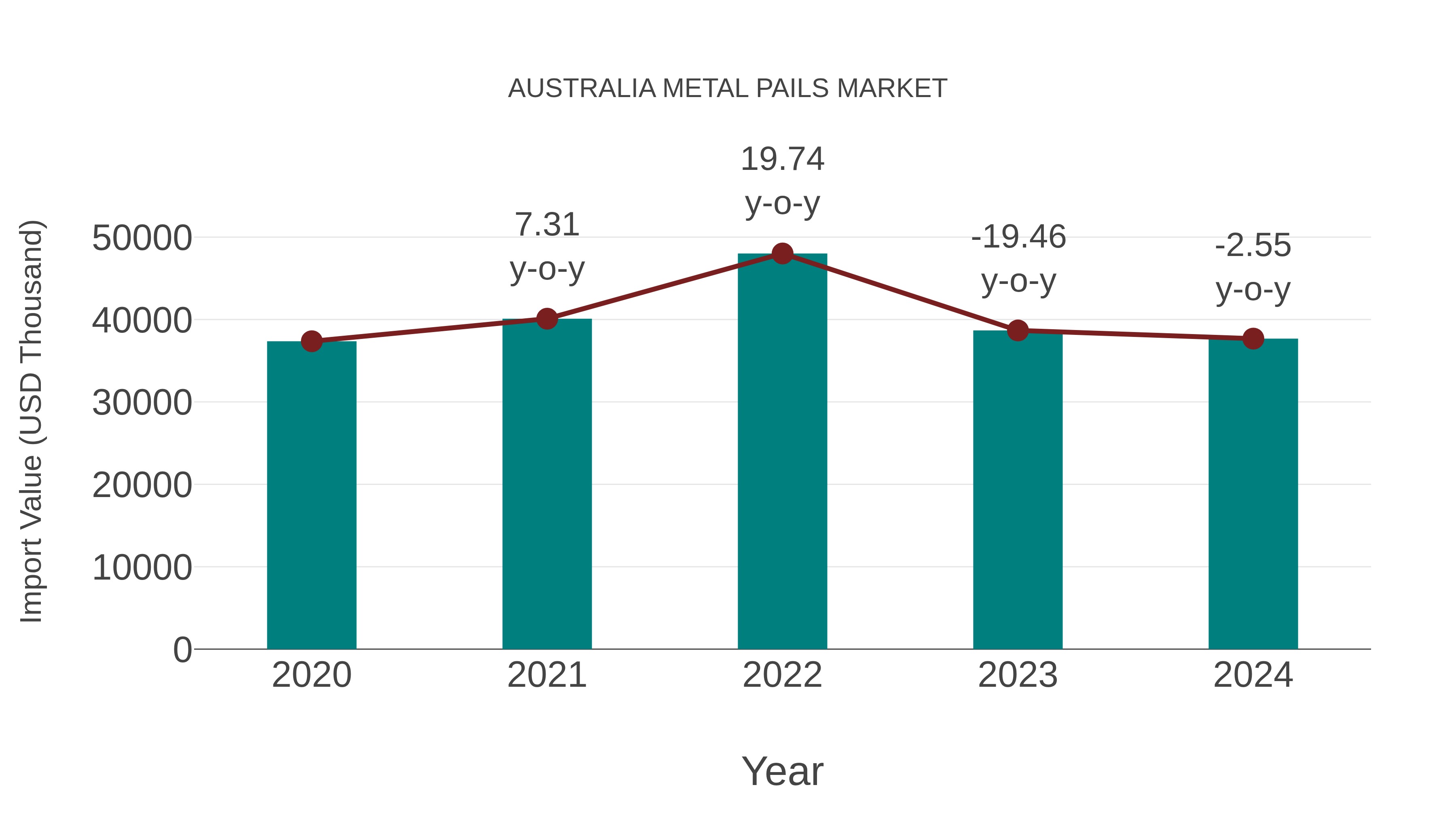
In the Australia metal pails market, the import trend experienced a decline in growth rate from 2023 to 2024, showing a -2.55% decrease. The compound annual growth rate (CAGR) for imports over the period 2020-2024 stood at 0.21%. This downturn in import momentum could be attributed to shifting demand patterns or changes in trade policies impacting market stability.
Australia Metal Pails Market Overview
The metal pails market in Australia serves industrial packaging needs for chemicals, lubricants, paints, and solvents. Steel and tin pails dominate due to their durability and resistance to corrosive materials. Growth in the industrial and construction sectors, along with increasing regulatory emphasis on safe packaging, is driving demand. Local manufacturers face competition from cheaper imports but leverage quality assurance and compliance with Australian safety standards to maintain market share.
Trends of the market
The metal pails market in Australia is being shaped by demand from chemical, paint, and food processing industries that require durable and spill-proof containers. A shift towards eco-friendly packaging has also influenced manufacturers to promote recyclable and reusable metal pails. Lightweight yet robust pail designs with improved sealing mechanisms are trending across logistics and transportation sectors.
Challenges of the market
The metal pails market in Australia faces significant challenges stemming from environmental regulations and the growing shift toward plastic and composite alternatives. While metal pails are durable, they are also heavier and costlier to transport. The market is also affected by the volatility in steel and tinplate prices, which directly impact production costs. In addition, recycling infrastructure in Australia is under pressure, and the circular economy approach is pushing manufacturers to explore more sustainable materials, thus challenging the dominance of metal pails.
Investment opportunities in the Market
Investors have the chance to back companies producing lightweight, stackable, and UN-certified metal pails for chemicals, food, and hazardous waste storage. As sustainability becomes a selling point, firms producing recyclable and reusable metal containers could gain strong market share. Automation in manufacturing and decoration of pails is another segment where investment could yield operational efficiencies.
Government Policy of the market
Government policies regarding waste management and recycling significantly impact the metal pails market in Australia. Policies that promote a circular economy, such as the National Waste Policy and initiatives encouraging extended producer responsibility (EPR), are pushing manufacturers to rethink their materials and designs to ensure greater recyclability and reduce landfill waste. Metal packaging faces challenges due to regulatory pressures to reduce the use of non-recyclable materials. Additionally, rising taxes or levies on single-use plastics could indirectly benefit metal pails, as they offer more sustainable alternatives, although they still face weight and transportation cost hurdles.
Key Highlights of the Report:
- Australia Metal Pails Market Outlook
- Market Size of Australia Metal Pails Market, 2025
- Forecast of Australia Metal Pails Market, 2032
- Historical Data and Forecast of Australia Metal Pails Revenues & Volume for the Period 2022 - 2032F
- Australia Metal Pails Market Trend Evolution
- Australia Metal Pails Market Drivers and Challenges
- Australia Metal Pails Price Trends
- Australia Metal Pails Porter's Five Forces
- Australia Metal Pails Industry Life Cycle
- Historical Data and Forecast of Australia Metal Pails Market Revenues & Volume By Type for the Period 2022 - 2032F
- Historical Data and Forecast of Australia Metal Pails Market Revenues & Volume By Open Top/Head for the Period 2022 - 2032F
- Historical Data and Forecast of Australia Metal Pails Market Revenues & Volume By Closed Top/Hea for the Period 2022 - 2032F
- Historical Data and Forecast of Australia Metal Pails Market Revenues & Volume By End Use for the Period 2022 - 2032F
- Historical Data and Forecast of Australia Metal Pails Market Revenues & Volume By Chemicals for the Period 2022 - 2032F
- Historical Data and Forecast of Australia Metal Pails Market Revenues & Volume By Agriculture for the Period 2022 - 2032F
- Historical Data and Forecast of Australia Metal Pails Market Revenues & Volume By Food & Beverage for the Period 2022 - 2032F
- Historical Data and Forecast of Australia Metal Pails Market Revenues & Volume By Building & Construction for the Period 2022 - 2032F
- Historical Data and Forecast of Australia Metal Pails Market Revenues & Volume By Automotive for the Period 2022 - 2032F
- Historical Data and Forecast of Australia Metal Pails Market Revenues & Volume By Others for the Period 2022 - 2032F
- Australia Metal Pails Import Export Trade Statistics
- Market Opportunity Assessment By Type
- Market Opportunity Assessment By End Use
- Australia Metal Pails Top Companies Market Share
- Australia Metal Pails Competitive Benchmarking By Technical and Operational Parameters
- Australia Metal Pails Company Profiles
- Australia Metal Pails Key Strategic Recommendations






































