Australia Microspheres Market: Import Trend Analysis
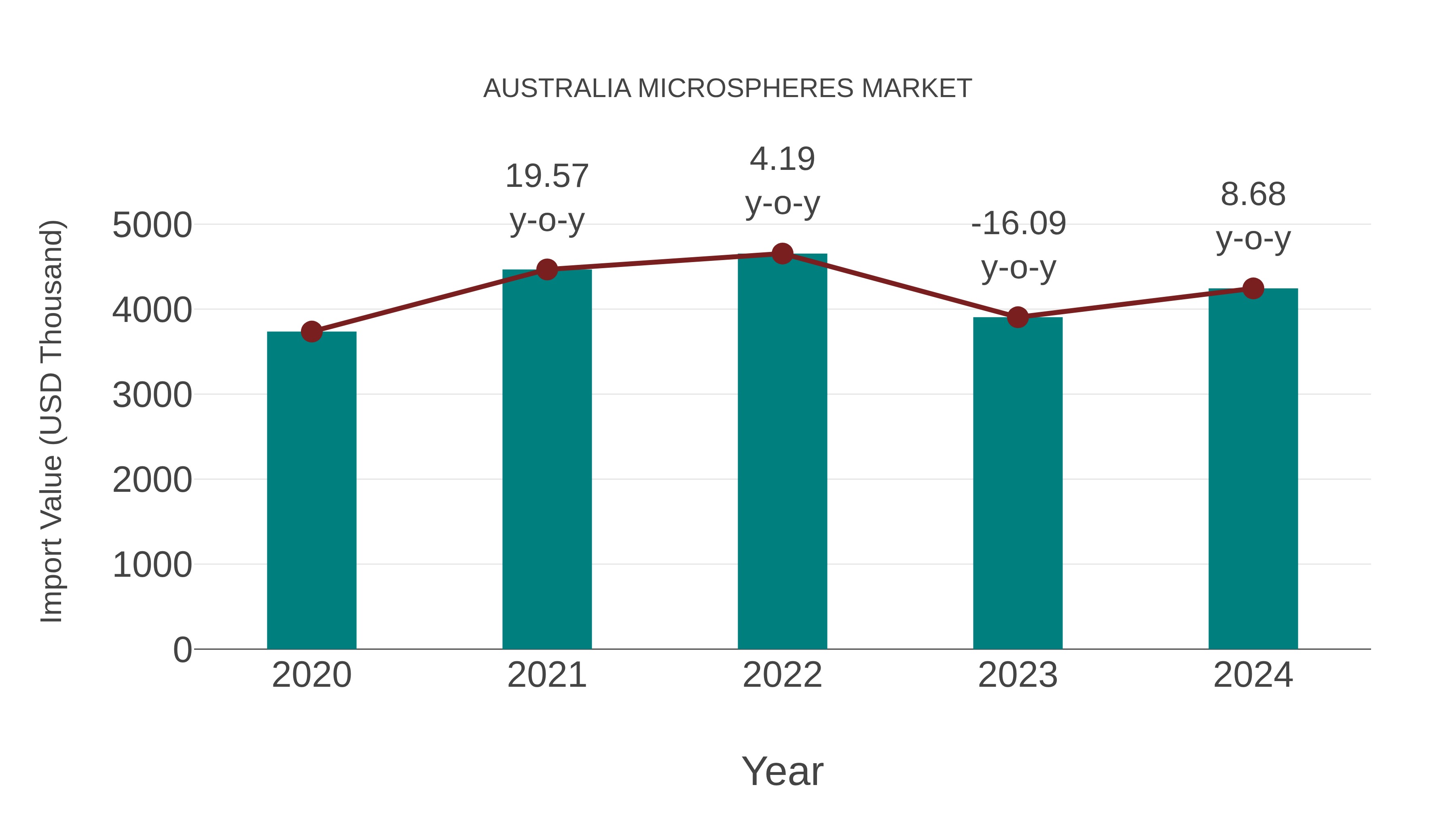
In the Australia microspheres market, the import trend showed a growth rate of 8.68% from 2023 to 2024, with a compound annual growth rate (CAGR) of 3.24% from 2020 to 2024. This increase can be attributed to a notable demand shift towards innovative materials and technologies in various industries, driving import momentum and market stability during this period.
Australia Microspheres Market Overview
Microspheres are spherical particles with precise size and composition used in various applications such as fillers, additives, and carriers in industries such as healthcare, cosmetics, automotive, and construction. In Australia, the microspheres market is driven by factors such as demand for lightweight materials, advancements in polymer science, and applications in drug delivery, composites, and specialty coatings.
Drivers of the market
In Australia, the microspheres market is experiencing significant growth driven by several factors. Microspheres, small spherical particles with precise size and composition, find applications in various industries such as healthcare, cosmetics, and automotive. The market growth is propelled by increasing demand for microspheres in drug delivery, tissue engineering, and medical diagnostics. Additionally, advancements in microsphere manufacturing technologies, such as polymer synthesis and particle engineering techniques, are driving innovation and expanding the application scope of microspheres in Australia. Moreover, the growing trend towards minimally invasive surgeries, personalized medicine, and advanced drug formulations is further stimulating market demand for microsphere-based solutions.
Challenges of the market
The Australia microspheres market faces challenges related to material innovation, quality control, and market diversification. Microspheres, spherical particles with diameters ranging from micrometers to millimeters, find applications in various industries such as healthcare, cosmetics, construction, and automotive. However, developing new microsphere materials with tailored properties and functionalities poses challenges for manufacturers. Additionally, ensuring consistent quality and performance across different batches of microspheres requires stringent quality control measures and characterization techniques. Moreover, expanding into new application areas and market segments while maintaining competitiveness and profitability poses challenges for market players. Overcoming these challenges involves investment in research and development, collaboration with end-users and industry partners, and strategic diversification to capture emerging opportunities in the Australia microspheres market.
Government Policy of the market
The Australia microspheres market benefits from government initiatives aimed at promoting advanced materials research, innovation, and industrial competitiveness. Government policies may include funding for research and development projects focused on the synthesis, characterization, and application of microspheres in various industries, including healthcare, cosmetics, and electronics. Additionally, government support for industry-academia collaborations and technology transfer initiatives enhances the commercialization and adoption of microsphere-based products. By investing in advanced materials research and development, the government aims to stimulate economic growth, create high-value jobs, and support Australia transition to a knowledge-based economy.
Key Highlights of the Report:
- Australia Microspheres Market Outlook
- Market Size of Australia Microspheres Market, 2022
- Forecast of Australia Microspheres Market, 2031
- Historical Data and Forecast of Australia Microspheres Revenues & Volume for the Period 2021-2031
- Australia Microspheres Market Trend Evolution
- Australia Microspheres Market Drivers and Challenges
- Australia Microspheres Price Trends
- Australia Microspheres Porter's Five Forces
- Australia Microspheres Industry Life Cycle
- Historical Data and Forecast of Australia Microspheres Market Revenues & Volume By Type for the Period 2021-2031
- Historical Data and Forecast of Australia Microspheres Market Revenues & Volume By Hollow for the Period 2021-2031
- Historical Data and Forecast of Australia Microspheres Market Revenues & Volume By Solid for the Period 2021-2031
- Historical Data and Forecast of Australia Microspheres Market Revenues & Volume By Raw Material for the Period 2021-2031
- Historical Data and Forecast of Australia Microspheres Market Revenues & Volume By Glass for the Period 2021-2031
- Historical Data and Forecast of Australia Microspheres Market Revenues & Volume By Ceramic for the Period 2021-2031
- Historical Data and Forecast of Australia Microspheres Market Revenues & Volume By Fly Ash for the Period 2021-2031
- Historical Data and Forecast of Australia Microspheres Market Revenues & Volume By Polymer for the Period 2021-2031
- Historical Data and Forecast of Australia Microspheres Market Revenues & Volume By Metallic for the Period 2021-2031
- Historical Data and Forecast of Australia Microspheres Market Revenues & Volume By Application for the Period 2021-2031
- Historical Data and Forecast of Australia Microspheres Market Revenues & Volume By Construction Composites for the Period 2021-2031
- Historical Data and Forecast of Australia Microspheres Market Revenues & Volume By Medical Technology for the Period 2021-2031
- Historical Data and Forecast of Australia Microspheres Market Revenues & Volume By Cosmetics & Personal Care for the Period 2021-2031
- Historical Data and Forecast of Australia Microspheres Market Revenues & Volume By Automotive for the Period 2021-2031
- Historical Data and Forecast of Australia Microspheres Market Revenues & Volume By Oil & Gas for the Period 2021-2031
- Australia Microspheres Import Export Trade Statistics
- Market Opportunity Assessment By Type
- Market Opportunity Assessment By Raw Material
- Market Opportunity Assessment By Application
- Australia Microspheres Top Companies Market Share
- Australia Microspheres Competitive Benchmarking By Technical and Operational Parameters
- Australia Microspheres Company Profiles
- Australia Microspheres Key Strategic Recommendations






































