Australia Mobile Application Security Market Size & Growth Rate (2026-2032)
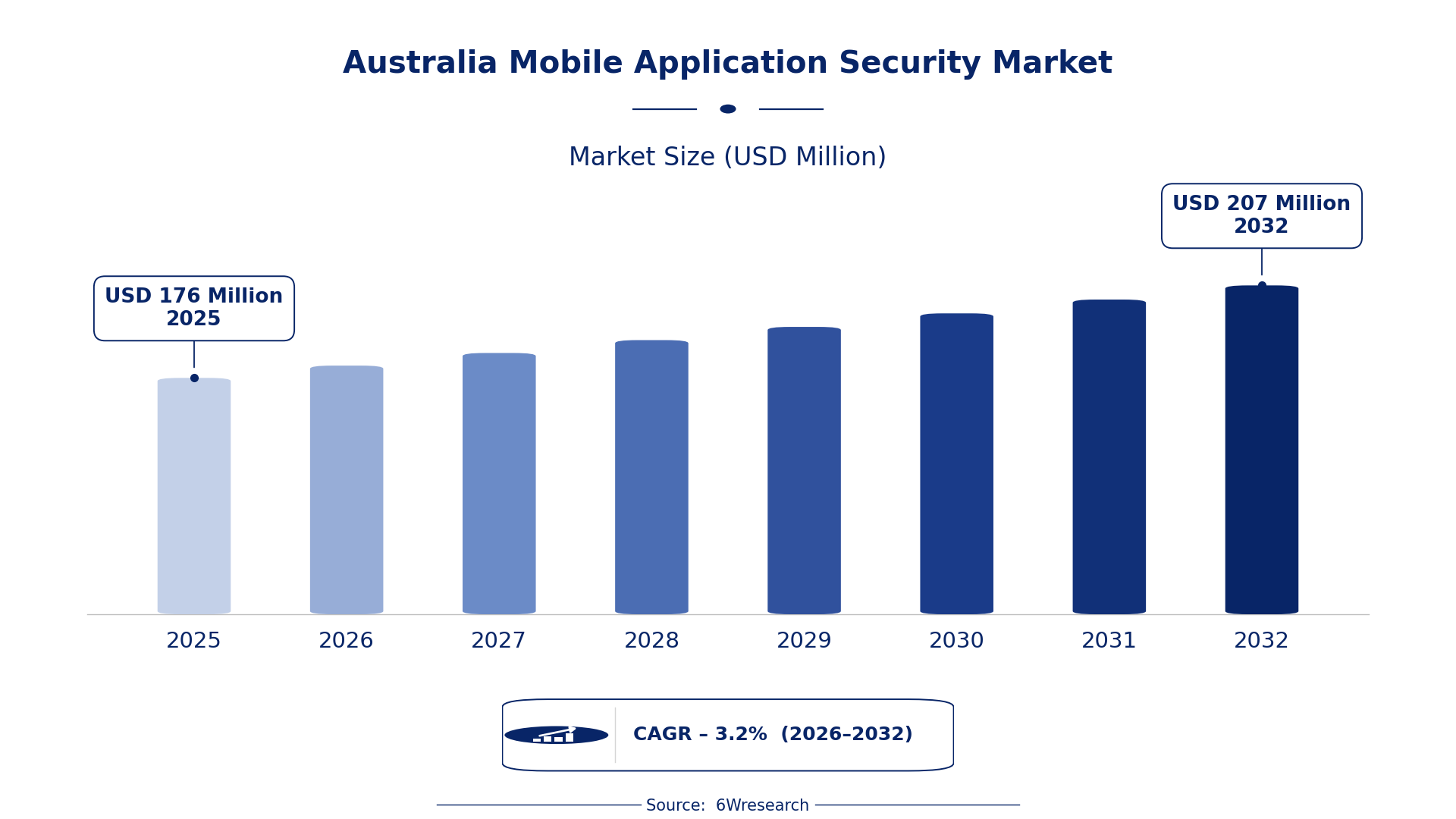
The Australia Mobile Application Security Market was estimated at USD 176 Million in 2025 and is projected to reach USD 207 Million by 2032, growing at a CAGR of 3.2% from 2026 to 2032.
Australia Mobile Application Security Market Synopsis
The Australia Mobile Application Security Market is witnessing dynamic growth as businesses adapt to a heightened focus on protecting their mobile applications. Recent years have shown a surge in mobile usage across e-commerce, banking, and enterprise applications, prompting a corresponding rise in security measures such as secure coding and penetration testing.
Looking ahead, the market is set to evolve amidst growing threats from malware and data breaches. The shift toward integrating security within the development lifecycle through DevSecOps is not just a trend; it is becoming essential for organizations aiming to safeguard sensitive user data effectively.
Australia Mobile Application Security Market Year-wise Growth Rate and Key Drivers
This graph illustrates the annual growth rates of the Australia Mobile Application Security Market from 2021 to 2032, highlighting a steady upward trajectory and projected expansion over the forecast period.
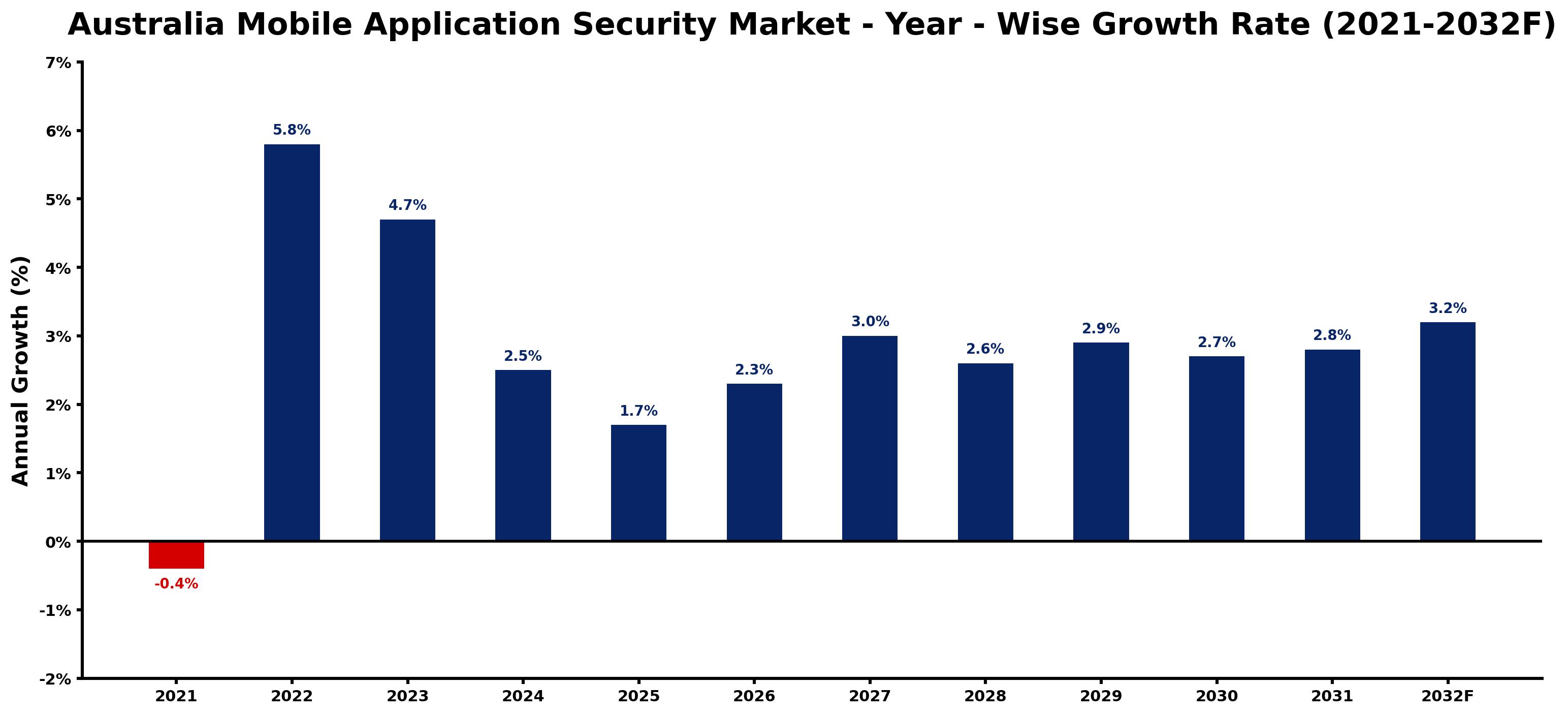
The table below presents the year‑wise growth rates along with the key drivers influencing the market
| Year | Growth Rate | Major Drivers |
| 2021 | -0.4% | Increased compliance costs from Australian Cyber Security Centre guidelines. |
| 2022 | 5.8% | Australian Cyber Security Strategy boosts mobile app protections. |
| 2023 | 4.7% | Growth in e-commerce drives security app investments. |
| 2024 | 2.5% | Surge in remote work necessitates secure application access. |
| 2025 | 1.7% | Regulatory pressures increase demand for app security compliance. |
| 2026 | 2.3% | Mobile payment adoption amplifies security application needs. |
| 2027 | 3.0% | Expanding digital identity initiatives enhance app security focus. |
| 2028 | 2.6% | Increased data protection legislation drives security technology adoption. |
| 2029 | 2.9% | Technological advancements in AI strengthen mobile app security. |
| 2030 | 2.7% | Rising cyber threat landscape demands enhanced security measures. |
| 2031 | 2.8% | Consumer demand for secure mobile banking applications grows. |
| 2032 | 3.2% | Government funding supports innovative security solution development. |
Note: Market size estimations and growth projections presented in this report are based on 6Wresearch's proprietary forecasting methodology, utilizing the latest available industry data, government publications, and primary research inputs.
Australia Mobile Application Security Market Key Takeaways
Below are some of the specific key takeaways from the market, including:
- Increased adoption of mobile banking and e-commerce is driving demand for robust security solutions.
- Real-time threat detection is becoming a priority as organizations seek to mitigate risks associated with app-based malware.
- Investment in AI-driven security technologies is on track to grow, providing innovative ways to enhance mobile application defenses.
- Regulatory requirements are escalating the urgency for secure coding and vulnerability management practices among developers.
- The integration of security within DevOps is emerging as a critical strategy for ensuring comprehensive app protection.
Evaluation of Restraints in Australia Mobile Application Security Market
The Australia Mobile Application Security Market grapples with several significant restraints that can hinder growth. High implementation costs associated with advanced security measures deter many small and medium enterprises from adopting necessary solutions. on top of that, the increasing complexity of securing third-party applications adds layers of difficulty in maintaining compliance and robust security. With the rise in malware threats and the prevalence of insecure coding practices, organizations face ongoing challenges that exacerbate the market's cautious growth trajectory.
Australia Mobile Application Security Market Trends
Current trends highlight a definitive shift towards prioritizing mobile application security within organizational strategies. Increasingly, enterprises are adopting cloud-based security solutions that offer scalability and flexibility, enabling real-time updates in response to emerging threats. on top of that, as consumer awareness regarding data privacy grows, businesses are investing heavily in user privacy controls, further driving the demand for advanced security features in mobile applications. The convergence of AI and security technology continues to shape the market, promising innovative solutions that can proactively address vulnerabilities.
Australia Mobile Application Security Market Opportunities
The potential for growth in the Australia Mobile Application Security Market is compelling. Companies that focus on developing AI-based threat detection and response solutions stand to benefit significantly as these technologies become integral to security frameworks. Additionally, sectors such as finance and healthcare are emerging hotspots for investment, as regulatory requirements amplify the need for stringent security measures. There is a clear opportunity for businesses to innovate within user privacy controls, establishing themselves as leaders in trust and reliability.
Government Initiatives in the Australia Mobile Application Security Market
Government policy is a crucial aspect influencing the Australia Mobile Application Security Market. Regulatory frameworks and initiatives have been established to bolster security practices and ensure that app developers adhere to strict guidelines. These regulations are essential not only for protecting consumer data but also for maintaining overall trust in mobile applications across the economy.
- A recent initiative under the Australian Cyber Security Strategy 2020 promotes secure coding practices among developers through nationwide training and resources.
- Current efforts are underway to enhance the regulatory framework surrounding data protection, with the Australian Signals Directorate (ASD) issuing new guidelines for secure app development.
- Future plans include a major public-private partnership aimed at creating a comprehensive cybersecurity framework by 2027, expected to encompass mobile application security standards.
- The Notifiable Data Breaches (NDB) scheme continues to evolve, placing additional reporting requirements on app developers to mitigate risks related to data breaches.
Future Insights of the Australia Mobile Application Security Market
As we look toward the years 2026 to 2032, the Australia Mobile Application Security Market is poised for considerable changes. Organizations will likely increase investment in integrated security measures that not only protect mobile applications but also enhance user experience. With the rising frequency of cyber threats, the emphasis on real-time threat detection and rapid response capabilities will intensify. The market will continue to mature, evolving as businesses adapt to both user expectations and regulatory demands.
Australia Mobile Application Security Market Latest Developments
The last year has brought about notable advancements in the Australia Mobile Application Security Market. Organizations are increasingly adopting sophisticated security solutions as they face persistent threats. Recent developments reflect a strong push toward innovation and enhanced security measures in response to rising concerns over data breaches and malware attacks.
- A major technology vendor launched an AI-driven mobile threat detection platform in Q2 2025, enhancing real-time monitoring capabilities for businesses.
- A regional operator initiated an ongoing program to audit the security protocols of third-party applications, aiming for completion by late 2026.
- In early 2025, a collaborative project between public and private sectors focused on enhancing user privacy controls in mobile applications was successfully completed.
- A planned rollout expected to begin in early 2026 will introduce advanced encryption technologies across financial mobile applications, aiming to strengthen data protection.
Australia Mobile Application Security Market - Key Attractiveness of the Report
- 10 Years of Market Numbers
- Historical Data Starting from 2022 to 2025
- Base Year: 2025
- Forecast Data until 2032
- Key Performance Indicators Impacting the Market
- Major Upcoming Developments and Projects
Key Highlights of the Report:
- Australia Mobile Application Security Market Outlook
- Market Size of Australia Mobile Application Security Market, 2025
- Forecast of Australia Mobile Application Security Market, 2032
- Historical Data and Forecast of Australia Mobile Application Security Revenues & Volume for the Period 2022-2032F
- Australia Mobile Application Security Market Trend Evolution
- Australia Mobile Application Security Market Drivers and Challenges
- Australia Mobile Application Security Price Trends
- Australia Mobile Application Security Porter's Five Forces
- Australia Mobile Application Security Industry Life Cycle
- Historical Data and Forecast of Australia Mobile Application Security Market Revenues & Volume By Solution for the Period 2022-2032F
- Historical Data and Forecast of Australia Mobile Application Security Market Revenues & Volume By Antivirus & Antitheft for the Period 2022-2032F
- Historical Data and Forecast of Australia Mobile Application Security Market Revenues & Volume By Data Recovery for the Period 2022-2032F
- Historical Data and Forecast of Australia Mobile Application Security Market Revenues & Volume By Others for the Period 2022-2032F
- Historical Data and Forecast of Australia Mobile Application Security Market Revenues & Volume By Deployment Type for the Period 2022-2032F
- Historical Data and Forecast of Australia Mobile Application Security Market Revenues & Volume By Cloud for the Period 2022-2032F
- Historical Data and Forecast of Australia Mobile Application Security Market Revenues & Volume By On Premise for the Period 2022-2032F
- Historical Data and Forecast of Australia Mobile Application Security Market Revenues & Volume By Industry Vertical for the Period 2022-2032F
- Historical Data and Forecast of Australia Mobile Application Security Market Revenues & Volume By BFSI for the Period 2022-2032F
- Historical Data and Forecast of Australia Mobile Application Security Market Revenues & Volume By Healthcare for the Period 2022-2032F
- Historical Data and Forecast of Australia Mobile Application Security Market Revenues & Volume By IT & Telecom for the Period 2022-2032F
- Historical Data and Forecast of Australia Mobile Application Security Market Revenues & Volume By Manufacturing for the Period 2022-2032F
- Historical Data and Forecast of Australia Mobile Application Security Market Revenues & Volume By Government and Public Sector for the Period 2022-2032F
- Historical Data and Forecast of Australia Mobile Application Security Market Revenues & Volume By Retail & E-commerce for the Period 2022-2032F
- Historical Data and Forecast of Australia Mobile Application Security Market Revenues & Volume By Others for the Period 2022-2032F
- Australia Mobile Application Security Import Export Trade Statistics
- Market Opportunity Assessment By Solution
- Market Opportunity Assessment By Deployment Type
- Market Opportunity Assessment By Industry Vertical
- Australia Mobile Application Security Top Companies Market Share
- Australia Mobile Application Security Competitive Benchmarking By Technical and Operational Parameters
- Australia Mobile Application Security Company Profiles
- Australia Mobile Application Security Key Strategic Recommendations






































