Australia Mobile Enterprise Application Market Size & Growth Rate (2026-2032)
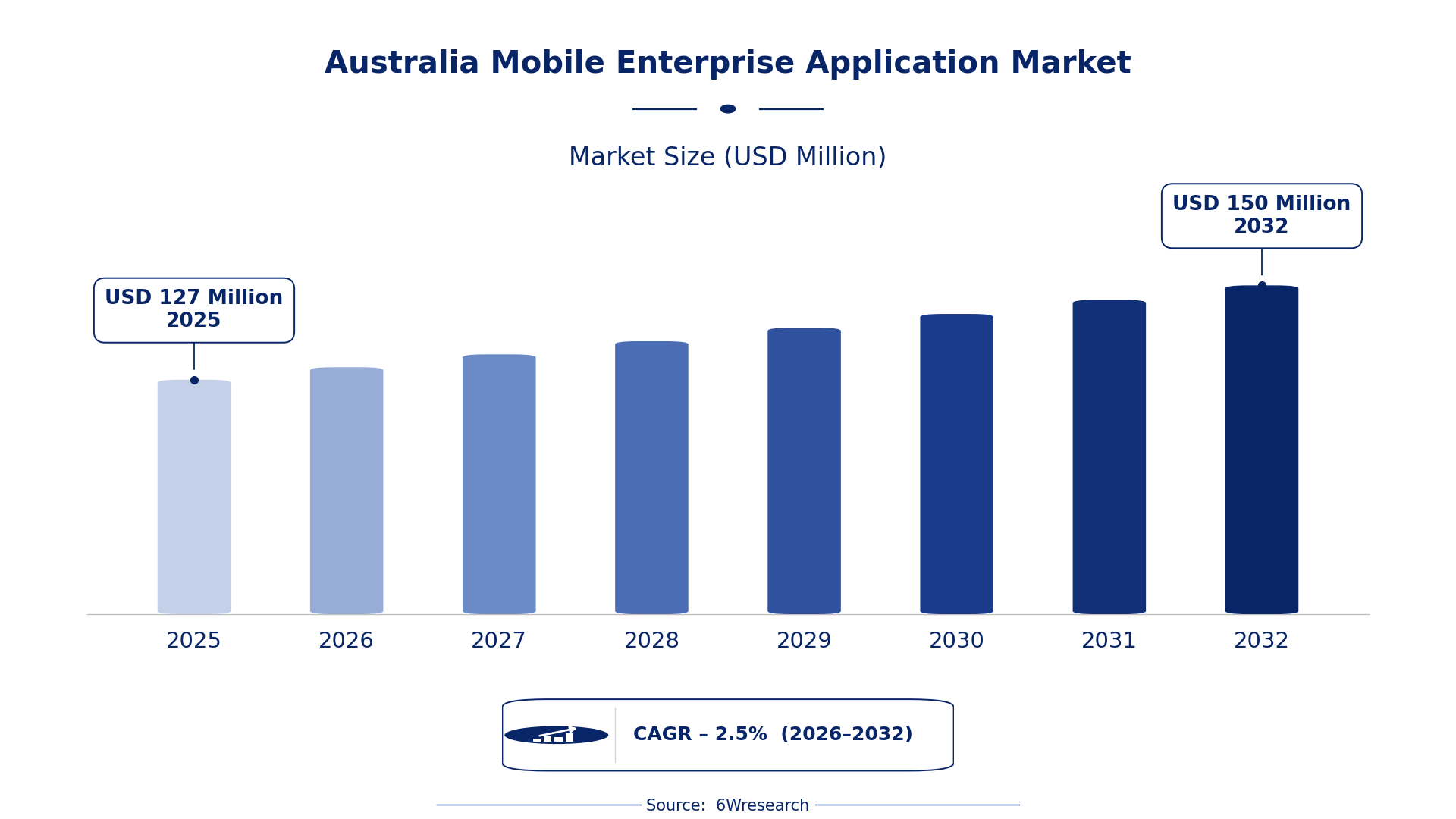
The Australia Mobile Enterprise Application Market was estimated at USD 127 Million in 2025 and is projected to reach USD 150 Million by 2032, growing at a CAGR of 2.5% from 2026 to 2032.
Australia Mobile Enterprise Application Market Synopsis
The surge in digital transformation initiatives within Australian businesses is the most influential factor propelling the mobile enterprise application market. Organizations are increasingly recognizing the need to streamline their operations and boost employee productivity through mobile solutions.
With smartphones and tablets becoming integral to daily business operations, the demand for mobile applications that facilitate secure communication and process automation is on the rise. Nevertheless, challenges surrounding integration with existing legacy systems and concerns over mobile data security persist.
Australia Mobile Enterprise Application Market Year-wise Growth Rate and Key Drivers
This graph illustrates the annual growth rates of the Australia Mobile Enterprise Application Market from 2021 to 2032, highlighting a steady upward trajectory and projected expansion over the forecast period.
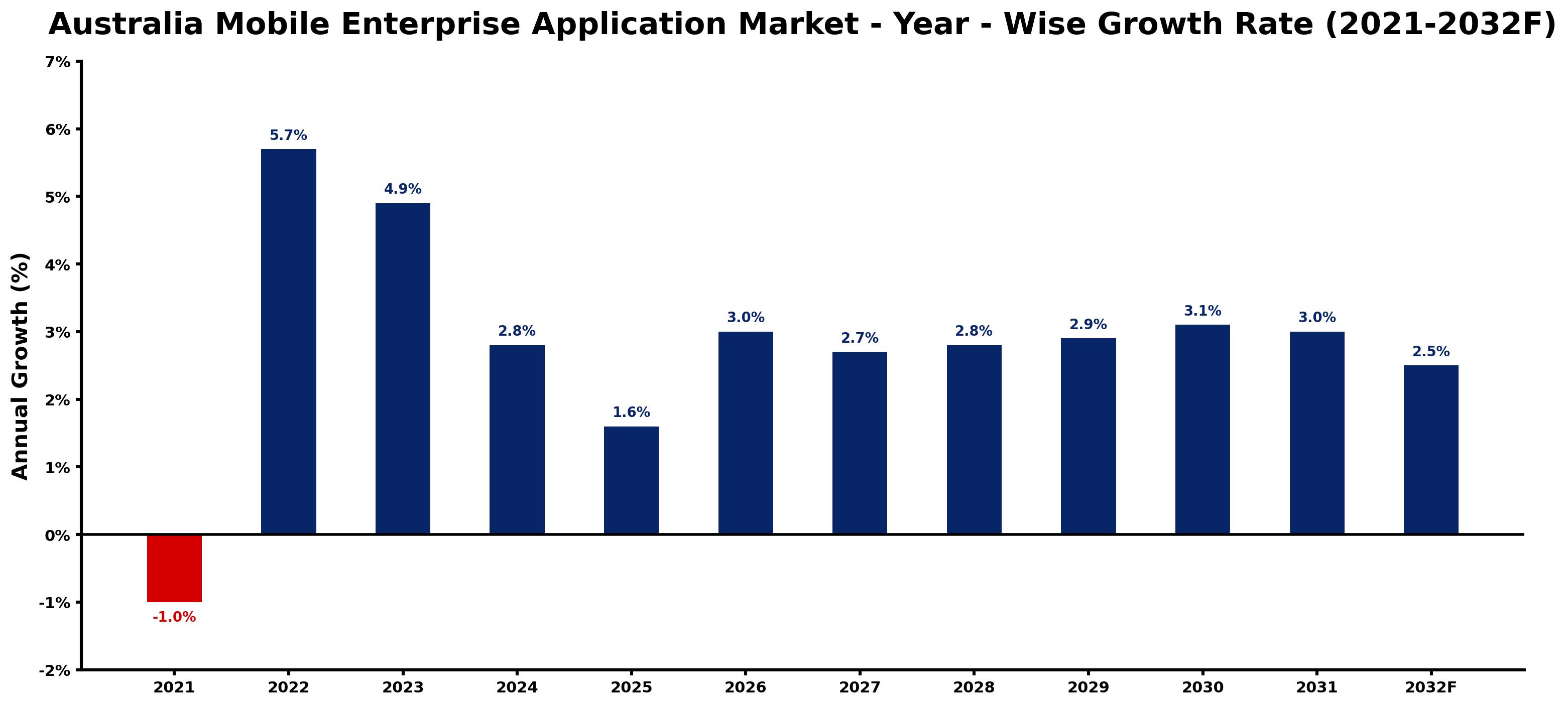
The table below presents the year‑wise growth rates along with the key drivers influencing the market
| Year | Growth Rate | Major Drivers |
| 2021 | -1.0% | COVID-19 lockdowns hampered mobile app adoption |
| 2022 | 5.7% | Government's Digital Economy Strategy boosting mobile technology adoption. |
| 2023 | 4.9% | Increased remote work driving demand for mobile applications. |
| 2024 | 2.8% | Rising smartphone penetration enhancing enterprise mobility solutions. |
| 2025 | 1.6% | Investment in 5G infrastructure improving app performance and usage. |
| 2026 | 3.0% | Growing interest in cloud-based mobile enterprise solutions. |
| 2027 | 2.7% | Rise of digital transformation initiatives in Australian enterprises. |
| 2028 | 2.8% | Emergence of new mobile security regulations enhancing app trust. |
| 2029 | 2.9% | High demand for mobile learning solutions in workforce training. |
| 2030 | 3.1% | Local startups innovating in mobile enterprise application development. |
| 2031 | 3.0% | Focus on customer experience spurring mobile app enhancements. |
| 2032 | 2.5% | Sustainable practices encouraging mobile resource management applications. |
Note: Market size estimations and growth projections presented in this report are based on 6Wresearch's proprietary forecasting methodology, utilizing the latest available industry data, government publications, and primary research inputs.
Australia Mobile Enterprise Application Market Key Takeaways
Below are some of the specific key takeaways from the market, including:
- Cloud-based and AI-driven mobile enterprise applications are gaining traction across various industries.
- Businesses are prioritizing security measures to mitigate risks associated with mobile data transmission.
- Investment in user interface enhancement is crucial to meet the growing expectations of workforce mobility.
- Integration challenges with legacy systems continue to hinder rapid adoption rates.
- The rising shift towards remote work solutions is creating additional demand for mobile enterprise applications.
Evaluation of Restraints in Australia Mobile Enterprise Application Market
Despite its growth potential, the Australia Mobile Enterprise Application Market faces tangible constraints. High development costs present a substantial barrier for many organizations looking to adopt mobile solutions. Additionally, integrating these new applications with outdated legacy systems complicates the implementation process. Security concerns regarding the integrity of mobile data during transmission further hinder market expansion, as businesses become increasingly cautious about potential breaches. Furthermore, the scarcity of skilled professionals capable of managing and developing advanced mobile applications adds another layer of difficulty for organizations in this sector.
Australia Mobile Enterprise Application Market Trends
Several noteworthy trends are shaping the mobile enterprise application market in Australia. The integration of artificial intelligence and machine learning is enhancing application functionalities, allowing for predictive analytics and improved user experiences. Furthermore, as remote work becomes entrenched in corporate culture, mobile applications are evolving to facilitate collaboration among distributed teams. Additionally, the emphasis on mobile data security is compelling developers to incorporate advanced encryption and authentication measures into their applications, driving innovation in security technologies.
Australia Mobile Enterprise Application Market Opportunities
Opportunities abound in the mobile enterprise application market as businesses seek to harness new technologies. The demand for secure, cloud-based applications presents a significant investment opportunity. Companies focusing on enhancing user interfaces to improve employee engagement and productivity will also find growth potential. Additionally, expanding into niche enterprise markets that require specialized applications can offer lucrative prospects for forward-thinking developers. Organizations that prioritize integration capabilities with existing systems will likely gain a competitive edge.
Government Initiatives in the Australia Mobile Enterprise Application Market
Government policy in Australia plays a significant role in shaping the mobile enterprise application market. Current regulations prioritize data protection and security, which is crucial for maintaining trust in mobile solutions. The government also supports innovation through various incentives aimed at encouraging local app development, contributing to a more competitive environment.
- A national digital infrastructure upgrade programme that began its rollout in early 2023 aims to enhance telecommunications access for businesses across Australia.
- Currently ongoing is the R&D Tax Incentive program, designed to support mobile application development and spur innovation among local technology firms.
- A regulatory framework introduced in 2025 mandates strict data protection measures for enterprise applications, ensuring higher levels of security.
- Planned initiatives include a public-private partnership aimed at expanding mobile network coverage in remote regions by 2027.
- In 2024, the Telecommunications Act was amended to reduce import tariffs on mobile development tools, fostering a more competitive development landscape.
Future Insights of the Australia Mobile Enterprise Application Market
Looking ahead to 2026-2032, the Australia Mobile Enterprise Application Market is expected to experience steady growth as companies continue to adopt mobile technologies. The ongoing emphasis on digital transformation will fuel demand for mobile applications that enhance productivity and operational efficiency. Furthermore, as security measures are strengthened, businesses may feel more confident in implementing mobile solutions. Companies that can innovate quickly and adapt to changing user expectations are likely to thrive in this evolving environment.
Australia Mobile Enterprise Application Market Latest Developments
Recent months have shown a notable uptick in activity within the Australia Mobile Enterprise Application Market. Companies are increasingly focused on integrating advanced technologies into their mobile solutions to meet the growing needs of businesses. The push for improved security and user experience is shaping a dynamic competitive environment.
- A new AI-powered mobile application designed for project management was launched in Q1 2025, aimed at enhancing team collaboration.
- An initiative that began in early 2025 focuses on upgrading existing enterprise applications to integrate advanced security features.
- A partnership established in late 2024 between a local tech firm and a global software company is currently underway, aiming to develop a suite of mobile applications tailored to healthcare providers.
- By mid-2025, an upcoming service upgrade is expected to roll out, enhancing user interface capabilities across several leading enterprise applications.
- In Q3 2024, a major technology vendor announced plans to expand their mobile application development team in Australia, aiming to increase their market share.
Australia Mobile Enterprise Application Market - Key Attractiveness of the Report
- 10 Years of Market Numbers
- Historical Data Starting from 2022 to 2025
- Base Year: 2025
- Forecast Data until 2032
- Key Performance Indicators Impacting the Market
- Major Upcoming Developments and Projects
The government is promoting mobile app development through the R&D Tax Incentive program and has introduced regulations to ensure data protection and security for enterprise applications.
Key Highlights of the Report:
- Australia Mobile Enterprise Application Market Outlook
- Market Size of Australia Mobile Enterprise Application Market, 2025
- Forecast of Australia Mobile Enterprise Application Market, 2032
- Historical Data and Forecast of Australia Mobile Enterprise Application Revenues & Volume for the Period 2022-2032F
- Australia Mobile Enterprise Application Market Trend Evolution
- Australia Mobile Enterprise Application Market Drivers and Challenges
- Australia Mobile Enterprise Application Price Trends
- Australia Mobile Enterprise Application Porter's Five Forces
- Australia Mobile Enterprise Application Industry Life Cycle
- Historical Data and Forecast of Australia Mobile Enterprise Application Market Revenues & Volume By Software for the Period 2022-2032F
- Historical Data and Forecast of Australia Mobile Enterprise Application Market Revenues & Volume By Accounting and Finance for the Period 2022-2032F
- Historical Data and Forecast of Australia Mobile Enterprise Application Market Revenues & Volume By Enterprise Resource Planning for the Period 2022-2032F
- Historical Data and Forecast of Australia Mobile Enterprise Application Market Revenues & Volume By Communication and Collaboration for the Period 2022-2032F
- Historical Data and Forecast of Australia Mobile Enterprise Application Market Revenues & Volume By Customer Relationship Management for the Period 2022-2032F
- Historical Data and Forecast of Australia Mobile Enterprise Application Market Revenues & Volume By mCommerce for the Period 2022-2032F
- Historical Data and Forecast of Australia Mobile Enterprise Application Market Revenues & Volume By Business Analytics for the Period 2022-2032F
- Historical Data and Forecast of Australia Mobile Enterprise Application Market Revenues & Volume By M Learning for the Period 2022-2032F
- Historical Data and Forecast of Australia Accounting and Finance Mobile Enterprise Application Market Revenues & Volume By Supply Chain Management for the Period 2022-2032F
- Historical Data and Forecast of Australia Mobile Enterprise Application Market Revenues & Volume By Operating System for the Period 2022-2032F
- Historical Data and Forecast of Australia Mobile Enterprise Application Market Revenues & Volume By Android for the Period 2022-2032F
- Historical Data and Forecast of Australia Mobile Enterprise Application Market Revenues & Volume By iOS for the Period 2022-2032F
- Historical Data and Forecast of Australia Mobile Enterprise Application Market Revenues & Volume By Windows for the Period 2022-2032F
- Historical Data and Forecast of Australia Mobile Enterprise Application Market Revenues & Volume By Type of App for the Period 2022-2032F
- Historical Data and Forecast of Australia Mobile Enterprise Application Market Revenues & Volume By Native for the Period 2022-2032F
- Historical Data and Forecast of Australia Mobile Enterprise Application Market Revenues & Volume By Hybrid for the Period 2022-2032F
- Historical Data and Forecast of Australia Mobile Enterprise Application Market Revenues & Volume By Web for the Period 2022-2032F
- Historical Data and Forecast of Australia Mobile Enterprise Application Market Revenues & Volume By Organization Size for the Period 2022-2032F
- Historical Data and Forecast of Australia Mobile Enterprise Application Market Revenues & Volume By Small and Medium Enterprise for the Period 2022-2032F
- Historical Data and Forecast of Australia Mobile Enterprise Application Market Revenues & Volume By Large Enterprise for the Period 2022-2032F
- Historical Data and Forecast of Australia Mobile Enterprise Application Market Revenues & Volume By Industry Vertical for the Period 2022-2032F
- Historical Data and Forecast of Australia Mobile Enterprise Application Market Revenues & Volume By BFSI for the Period 2022-2032F
- Historical Data and Forecast of Australia Mobile Enterprise Application Market Revenues & Volume By Government for the Period 2022-2032F
- Historical Data and Forecast of Australia Mobile Enterprise Application Market Revenues & Volume By Media and Entertainment for the Period 2022-2032F
- Historical Data and Forecast of Australia Mobile Enterprise Application Market Revenues & Volume By Transport and Logistics for the Period 2022-2032F
- Historical Data and Forecast of Australia Mobile Enterprise Application Market Revenues & Volume By Retail for the Period 2022-2032F
- Historical Data and Forecast of Australia Mobile Enterprise Application Market Revenues & Volume By Healthcare and Life Sciences for the Period 2022-2032F
- Historical Data and Forecast of Australia Mobile Enterprise Application Market Revenues & Volume By Education for the Period 2022-2032F
- Historical Data and Forecast of Australia Mobile Enterprise Application Market Revenues & Volume By Manufacturing and Automotive for the Period 2022-2032F
- Australia Mobile Enterprise Application Import Export Trade Statistics
- Market Opportunity Assessment By Software
- Market Opportunity Assessment By Operating System
- Market Opportunity Assessment By Type of App
- Market Opportunity Assessment By Organization Size
- Market Opportunity Assessment By Industry Vertical
- Australia Mobile Enterprise Application Top Companies Market Share
- Australia Mobile Enterprise Application Competitive Benchmarking By Technical and Operational Parameters
- Australia Mobile Enterprise Application Company Profiles
- Australia Mobile Enterprise Application Key Strategic Recommendations






































