Australia Mobile Phone Accessories Market Summary
The australia mobile phone accessories market was estimated at USD 88 Million in 2025 and is projected to reach USD 103 Million by 2032, growing at a CAGR of 2.9% from 2026 to 2032.
Australia Mobile Phone Accessories Market Year-wise Growth Rate and Key Drivers
This graph highlights how the Australia Mobile Phone Accessories Market has steadily grown over the past five years, supported by major growth factors.
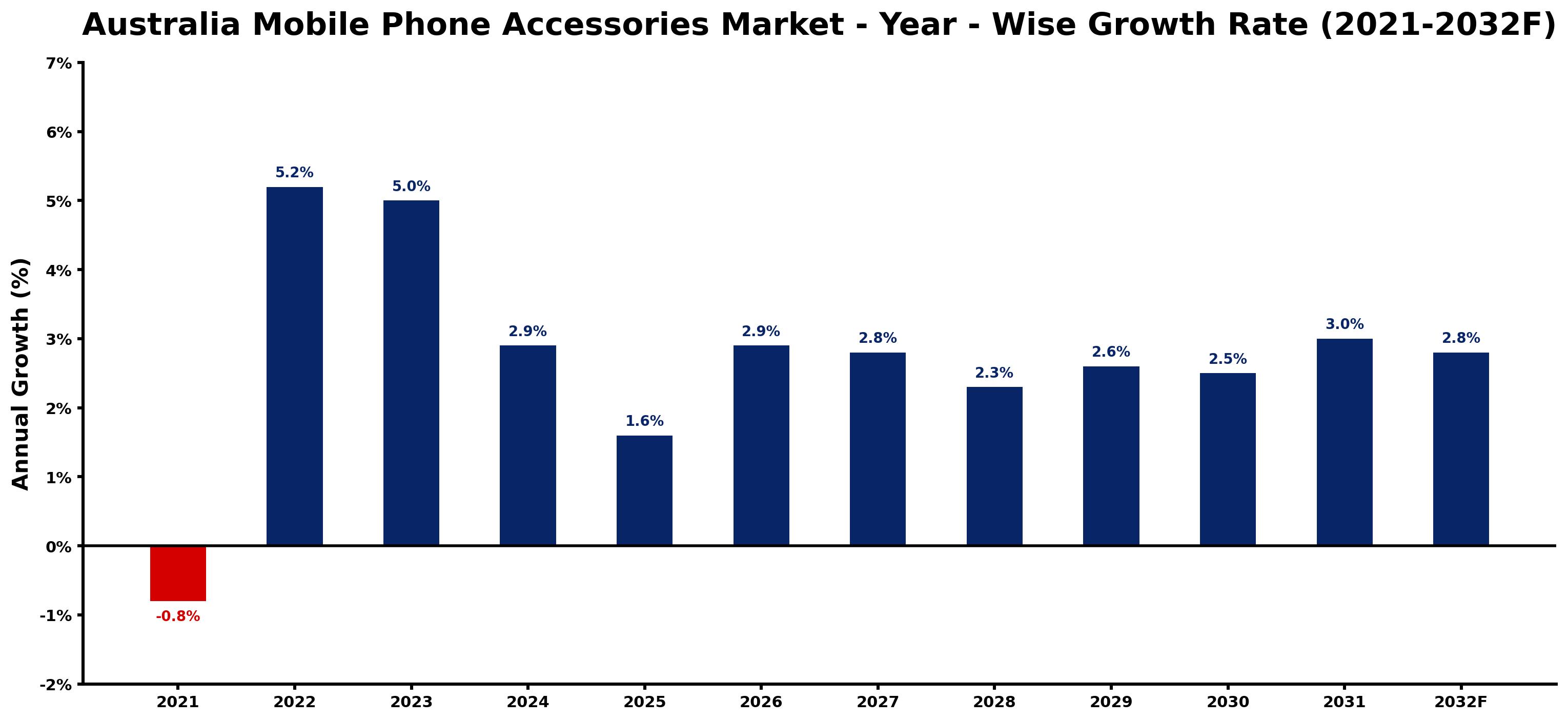
The table below presents the year wise growth rates along with the key drivers influencing the market
| Year | Growth Rate | Major Drivers |
| 2021 | -0.8% | Supply chain disruptions hindered product availability, leading to decreased consumer purchases in the mobile accessories market. |
| 2022 | 5.2% | Smartphone manufacturers launched new models, boosting accessory compatibility demands. |
| 2023 | 5.0% | Consumer preferences shifted towards eco-friendly materials in mobile accessories production. |
| 2024 | 2.9% | Technological innovations enhanced device protection and charging efficiency standards. |
| 2025 | 1.6% | Expansion of 5G networks prompted the need for upgraded accessory functionalities. |
| 2026 | 2.9% | Increased smartphone penetration in rural areas created new accessory market opportunities. |
| 2027 | 2.8% | Emergence of AR and VR applications drove demand for immersive mobile accessories. |
| 2028 | 2.3% | Corporate budgets prioritized digital transformation, increasing accessory customization options. |
| 2029 | 2.6% | Growing interest in wearable technology complemented the mobile accessories market expansion. |
| 2030 | 2.5% | Sustainability trends pushed brands to innovate with biodegradable accessory solutions. |
| 2031 | 3.0% | User-generated content on social media showcased the latest accessory trends and usage. |
| 2032 | 2.8% | Consumer tech literacy improved, elevating expectations for accessory quality and performance. |
Note - Market size estimations and growth projections presented in this report are based on 6Wresearch's advanced forecasting approach, validated with industry datasets as of June 2026.
Australia Mobile Phone Accessories Market Synopsis
The Australia Mobile Phone Accessories Market is projected to reach 2.9% and witness significant growth during the forecast period (2026-2032). The anticipated growth rate of 5.2% CAGR is attributed to several factors, including the increasing adoption of modern technologies by both consumers and enterprises. Furthermore, the rising disposable income among the urban population creates a favorable environment for the expansion of this market, particularly in the demand for high-quality protective cases and innovative accessories. The robust growth of e-commerce platforms is also crucial, providing consumers with diverse options in mobile phone accessories, thereby stimulating market demand.
Australia Mobile Phone Accessories Market Growth Drivers
The growth of the Australia Mobile Phone Accessories Market is driven by multiple factors:
- The widespread adoption of advanced mobile technologies leads to an increased demand for accessories that enhance user experience and device functionality.
- Consumers are increasingly willing to invest in protective cases and accessories that align with their lifestyle needs, prompted by rising disposable incomes.
- The growth of e-commerce platforms allows seamless access to various mobile phone accessories, making it easier for consumers to find and purchase desired products.
- Urbanization contributes significantly to market growth, as a more technology-oriented urban population drives demand for innovative mobile accessories.
- Technological advancements are facilitating the introduction of improved accessory designs that cater to evolving consumer preferences, further bolstering market growth.
Australia Mobile Phone Accessories Market Challenges and Restraints
While the Australia Mobile Phone Accessories Market shows promising growth, several challenges could impede its progress:
- The presence of low-quality counterfeit products in the market creates significant challenges, as these products can undermine consumer trust and deter investment in reputable brands.
- High prices associated with premium accessory brands may restrict market penetration among budget-conscious consumers, limiting overall growth potential.
- Fluctuating economic conditions can impact consumer spending habits, especially in discretionary categories like mobile phone accessories.
- Rapid technological changes can render existing products obsolete, leading to increased pressure on manufacturers to innovate constantly.
- Market saturation in certain product categories may lead to intense competition, potentially causing price wars that could affect profit margins.
Australia Mobile Phone Accessories Market Trends and Opportunities
The Australia Mobile Phone Accessories Market is experiencing notable trends that present opportunities for growth:
- The trend towards sustainability is prompting consumers to seek eco-friendly accessories, pushing manufacturers to explore sustainable materials and production processes.
- Personalization is gaining traction, with consumers expressing a preference for customizable accessories that reflect individual style and preference.
- Health-conscious consumers are increasingly interested in accessories that promote well-being, such as ergonomic cases and fitness tracking devices.
- The integration of smart technology within mobile accessories, such as wireless charging stations and smart wearables, opens numerous opportunities for innovation.
- The rising trend of remote work and online activities has increased demand for accessories that enhance productivity, such as portable chargers and headphones.
Australia Mobile Phone Accessories Market Government Investment and Initiatives
The Australian government has recognized the importance of the mobile accessories market as part of its broader technology and innovation strategy. Various initiatives are aimed at supporting the growth of technology-related sectors, including mobile accessories:
- Investment in digital infrastructure aims to enhance connectivity, which indirectly supports the e-commerce channels through which mobile accessories are sold.
- Government programs promoting research and development in technology encourage innovation in mobile phone accessories, fostering a competitive market landscape.
- Public spending on education and training programs helps to develop a skilled workforce capable of driving advancements in this industry.
- Incentives for startups and tech companies focusing on mobile solutions provide a nurturing environment for creativity and innovation.
- Policy frameworks aimed at combating counterfeit products help to protect consumers and legitimate businesses in the market.
Australia Mobile Phone Accessories Market Latest Developments (May 2025 - June 2026)
Recent developments in the Australia Mobile Phone Accessories Market indicate a dynamic landscape characterized by innovation and responsiveness to consumer demands. Companies are increasingly focusing on product differentiation, introducing new designs that incorporate advanced features aimed at enhancing user experience. Furthermore, there is a noticeable uptick in collaborations between e-commerce platforms and accessory manufacturers, facilitating better market access for a wider range of products. Additionally, growing consumer awareness about the benefits of high-quality accessories is contributing to a shift from generic options to more specialized products tailored to user needs.
Australia Mobile Phone Accessories Market - Key Attractiveness of the Report
- 10 Years of Market Numbers
- Historical Data Starting from 2022 to 2025
- Base Year: 2025
- Forecast Data until 2032
- Key Performance Indicators Impacting the Market
- Major Upcoming Developments and Projects
Key Highlights of the Report:
- Australia Mobile Phone Accessories Market Outlook
- Market Size of Australia Mobile Phone Accessories Market, 2025
- Forecast of Australia Mobile Phone Accessories Market, 2032F
- Historical Data and Forecast of Australia Mobile Phone Accessories Revenues & Volume for the Period 2022-2032F
- Australia Mobile Phone Accessories Market Trend Evolution
- Australia Mobile Phone Accessories Market Drivers and Challenges
- Australia Mobile Phone Accessories Price Trends
- Australia Mobile Phone Accessories Porter's Five Forces
- Australia Mobile Phone Accessories Industry Life Cycle
- Historical Data and Forecast of Australia Mobile Phone Accessories Market Revenues & Volume By Product Type for the Period 2022-2032F
- Historical Data and Forecast of Australia Mobile Phone Accessories Market Revenues & Volume By Earphones/Headphone for the Period 2022-2032F
- Historical Data and Forecast of Australia Mobile Phone Accessories Market Revenues & Volume By Charger for the Period 2022-2032F
- Historical Data and Forecast of Australia Mobile Phone Accessories Market Revenues & Volume By Power Bank for the Period 2022-2032F
- Historical Data and Forecast of Australia Mobile Phone Accessories Market Revenues & Volume By Protective Cases for the Period 2022-2032F
- Historical Data and Forecast of Australia Mobile Phone Accessories Market Revenues & Volume By Others for the Period 2022-2032F
- Historical Data and Forecast of Australia Mobile Phone Accessories Market Revenues & Volume By Distribution Channel for the Period 2022-2032F
- Historical Data and Forecast of Australia Mobile Phone Accessories Market Revenues & Volume By Online for the Period 2022-2032F
- Historical Data and Forecast of Australia Mobile Phone Accessories Market Revenues & Volume By Offline for the Period 2022-2032F
- Historical Data and Forecast of Australia Mobile Phone Accessories Market Revenues & Volume By Price Range for the Period 2022-2032F
- Historical Data and Forecast of Australia Mobile Phone Accessories Market Revenues & Volume By Premium for the Period 2022-2032F
- Historical Data and Forecast of Australia Mobile Phone Accessories Market Revenues & Volume By Mid for the Period 2022-2032F
- Historical Data and Forecast of Australia Mobile Phone Accessories Market Revenues & Volume By Low for the Period 2022-2032F
- Australia Mobile Phone Accessories Import Export Trade Statistics
- Market Opportunity Assessment By Product Type
- Market Opportunity Assessment By Distribution Channel
- Market Opportunity Assessment By Price Range
- Australia Mobile Phone Accessories Top Companies Market Share
- Australia Mobile Phone Accessories Competitive Benchmarking By Technical and Operational Parameters
- Australia Mobile Phone Accessories Company Profiles
- Australia Mobile Phone Accessories Key Strategic Recommendations






































