Australia Mobile Security Market Size & Growth Rate (2026-2032)
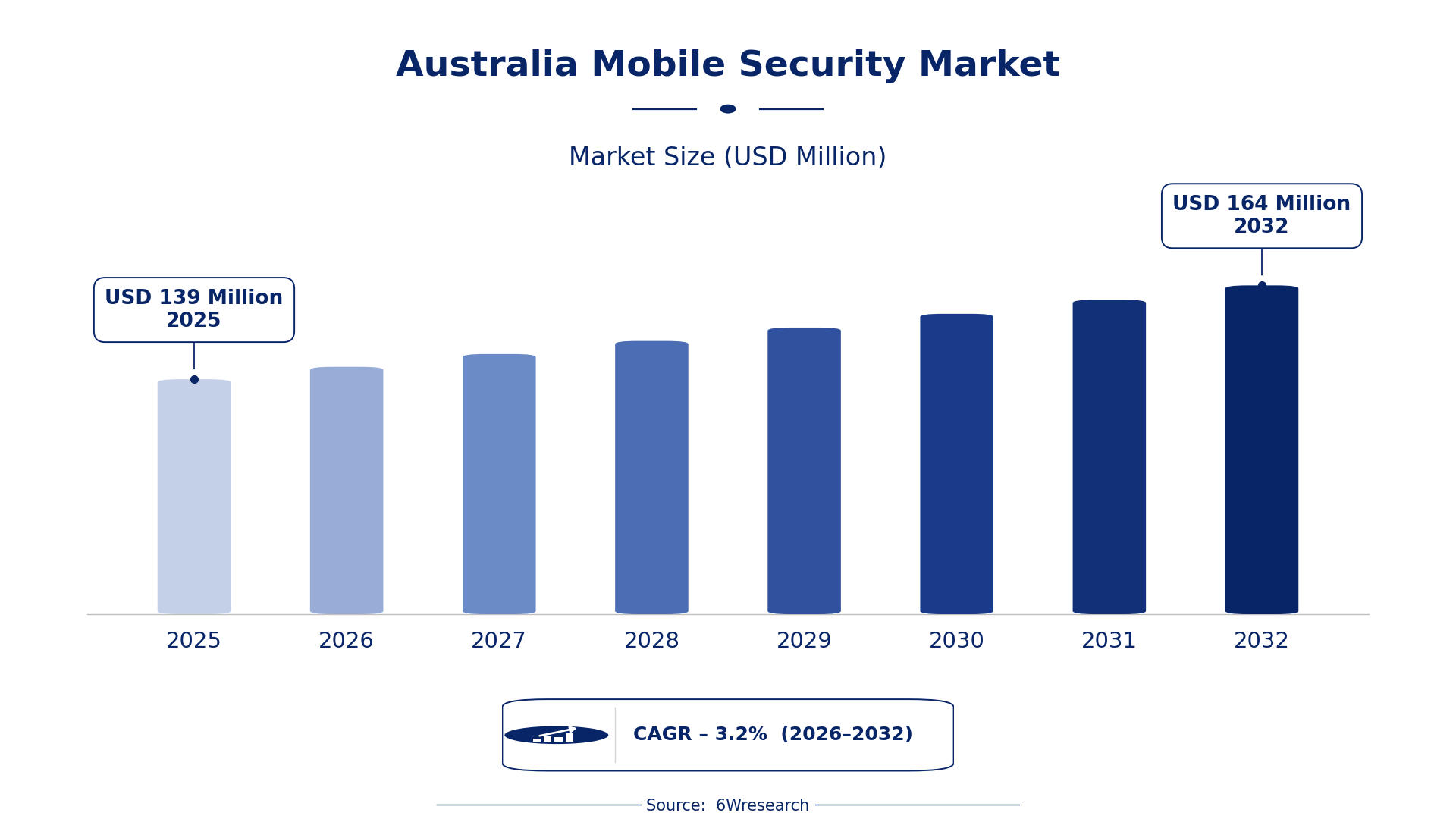
The Australia Mobile Security Market was estimated at USD 139 Million in 2025 and is projected to reach USD 164 Million by 2032, growing at a CAGR of 3.2% from 2026 to 2032.
Australia Mobile Security Market Synopsis
As Australia continues to embrace mobile technology, the demand for robust mobile security solutions has never been higher. Organizations are increasingly turning to endpoint security, mobile device management (MDM), and encryption to safeguard sensitive data from an ever-growing array of cyber threats.
The mobile security landscape is shaped by alarming trends such as rising mobile malware and phishing attacks. These threats are driving both consumer and enterprise investments in advanced security measures. The transition to zero-trust frameworks further emphasizes the need for comprehensive security protocols in mobile communications.
Australia Mobile Security Market Year-wise Growth Rate and Key Drivers
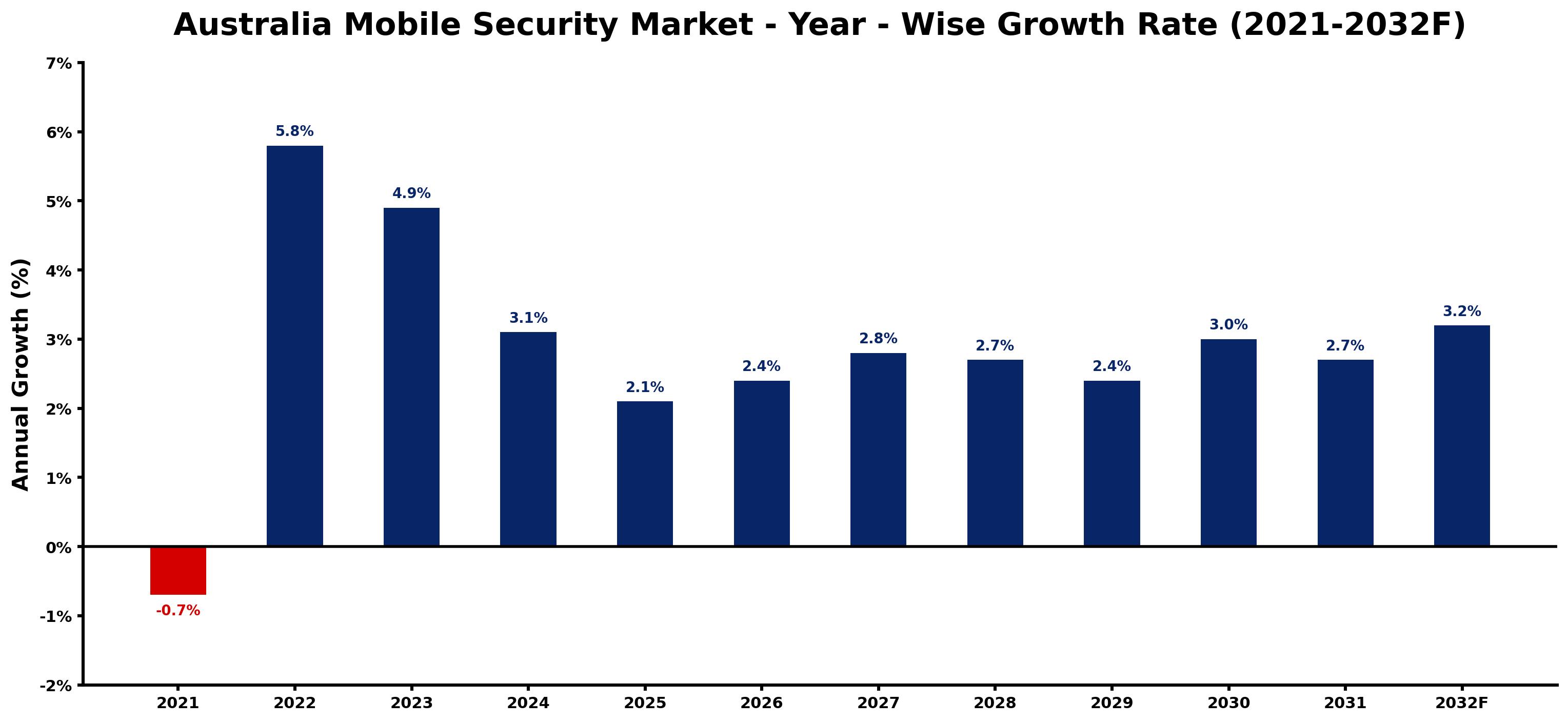
This graph illustrates the annual growth rates of the Australia Mobile Security Market from 2021 to 2032, highlighting a steady upward trajectory and projected expansion over the forecast period.
The table below presents the year‑wise growth rates along with the key drivers influencing the market
| Year | Growth Rate | Major Drivers |
| 2021 | -0.7% | Australian Cyber Security Centre warned about mobile threats. |
| 2022 | 5.8% | Cybersecurity Strategy 2020-2025 promotes mobile security solutions. |
| 2023 | 4.9% | Increased mobile payment adoption drives security demand. |
| 2024 | 3.1% | Rising telehealth services heighten mobile security concerns. |
| 2025 | 2.1% | Strong regulatory compliance for data protection enhances security needs. |
| 2026 | 2.4% | Emergence of 5G technology increases mobile cyber threats. |
| 2027 | 2.8% | Growing remote work generates higher mobile security investments. |
| 2028 | 2.7% | Regulatory updates on personal data protection boost market investments. |
| 2029 | 2.4% | Apple and Google introduce advanced security features in devices. |
| 2030 | 3.0% | Increased mobile app usage necessitates robust security protocols. |
| 2031 | 2.7% | Fast consumer adoption of IoT devices raises mobile vulnerabilities. |
| 2032 | 3.2% | Government initiatives support local cybersecurity start-ups and innovation. |
Note: Market size estimations and growth projections presented in this report are based on 6Wresearch's proprietary forecasting methodology, utilizing the latest available industry data, government publications, and primary research inputs.
Australia Mobile Security Market Key Takeaways
Below are some of the specific key takeaways from the market, including:
- Mobile device penetration in Australia is fueling demand for enhanced security solutions.
- Adoption of zero-trust security frameworks is becoming increasingly commonplace among businesses.
- Rising incidents of data breaches are compelling organizations to invest more in mobile security.
- High implementation costs remain a barrier for some businesses seeking advanced mobile security solutions.
- Opportunities exist for innovative AI-based solutions that improve threat detection and malware protection.
Evaluation of Restraints in Australia Mobile Security Market
The mobile security market in Australia faces hurdles primarily from the increasing sophistication of cyberattacks. As criminals evolve their tactics, organizations often struggle to keep pace. The high costs associated with deploying advanced security measures deter some businesses from making necessary upgrades. on top of that, employee reluctance to adopt complex security protocols can lead to vulnerabilities, hindering overall security posture and market growth.
Australia Mobile Security Market Trends
Current trends include a rising interest in biometric authentication and encryption technologies as users demand stronger protective measures. The proliferation of mobile apps for banking and enterprise functions further amplifies this need. Notably, organizations are increasingly implementing mobile device management solutions to gain centralized control over their security policies and practices. The shift toward cloud-based security solutions also represents a significant trend, offering flexibility and scalability.
Australia Mobile Security Market Opportunities
Genuine growth opportunities lie in the development of AI-driven threat detection systems specifically designed for mobile platforms. The potential for improved malware protection is substantial, especially as mobile usage continues to rise. There is also room for expansion into the enterprise market, where robust security measures are critical. Partnerships with telecom operators and app developers can enhance market reach and foster innovation in mobile security solutions.
Government Initiatives in the Australia Mobile Security Market
Government policies play a crucial role in shaping the mobile security environment in Australia. With regulations such as the Telecommunications Act and the Privacy Act, authorities are actively working to ensure data protection and network security. The government's support for mobile security development, as articulated in the Digital Economy Strategy, demonstrates a commitment to enhancing the security framework across the nation.
- A regulatory framework introduced in 2025 mandates improved data privacy standards for mobile applications.
- A national digital infrastructure upgrade program is currently underway to bolster security across telecommunications networks.
- The Cyber Security Strategy enforces strict compliance standards to combat rising cyber threats.
- A recent initiative in mid-2025 launched funding opportunities for startups focused on mobile security technologies.
- Planned enhancements to the privacy regulations aim to be implemented by 2028, focusing on mobile data encryption.
Future Insights of the Australia Mobile Security Market
Looking ahead to 2026-2032, the Australia Mobile Security Market is set for a steady trajectory of growth. The increasing reliance on mobile devices for personal and business transactions will require ongoing innovation in security technologies. As cyber threats become more advanced, organizations will need to prioritize investments in comprehensive security frameworks, further entrenching mobile security as a core component of their IT strategies. The shift toward AI and machine learning in threat detection will likely transform how security measures are implemented and managed.
Australia Mobile Security Market Latest Developments
In the past 12-14 months, the Australia Mobile Security Market has seen significant advancements as businesses seek to fortify their defenses against increasing cyber threats. With rising awareness regarding data protection, many organizations are prioritizing mobile security initiatives. Key developments include new technology implementations and strategic partnerships aimed at enhancing security protocols.
- A leading technology vendor introduced a comprehensive endpoint security solution in Q3 2025, significantly improving malware protection for mobile devices.
- An ongoing initiative that began in early 2025 focuses on integrating biometric authentication into existing mobile applications.
- A major telecom operator is rolling out enhanced mobile device management features expected to be completed by late 2026.
- A public-private partnership aimed at enhancing mobile security education and resources is currently being developed and will launch in early 2026.
- Plans for a new mobile application security certification program are slated to begin in late 2025.
Australia Mobile Security Market - Key Attractiveness of the Report
- 10 Years of Market Numbers
- Historical Data Starting from 2022 to 2025
- Base Year: 2025
- Forecast Data until 2032
- Key Performance Indicators Impacting the Market
- Major Upcoming Developments and Projects
Key Highlights of the Report:
- Australia Mobile Security Market Outlook
- Market Size of Australia Mobile Security Market, 2025
- Forecast of Australia Mobile Security Market, 2032
- Historical Data and Forecast of Australia Mobile Security Revenues & Volume for the Period 2022-2032F
- Australia Mobile Security Market Trend Evolution
- Australia Mobile Security Market Drivers and Challenges
- Australia Mobile Security Price Trends
- Australia Mobile Security Porter's Five Forces
- Australia Mobile Security Industry Life Cycle
- Historical Data and Forecast of Australia Mobile Security Market Revenues & Volume By End User for the Period 2022-2032F
- Historical Data and Forecast of Australia Mobile Security Market Revenues & Volume By Individual for the Period 2022-2032F
- Historical Data and Forecast of Australia Mobile Security Market Revenues & Volume By Enterprise (Solution (Authentication, Application Security, & Device Security), Service) for the Period 2022-2032F
- Historical Data and Forecast of Australia Mobile Security Market Revenues & Volume By Deployment Mode for the Period 2022-2032F
- Historical Data and Forecast of Australia Mobile Security Market Revenues & Volume By On-premises for the Period 2022-2032F
- Historical Data and Forecast of Australia Mobile Security Market Revenues & Volume By Cloud for the Period 2022-2032F
- Historical Data and Forecast of Australia Mobile Security Market Revenues & Volume By Organization Size for the Period 2022-2032F
- Historical Data and Forecast of Australia Mobile Security Market Revenues & Volume By Small and Medium-Sized Enterprises (SMEs) for the Period 2022-2032F
- Historical Data and Forecast of Australia Mobile Security Market Revenues & Volume By Large Enterprises for the Period 2022-2032F
- Historical Data and Forecast of Australia Mobile Security Market Revenues & Volume By Vertical for the Period 2022-2032F
- Historical Data and Forecast of Australia Mobile Security Market Revenues & Volume By BFSI for the Period 2022-2032F
- Historical Data and Forecast of Australia Mobile Security Market Revenues & Volume By Telecom & IT for the Period 2022-2032F
- Historical Data and Forecast of Australia Mobile Security Market Revenues & Volume By Retail for the Period 2022-2032F
- Historical Data and Forecast of Australia Mobile Security Market Revenues & Volume By Healthcare for the Period 2022-2032F
- Historical Data and Forecast of Australia Mobile Security Market Revenues & Volume By Government & Defense for the Period 2022-2032F
- Historical Data and Forecast of Australia Mobile Security Market Revenues & Volume By Manufacturing for the Period 2022-2032F
- Historical Data and Forecast of Australia Mobile Security Market Revenues & Volume By Others for the Period 2022-2032F
- Historical Data and Forecast of Australia Mobile Security Market Revenues & Volume By Operating System for the Period 2022-2032F
- Historical Data and Forecast of Australia Mobile Security Market Revenues & Volume By iOS for the Period 2022-2032F
- Historical Data and Forecast of Australia Mobile Security Market Revenues & Volume By Android for the Period 2022-2032F
- Australia Mobile Security Import Export Trade Statistics
- Market Opportunity Assessment By End User
- Market Opportunity Assessment By Deployment Mode
- Market Opportunity Assessment By Organization Size
- Market Opportunity Assessment By Vertical
- Market Opportunity Assessment By Operating System
- Australia Mobile Security Top Companies Market Share
- Australia Mobile Security Competitive Benchmarking By Technical and Operational Parameters
- Australia Mobile Security Company Profiles
- Australia Mobile Security Key Strategic Recommendations






































