Australia Molecular Spectroscopy Market Size, Share & Growth Rate
The Australia Molecular Spectroscopy Market was estimated at USD 180 Million in 2025 and is projected to reach USD 209 Million by 2032, growing at a CAGR of 2.2% from 2026 to 2032. This growth trajectory is primarily driven by the increasing adoption of advanced spectroscopic techniques in healthcare, pharmaceuticals, and environmental monitoring. The demand for high-precision instruments is becoming imperative as industries seek to enhance drug discovery processes and ensure food safety through rigorous testing methods.
Australia Molecular Spectroscopy Market Year-wise Growth Rate and Key Drivers
This graph highlights how the Australia Molecular Spectroscopy Market has steadily grown over the years, supported by major growth factors.
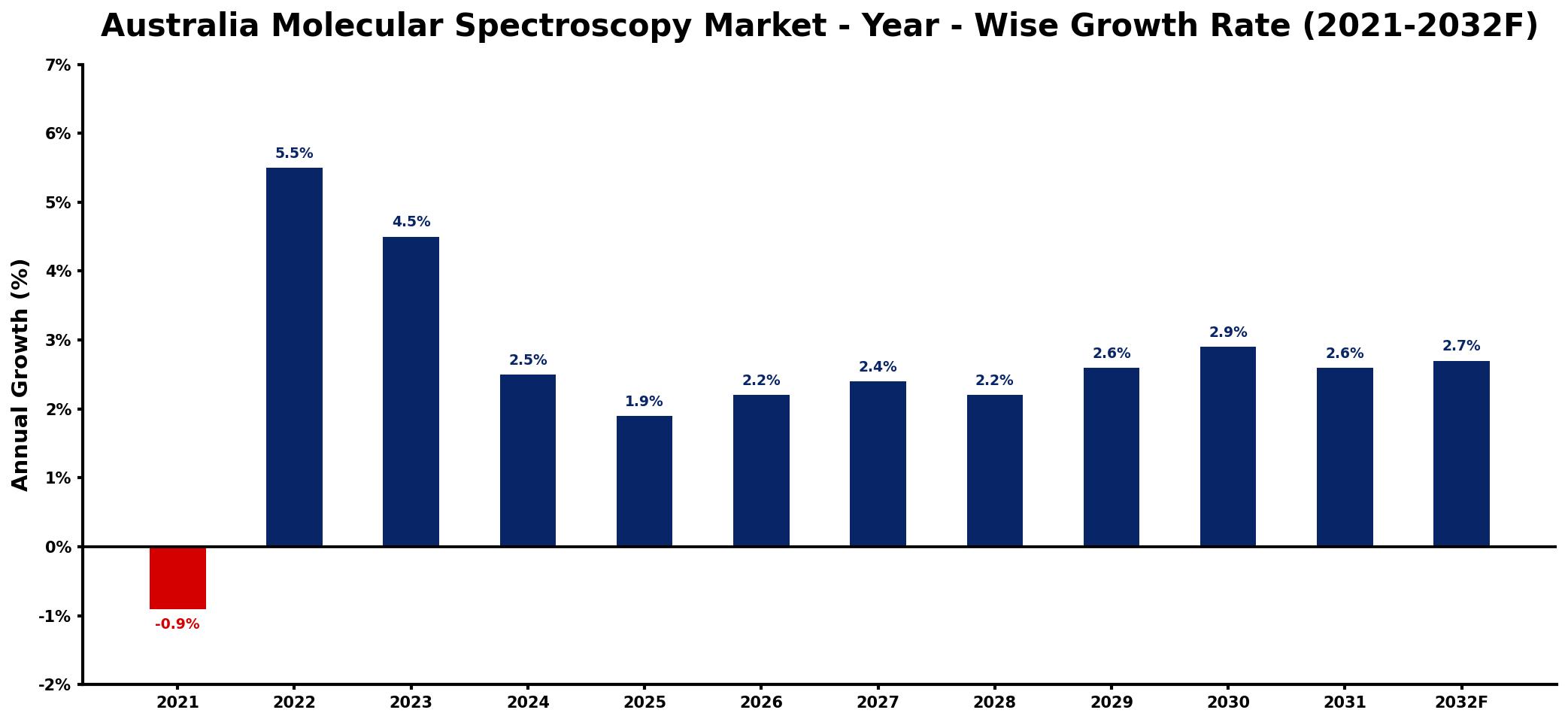
The table below presents the year‑wise growth rates along with the key drivers influencing the market
| Year | Growth Rate | Major Drivers |
| 2021 | -0.9% | decrease in research funding allocation |
| 2022 | 5.5% | increased investments in healthcare technologies |
| 2023 | 4.5% | growing adoption in academic laboratories |
| 2024 | 2.5% | expansion of environmental monitoring applications |
| 2025 | 1.9% | rising demand in pharmaceutical industry |
| 2026 | 2.2% | stronger distribution network expansion |
| 2027 | 2.4% | adoption of advanced analytical techniques |
| 2028 | 2.2% | growth in biotechnology sector applications |
| 2029 | 2.6% | increased collaborations with research institutions |
| 2030 | 2.9% | increased production capacity utilization |
| 2031 | 2.6% | emphasis on regulatory compliance requirements |
| 2032 | 2.7% | growing interest in sustainability practices |
Note: Market size estimations and growth projections presented in this report are based on 6Wresearch's proprietary forecasting methodology, utilizing the latest available industry data, government publications, and primary research inputs.
Australia Molecular Spectroscopy Market Synopsis
The landscape of the molecular spectroscopy market in Australia is rapidly evolving, influenced by technological advancements and the growing need for precise analytical tools. Applications spanning pharmaceuticals, biotechnology, and environmental testing underscore the relevance of this technology in today's scientific endeavors.
Recent innovations in portable and high-resolution spectroscopy systems are paving the way for wider accessibility and utilization across various sectors. As a vital tool for chemical analysis, forensic investigations, and drug discovery, molecular spectroscopy continues to solidify its position as a cornerstone of modern analytical science in Australia.
Australia Molecular Spectroscopy Market Key Takeaways
- The market is poised for steady growth, driven by advancements in spectroscopic technologies.
- Applications in healthcare and environmental monitoring are significantly expanding.
- Investment in portable and AI-driven solutions is reshaping the competitive landscape.
- Regulatory frameworks are in place to ensure quality and accuracy in spectroscopic analyses.
- Challenges related to costs and skilled workforce remain prominent but manageable.
Evaluation of Restraints in Australia Molecular Spectroscopy Market
Despite the growth potential, the Australia Molecular Spectroscopy Market faces several constraints. The high costs associated with advanced analytical instruments often deter smaller laboratories and industries from adopting these technologies. This limitation is compounded by the reliance on imported equipment and spare parts, which inflate market prices. Moreover, competition from alternative analytical techniques can dilute demand, presenting an additional challenge for stakeholders. The need for specialized training to operate sophisticated instruments further complicates the landscape, as finding skilled personnel can be difficult and resource-intensive.
Australia Molecular Spectroscopy Market Trends
Several trends are currently shaping the Australian molecular spectroscopy landscape. The integration of artificial intelligence into spectroscopy solutions is a game changer, providing improved accuracy and efficiency in data analysis. Furthermore, there is a noticeable shift towards portable systems, allowing for field analysis and real-time data acquisition, which is particularly beneficial in environmental applications. These trends highlight an industry moving towards greater convenience and technological sophistication, addressing the needs of various sectors.
Australia Molecular Spectroscopy Market Opportunities
Opportunities within the Australia Molecular Spectroscopy Market are plentiful, particularly in pharmaceuticals and biotechnology sectors where precision analysis is critical. The ongoing push for innovation in analytical instrumentation presents a lucrative avenue for investment. Government funding dedicated to scientific research and quality control initiatives serves as a catalyst for market expansion, enticing businesses to develop and market high-performance spectroscopy solutions tailored to meet these rising demands.
Government Initiatives in the Australia Molecular Spectroscopy Market
The Australian government actively regulates the molecular spectroscopy market through comprehensive policies aimed at ensuring laboratory safety and analytical accuracy. Compliance with metrology standards is mandatory for laboratory equipment, particularly within pharmaceuticals and environmental monitoring. These regulations ensure that imported spectroscopic equipment meets stringent local certification standards, thereby maintaining high quality and reliability. Furthermore, various government research grants are available, promoting innovation in molecular spectroscopy technologies tailored for medical diagnostics and material analysis.
Future Insights of the Australia Molecular Spectroscopy Market
Looking ahead to the period from 2026 to 2032, the Australia Molecular Spectroscopy Market is anticipated to continue its upward trajectory. The persistent demand for precision in chemical analysis, combined with the rapid advancements in technology, will drive further adoption across multiple industries. The ongoing emphasis on regulatory compliance and the need for sophisticated analytical solutions in healthcare will bolster market growth. As companies focus on developing innovative spectroscopy solutions, Australia will likely see a transformation in how molecular analysis is approached in both research and practical applications.
Australia Molecular Spectroscopy Market Latest Developments (2025 - 2026)
Recent months have witnessed significant industry direction, with a notable emphasis on integrating AI technologies into spectroscopy systems. This integration enhances the analytical capabilities and operational efficiencies of these devices. Additionally, the market has seen increased collaboration between public institutions and private firms aimed at driving innovation in spectroscopy techniques, paving the way for new applications in environmental monitoring and pharmaceuticals.
Australia Molecular Spectroscopy Market - Key Attractiveness of the Report
- 10 Years of Market Numbers
- Historical Data Starting from 2022 to 2025
- Base Year: 2025
- Forecast Data until 2032
- Key Performance Indicators Impacting the Market
- Major Upcoming Developments and Projects
Key Highlights of the Report:
- Australia Molecular Spectroscopy Market Outlook
- Market Size of Australia Molecular Spectroscopy Market, 2025
- Forecast of Australia Molecular Spectroscopy Market, 2032
- Historical Data and Forecast of Australia Molecular Spectroscopy Revenues & Volume for the Period 2022-2032F
- Australia Molecular Spectroscopy Market Trend Evolution
- Australia Molecular Spectroscopy Market Drivers and Challenges
- Australia Molecular Spectroscopy Price Trends
- Australia Molecular Spectroscopy Porter's Five Forces
- Australia Molecular Spectroscopy Industry Life Cycle
- Historical Data and Forecast of Australia Molecular Spectroscopy Market Revenues & Volume By Type of Spectroscopy for the Period 2022-2032F
- Historical Data and Forecast of Australia Molecular Spectroscopy Market Revenues & Volume By NMR Spectroscopy for the Period 2022-2032F
- Historical Data and Forecast of Australia Molecular Spectroscopy Market Revenues & Volume By Raman Spectroscopy for the Period 2022-2032F
- Historical Data and Forecast of Australia Molecular Spectroscopy Market Revenues & Volume By UV-visible Spectroscopy for the Period 2022-2032F
- Historical Data and Forecast of Australia Molecular Spectroscopy Market Revenues & Volume By Mass Spectroscopy for the Period 2022-2032F
- Historical Data and Forecast of Australia Molecular Spectroscopy Market Revenues & Volume By Infrared Spectroscopy for the Period 2022-2032F
- Historical Data and Forecast of Australia Molecular Spectroscopy Market Revenues & Volume By Near-infrared Spectroscopy for the Period 2022-2032F
- Historical Data and Forecast of Australia Molecular Spectroscopy Market Revenues & Volume By Others for the Period 2022-2032F
- Historical Data and Forecast of Australia Molecular Spectroscopy Market Revenues & Volume By Application for the Period 2022-2032F
- Historical Data and Forecast of Australia Molecular Spectroscopy Market Revenues & Volume By Pharmaceutical Applications for the Period 2022-2032F
- Historical Data and Forecast of Australia Molecular Spectroscopy Market Revenues & Volume By Food and Beverage Testing for the Period 2022-2032F
- Historical Data and Forecast of Australia Molecular Spectroscopy Market Revenues & Volume By Biotechnology and Biopharmaceutical Applications for the Period 2022-2032F
- Historical Data and Forecast of Australia Molecular Spectroscopy Market Revenues & Volume By Environmental Testing for the Period 2022-2032F
- Historical Data and Forecast of Australia Molecular Spectroscopy Market Revenues & Volume By Academic Research for the Period 2022-2032F
- Historical Data and Forecast of Australia Molecular Spectroscopy Market Revenues & Volume By Other for the Period 2022-2032F
- Australia Molecular Spectroscopy Import Export Trade Statistics
- Market Opportunity Assessment By Type of Spectroscopy
- Market Opportunity Assessment By Application
- Australia Molecular Spectroscopy Top Companies Market Share
- Australia Molecular Spectroscopy Competitive Benchmarking By Technical and Operational Parameters
- Australia Molecular Spectroscopy Company Profiles
- Australia Molecular Spectroscopy Key Strategic Recommendations






































