Australia Mortar Market Summary
The australia mortar market was estimated at USD 116 Million in 2025 and is projected to reach USD 136 Million by 2032, growing at a CAGR of 2.7% from 2026 to 2032.
Australia Mortar Market Year-wise Growth Rate and Key Drivers
This graph highlights how the Australia Mortar Market has steadily grown over the past five years, supported by major growth factors.
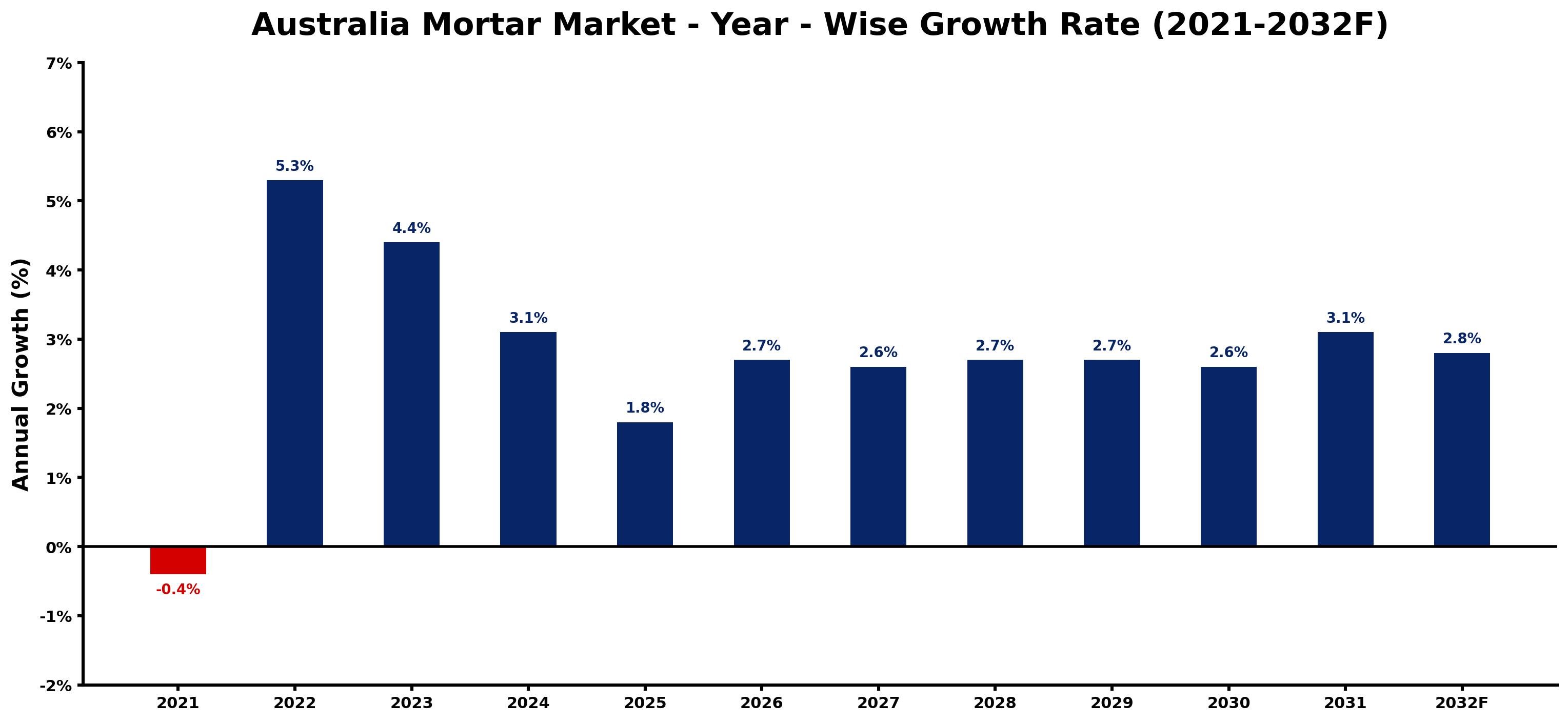
The table below presents the year wise growth rates along with the key drivers influencing the market
| Year | Growth Rate | Major Drivers |
| 2021 | -0.4% | Increased competition from alternative building materials diminished market demand for traditional mortar products. |
| 2022 | 5.3% | Sustainability trends prompted manufacturers to innovate eco-friendly mortar formulations for construction. |
| 2023 | 4.4% | Urbanization in major cities has intensified, increasing the need for high-quality mortar solutions. |
| 2024 | 3.1% | Infrastructure investments aimed at public transport improvements have accelerated the mortar market's expansion. |
| 2025 | 1.8% | Emerging technologies in construction materials have enhanced mortar performance and application efficiency. |
| 2026 | 2.7% | Increasing awareness of building resilience against natural disasters influences premium mortar product uptake. |
| 2027 | 2.6% | Digital construction tools streamline procurement processes, facilitating faster mortar sourcing for projects. |
| 2028 | 2.7% | Rural development initiatives are spurring demand for mortars tailored for local climatic conditions. |
| 2029 | 2.7% | Collaborations between suppliers and contractors improve mortar accessibility and foster market growth. |
| 2030 | 2.6% | An influx of foreign investments in construction is set to elevate mortar market dynamics. |
| 2031 | 3.1% | Focus on retrofitting existing structures drives demand for specialized mortar applications and solutions. |
| 2032 | 2.8% | Competition among manufacturers results in innovations that enhance mortar strength and durability. |
Note - Market size estimations and growth projections presented in this report are based on 6Wresearch's advanced forecasting approach, validated with industry datasets as of June 2026.
Australia Mortar Market Synopsis
The Australia Mortar Market is projected to reach 2.7% and witness significant growth during the forecast period (2026-2032). The market's trajectory is intrinsically linked to the broader construction industry, which includes various sectors such as residential, commercial, and infrastructure projects. The increasing emphasis on sustainability in building materials is driving innovations in fast-drying and eco-friendly mortar solutions, reshaping the landscape of the industry.
Australia Mortar Market Growth Drivers
The growth of the Australia Mortar Market is primarily driven by several key factors:
- Robust construction activity: The continuous growth in the construction sector, fueled by infrastructure development and residential housing projects, significantly enhances the demand for mortar products.
- Efficiencies through ready-mix solutions: There is an increasing preference for ready-mix mortar, which streamlines construction processes by reducing labor costs and enhancing overall efficiency.
- Sustainability initiatives: The construction industry's shift toward sustainable practices is encouraging the adoption of eco-friendly mortar formulations, which are less harmful to the environment.
- Technological advancements: Innovations in mortar technology, including faster setting times and improved formulations, are appealing to construction companies seeking competitive advantages.
- Government infrastructure investment: Increased public spending on infrastructure projects elevates the overall demand for high-quality mortar products.
Australia Mortar Market Challenges and Restraints
Despite its growth potential, the Australia Mortar Market faces several challenges that could impede development:
- Raw material price volatility: Fluctuating prices of key raw materials such as cement and sand, often influenced by global supply chain disruptions, pose a risk to production costs.
- Regulatory compliance: Stricter construction regulations and quality control standards can lead to increased production expenses, impacting market competitiveness.
- Competition from alternative materials: The growing adoption of prefabricated concrete and alternative construction materials could divert demand away from traditional mortar products.
- Technological investment: The shift towards dry mortar solutions over traditional mixes requires significant technological advancements, demanding resource investment from manufacturers.
- Market maturity: The saturation of certain segments may limit growth opportunities, necessitating differentiation through innovation and quality.
Australia Mortar Market Investment Opportunities
Investment opportunities in the Australia Mortar Market are promising, especially in light of the current construction boom. Key areas of potential include:
- Pre-mixed mortars: Investing in pre-mixed and specialty mortar solutions can attract customers looking to improve construction efficiency and reduce on-site labor.
- Innovative formulations: Companies that develop fast-setting and eco-friendly mortar products are likely to capture significant market share amidst changing consumer preferences.
- Research and development: Allocating resources towards R&D activities can enhance product offerings, allowing businesses to stay competitive and meet evolving market demands.
- Sustainability focus: Engaging in practices that promote sustainability will provide businesses with a competitive edge, aligning with government and private sector initiatives.
- Partnership opportunities: Collaborating with construction firms and government agencies can enhance market access and foster growth in various segments of the market.
Australia Mortar Market Government Investment and Initiatives
Government policies and initiatives play a pivotal role in shaping the Australia Mortar Market. Key aspects include:
- Quality standards enforcement: The government enforces regulations that ensure the safety and durability of construction materials, including mortar, fostering industry-wide compliance.
- Support for innovation: Initiatives designed to promote eco-friendly and high-performance mortar products align with the broader sustainability goals of the construction sector.
- Infrastructure development plans: Long-term government commitments to infrastructure projects provide a steady stream of demand for mortar and related construction materials.
- Public spending increases: A focus on public construction projects is likely to result in increased funding and investments, thereby bolstering the mortar market.
- Trade regulations: Government policies regulating the import and export of raw materials help stabilize the supply chain, ensuring consistent availability of essential inputs.
Australia Mortar Market Latest Developments (May 2025 - June 2026)
Recent developments within the Australia Mortar Market have indicated a decisive shift towards sustainability and innovation. The industry is witnessing a notable increase in the adoption of eco-friendly mortar formulations as companies respond to consumer demand for environmentally responsible construction materials. Innovations in product technology have also emerged, with a focus on faster setting times and improved performance. Additionally, there is a palpable sense of optimism surrounding infrastructure spending, driven by government initiatives aimed at bolstering the construction sector. This period has also seen ongoing enhancements in supply chain management, addressing previous disruptions and stabilizing raw material availability.
Australia Mortar Market - Key Attractiveness of the Report
- 10 Years of Market Numbers
- Historical Data Starting from 2022 to 2025
- Base Year: 2025
- Forecast Data until 2032
- Key Performance Indicators Impacting the Market
- Major Upcoming Developments and Projects
Key Highlights of the Report:
- Australia Mortar Market Outlook
- Market Size of Australia Mortar Market, 2025
- Forecast of Australia Mortar Market, 2032
- Historical Data and Forecast of Australia Mortar Revenues & Volume for the Period 2022-2032F
- Australia Mortar Market Trend Evolution
- Australia Mortar Market Drivers and Challenges
- Australia Mortar Price Trends
- Australia Mortar Porter's Five Forces
- Australia Mortar Industry Life Cycle
- Historical Data and Forecast of Australia Mortar Market Revenues & Volume By Type for the Period 2022-2032F
- Historical Data and Forecast of Australia Mortar Market Revenues & Volume By Wet Mixed Mortar for the Period 2022-2032F
- Historical Data and Forecast of Australia Mortar Market Revenues & Volume By Dry Mortar for the Period 2022-2032F
- Historical Data and Forecast of Australia Mortar Market Revenues & Volume By Application for the Period 2022-2032F
- Historical Data and Forecast of Australia Mortar Market Revenues & Volume By Construction Industry for the Period 2022-2032F
- Historical Data and Forecast of Australia Mortar Market Revenues & Volume By Home Decoration Industry for the Period 2022-2032F
- Historical Data and Forecast of Australia Mortar Market Revenues & Volume By Others for the Period 2022-2032F
- Australia Mortar Import Export Trade Statistics
- Market Opportunity Assessment By Type
- Market Opportunity Assessment By Application
- Australia Mortar Top Companies Market Share
- Australia Mortar Competitive Benchmarking By Technical and Operational Parameters
- Australia Mortar Company Profiles
- Australia Mortar Key Strategic Recommendations






































