Australia Motorcycle Saddle Market Size, Share & Growth Rate
The Australia Motorcycle Saddle Market was estimated at USD 183 Million in 2025 and is projected to reach USD 215 Million by 2032, growing at a CAGR of 2.3% from 2026 to 2032. This growth trajectory is driven by the increasing number of motorcycle enthusiasts and a growing interest in long-distance and adventure riding, necessitating high-quality, comfortable saddles. Furthermore, the demand for customization is influencing manufacturers to innovate, catering to riders who are looking for personalized seating solutions.
Australia Motorcycle Saddle Market Year-wise Growth Rate and Key Drivers
This graph highlights how the Australia Motorcycle Saddle Market has steadily grown over the years, supported by major growth factors.
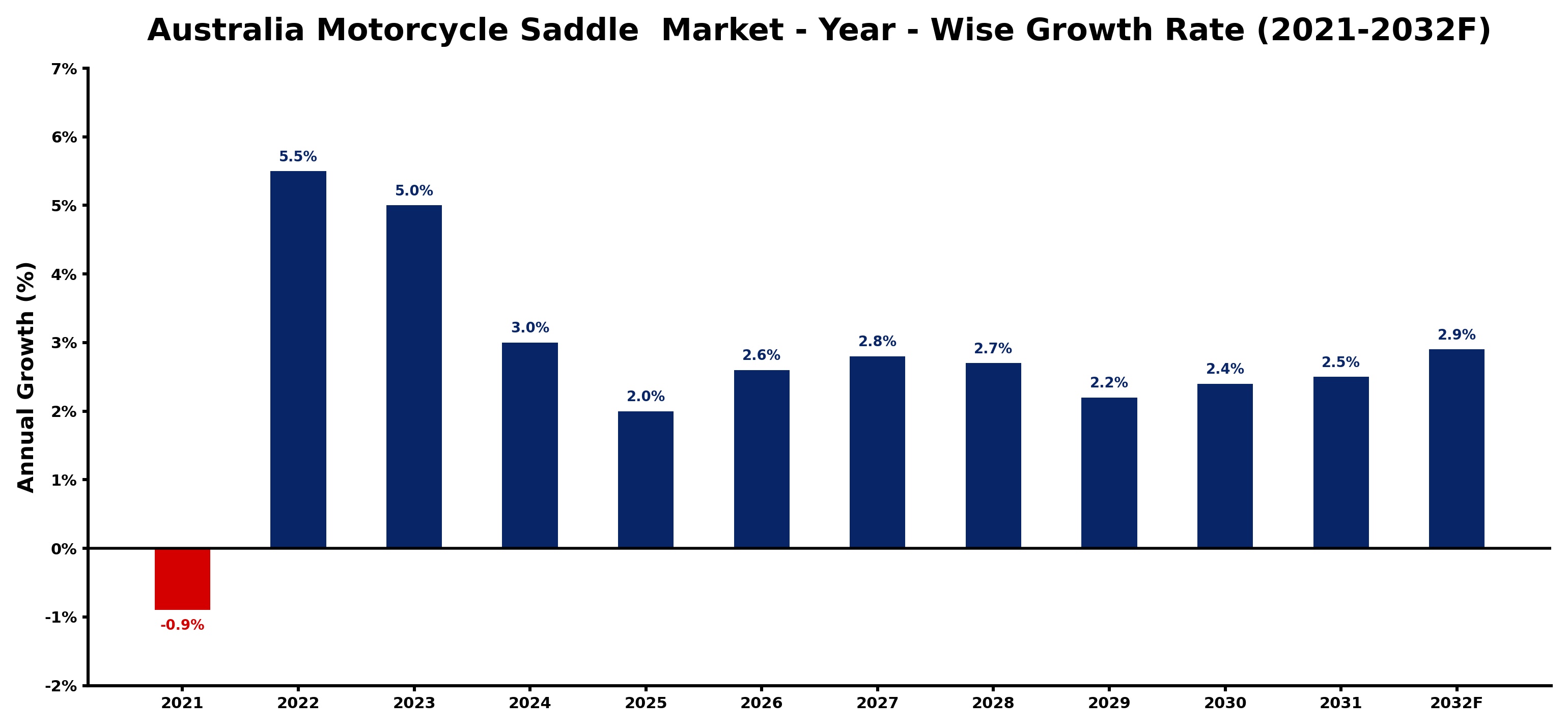
The table below presents the year‑wise growth rates along with the key drivers influencing the market
| Year | Growth Rate | Major Drivers |
| 2021 | -0.9% | Decreased mining sector investments reduced demand for motorcycle components |
| 2022 | 5.5% | Export driven mining sector demands tailored motorcycle saddle solutions |
| 2023 | 5.0% | Increased mining activity drives demand for durable motorcycle saddles |
| 2024 | 3.0% | Domestic mining equipment maintenance boosted demand for custom saddles |
| 2025 | 2.0% | Mining sector investments boost motorcycle saddle aftermarket demand |
| 2026 | 2.6% | Export driven demand for rugged motorcycle seats boosts manufacturing investments |
| 2027 | 2.8% | Mining sector recovery drives demand for heavy duty motorcycle saddles |
| 2028 | 2.7% | Mining sector expansions boost aftermarket motorcycle saddle production efficiency |
| 2029 | 2.2% | Technology integration in aftermarket services enhances saddle production efficiency |
| 2030 | 2.4% | Mining sector investments drive custom motorcycle saddle production expansion |
| 2031 | 2.5% | Advanced manufacturing investments boost motorcycle saddle production capabilities |
| 2032 | 2.9% | Improved mining sector equipment maintenance drives saddle production increases |
Note - Market size estimations and growth projections presented in this report are based on 6Wresearch’s advanced forecasting approach, validated with industry datasets as of June 2026.
Australia Motorcycle Saddle Market Synopsis
The Australian motorcycle saddle market is experiencing a notable shift towards ergonomic and custom-designed products. With the rise in motorcycling for both commuting and leisure, there's an increasing consumer preference for durable saddles that promise comfort over extended rides.
In addition, innovative materials such as gel-infused and memory foam saddles are gaining traction, responding to the demands of riders looking for enhanced comfort. However, local manufacturers face stiff competition from low-cost imports, which complicates their market positioning.
Australia Motorcycle Saddle Market Key Takeaways
- Growing demand for high-quality motorcycle saddles, especially for long-distance riding.
- Increased interest in ergonomic and weather-resistant designs among Australian motorcyclists.
- Competition from low-cost imports is challenging local manufacturers to innovate.
- Rising trend toward customization, with consumers willing to invest in premium saddles.
- Government regulations emphasize safety, durability, and sustainable materials in saddle manufacturing.
Evaluation of Restraints in Australia Motorcycle Saddle Market
The motorcycle saddle market in Australia is currently navigating various constraints that could limit its potential. One significant restraint is the volatility of raw material prices, particularly for premium materials like leather and high-quality synthetics, which can impact manufacturing costs. Additionally, while customization is a key demand driver, the associated costs can be a deterrent for some consumers. This necessitates a delicate balance between innovation and affordability. Moreover, the influx of international brands offering competitive pricing introduces further challenges, compelling local manufacturers to reassess their pricing strategies and value propositions.
Australia Motorcycle Saddle Market Trends
The current landscape of the Australian motorcycle saddle market is shaped by several notable trends. There's a significant push towards sustainable materials as eco-conscious consumers demand products that align with their values. Additionally, advancements in manufacturing technology enable the creation of lighter, more durable saddles that enhance riding experience. The customization trend continues to grow, as riders look for unique designs and features that reflect their personal style, driving manufacturers to innovate. Furthermore, as electric motorcycles gain popularity, the development of compatible saddle designs has become increasingly important.
Australia Motorcycle Saddle Market Opportunities
Investment opportunities abound in the Australian motorcycle saddle market. There is a distinct niche for ergonomic saddle design that prioritizes comfort on longer rides, attracting enthusiasts willing to pay a premium. Collaborations with motorcycle manufacturers present avenues for innovation, allowing for integrated saddle designs tailored specifically to new motorcycle models. Additionally, the handcrafted saddle segment is poised for growth, appealing to a demographic that values artisanal quality and customization.
Government Initiatives in the Australia Motorcycle Saddle Market
The Australian government plays a crucial role in shaping the motorcycle saddle market through various regulations and policies. Standards for ergonomic design and durability are mandated to ensure rider safety and comfort. Additionally, initiatives encouraging the use of sustainable materials aim to promote eco-friendly manufacturing practices. Trade regulations further ensure that imported products comply with national safety standards, which helps maintain a level playing field for local manufacturers.
Future Insights of the Australia Motorcycle Saddle Market
Looking forward to the period between 2026 and 2032, the Australia motorcycle saddle market is set to expand in response to evolving consumer preferences and technological advancements. The increasing inclination toward electric motorcycles will challenge manufacturers to adapt to new designs and materials. Moreover, as riders increasingly prioritize comfort and customization, companies that invest in innovative designs and premium materials stand to gain significant market share. This shift towards personalization will likely redefine the competitive landscape, fostering a dynamic and responsive marketplace.
Australia Motorcycle Saddle Market Latest Developments (May 2025 - June 2026)
Recent developments in the Australian motorcycle saddle market indicate a strong focus on innovation and customization. Manufacturers are increasingly leveraging technology to enhance product design, ensuring saddles meet evolving consumer needs for both comfort and aesthetics. Additionally, collaborations with local motorcycle brands are on the rise, enhancing product offerings and expanding market reach. The emphasis on sustainability continues to grow, leading companies to explore eco-friendly materials in their production processes, aligning with the broader industry shift toward responsible manufacturing.
Australia Motorcycle Saddle Market - Key Attractiveness of the Report
- 10 Years of Market Numbers
- Historical Data Starting from 2022 to 2025
- Base Year: 2025
- Forecast Data until 2032
- Key Performance Indicators Impacting the Market
- Major Upcoming Developments and Projects
Key Highlights of the Report:
- Australia Motorcycle Saddle Market Outlook
- Market Size of Australia Motorcycle Saddle Market, 2025
- Forecast of Australia Motorcycle Saddle Market, 2032
- Historical Data and Forecast of Australia Motorcycle Saddle Revenues & Volume for the Period 2022-2032F
- Australia Motorcycle Saddle Market Trend Evolution
- Australia Motorcycle Saddle Market Drivers and Challenges
- Australia Motorcycle Saddle Price Trends
- Australia Motorcycle Saddle Porter's Five Forces
- Australia Motorcycle Saddle Industry Life Cycle
- Historical Data and Forecast of Australia Motorcycle Saddle Market Revenues & Volume By Type for the Period 2022-2032F
- Historical Data and Forecast of Australia Motorcycle Saddle Market Revenues & Volume By Foam Seat for the Period 2022-2032F
- Historical Data and Forecast of Australia Motorcycle Saddle Market Revenues & Volume By Gel Seat for the Period 2022-2032F
- Historical Data and Forecast of Australia Motorcycle Saddle Market Revenues & Volume By Application for the Period 2022-2032F
- Historical Data and Forecast of Australia Motorcycle Saddle Market Revenues & Volume By OEM for the Period 2022-2032F
- Historical Data and Forecast of Australia Motorcycle Saddle Market Revenues & Volume By Aftermarket for the Period 2022-2032F
- Australia Motorcycle Saddle Import Export Trade Statistics
- Market Opportunity Assessment By Type
- Market Opportunity Assessment By Application
- Australia Motorcycle Saddle Top Companies Market Share
- Australia Motorcycle Saddle Competitive Benchmarking By Technical and Operational Parameters
- Australia Motorcycle Saddle Company Profiles
- Australia Motorcycle Saddle Key Strategic Recommendations






































