Australia Music Recording Market Size, Share & Growth Rate
The Australia Music Recording Market was estimated at USD 175 Million in 2025 and is projected to reach USD 207 Million by 2032, growing at a CAGR of 2.4% from 2026 to 2032. This growth trajectory is underpinned by the continued rise of digital streaming platforms, which are reshaping how artists distribute their music. Additionally, the increasing engagement of independent artists in the recording space is fostering a dynamic market environment, encouraging investment in modern recording technologies and studio services.
Australia Music Recording Market Year-wise Growth Rate and Key Drivers
This graph highlights how the Australia Music Recording Market has steadily grown over the years, supported by major growth factors.
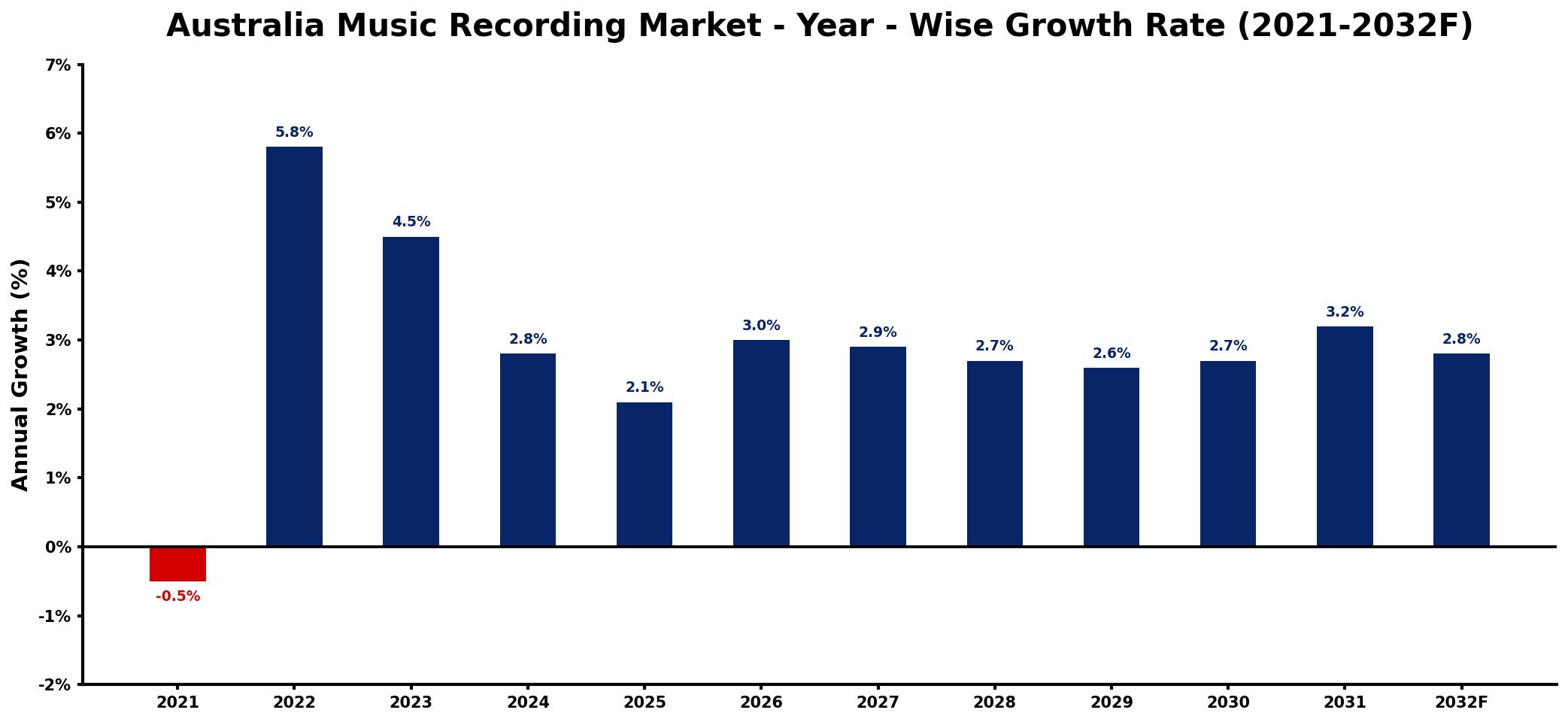
The table below presents the year‑wise growth rates along with the key drivers influencing the market
| Year | Growth Rate | Major Drivers |
| 2021 | -0.5% | reduced consumer spending on entertainment |
| 2022 | 5.8% | increased streaming subscription services |
| 2023 | 4.5% | growing popularity of live events |
| 2024 | 2.8% | expansion of digital distribution platforms |
| 2025 | 2.1% | rise in independent artist investments |
| 2026 | 3.0% | enhanced technology for content creation |
| 2027 | 2.9% | growing global collaboration opportunities |
| 2028 | 2.7% | increased focus on local talent |
| 2029 | 2.6% | emerging trends in genre fusion |
| 2030 | 2.7% | growing commercial sector adoption |
| 2031 | 3.2% | increased international market access |
| 2032 | 2.8% | growing demand for immersive experiences |
Note: Market size estimations and growth projections presented in this report are based on 6Wresearch's proprietary forecasting methodology, utilizing the latest available industry data, government publications, and primary research inputs.
Australia Music Recording Market Synopsis
Recent years have seen a robust adaptation within the Australian music recording industry, transitioning from traditional sales towards a digital-first paradigm. While physical album sales have plummeted, the flourishing digital landscape is facilitating new opportunities for artists and producers alike.
Looking ahead, the market is expected to continue this shift, driven largely by independent musicians who are leveraging online platforms for distribution. Government support and a vibrant festival scene are also pivotal in nurturing local talent, ensuring that the industry remains buoyant despite ongoing challenges.
Australia Music Recording Market Key Takeaways
- The transition to digital platforms has created a thriving environment for independent artists.
- Government initiatives bolster industry growth and protect artist rights through effective copyright laws.
- Demand for professional recording studios remains steady as home-based production rises.
- Music festivals contribute significantly to market expansion and artist visibility.
- Investment opportunities are emerging in digital music platforms and international licensing agreements.
Evaluation of Restraints in Australia Music Recording Market
The Australia Music Recording Market faces notable restraints stemming primarily from the decline of physical album sales, as streaming services dominate consumer preferences. This shift is forcing many artists to forgo traditional recording studios, opting instead for home-based production setups, which can impact the revenue streams of established studios. Furthermore, issues such as music piracy continue to challenge market players by undermining revenue potentials, while reduced monetization opportunities from streaming services further complicate the landscape.
Australia Music Recording Market Trends
A key trend shaping the Australia Music Recording Market is the rapid growth of user-generated content platforms, where artists are increasingly harnessing social media and video platforms to promote their music. As podcasts gain popularity, recording studios are also adapting their services to accommodate this new demand. Furthermore, technological advancements in recording equipment are empowering a greater number of home-based producers, ultimately democratizing music production.
Australia Music Recording Market Opportunities
The future appears promising for those willing to invest in the Australia Music Recording Market. Significant growth opportunities lie in enhancing digital music platforms and expanding recording studio services that cater to both traditional and independent artists. Additionally, exploring licensing agreements for international distribution will open up new revenue streams, while collaborations with local festivals can further elevate artist exposure and market presence.
Government Initiatives in the Australia Music Recording Market
The Australian government plays a vital role in fostering the music recording sector through supportive policies and funding programs. The Australian Copyright Act ensures the protection of artists intellectual property rights, allowing them fair compensation for their work. Various grants, notably from the Australia Council for the Arts and Screen Australia, are designed to promote the production and distribution of local music, underscoring the governments commitment to nurturing homegrown talent.
Future Insights of the Australia Music Recording Market
From 2026 to 2032, the Australia Music Recording Market is expected to navigate a landscape increasingly defined by digital engagement and innovative production technologies. As independent artists continue to thrive, the demand for high-quality recording services and cutting-edge equipment will likely remain strong. This digital transformation will pave the way for enhanced consumer experiences, driving growth through new music consumption patterns.
Australia Music Recording Market Latest Developments (2025 - 2026)
Recent developments in the Australia Music Recording Market have highlighted a surge in independent artist collaborations with local recording studios, reflecting the ongoing shift towards personalized music production. Additionally, the growing popularity of digital festivals and virtual performances has opened new avenues for artists to showcase their work while reaching broader audiences. Industry stakeholders are increasingly focusing on enhancing digital distribution channels to better serve this evolving market.
Australia Music Recording Market - Key Attractiveness of the Report
- 10 Years of Market Numbers
- Historical Data Starting from 2022 to 2025
- Base Year: 2025
- Forecast Data until 2032
- Key Performance Indicators Impacting the Market
- Major Upcoming Developments and Projects
Key Highlights of the Report:
- Australia Music Recording Market Outlook
- Market Size of Australia Music Recording Market, 2025
- Forecast of Australia Music Recording Market, 2032
- Historical Data and Forecast of Australia Music Recording Revenues & Volume for the Period 2022-2032F
- Australia Music Recording Market Trend Evolution
- Australia Music Recording Market Drivers and Challenges
- Australia Music Recording Price Trends
- Australia Music Recording Porter's Five Forces
- Australia Music Recording Industry Life Cycle
- Historical Data and Forecast of Australia Music Recording Market Revenues & Volume By Type for the Period 2022-2032F
- Historical Data and Forecast of Australia Music Recording Market Revenues & Volume By Record Production for the Period 2022-2032F
- Historical Data and Forecast of Australia Music Recording Market Revenues & Volume By Music Publishers for the Period 2022-2032F
- Historical Data and Forecast of Australia Music Recording Market Revenues & Volume By Record Distribution for the Period 2022-2032F
- Historical Data and Forecast of Australia Music Recording Market Revenues & Volume By Sound Recording Studios for the Period 2022-2032F
- Historical Data and Forecast of Australia Music Recording Market Revenues & Volume By Application for the Period 2022-2032F
- Historical Data and Forecast of Australia Music Recording Market Revenues & Volume By Mechanical for the Period 2022-2032F
- Historical Data and Forecast of Australia Music Recording Market Revenues & Volume By Performance for the Period 2022-2032F
- Historical Data and Forecast of Australia Music Recording Market Revenues & Volume By Synchronization for the Period 2022-2032F
- Historical Data and Forecast of Australia Music Recording Market Revenues & Volume By Digital for the Period 2022-2032F
- Historical Data and Forecast of Australia Music Recording Market Revenues & Volume By Others for the Period 2022-2032F
- Historical Data and Forecast of Australia Music Recording Market Revenues & Volume By End-User for the Period 2022-2032F
- Historical Data and Forecast of Australia Music Recording Market Revenues & Volume By Individual for the Period 2022-2032F
- Historical Data and Forecast of Australia Music Recording Market Revenues & Volume By Commercial for the Period 2022-2032F
- Historical Data and Forecast of Australia Music Recording Market Revenues & Volume By Genre for the Period 2022-2032F
- Historical Data and Forecast of Australia Music Recording Market Revenues & Volume By Rock for the Period 2022-2032F
- Historical Data and Forecast of Australia Music Recording Market Revenues & Volume By Hip Hop for the Period 2022-2032F
- Historical Data and Forecast of Australia Music Recording Market Revenues & Volume By Pop for the Period 2022-2032F
- Historical Data and Forecast of Australia Music Recording Market Revenues & Volume By Jazz for the Period 2022-2032F
- Historical Data and Forecast of Australia Music Recording Market Revenues & Volume By Others for the Period 2022-2032F
- Australia Music Recording Import Export Trade Statistics
- Market Opportunity Assessment By Type
- Market Opportunity Assessment By Application
- Market Opportunity Assessment By End-User
- Market Opportunity Assessment By Genre
- Australia Music Recording Top Companies Market Share
- Australia Music Recording Competitive Benchmarking By Technical and Operational Parameters
- Australia Music Recording Company Profiles
- Australia Music Recording Key Strategic Recommendations






































