Australia Nail Gun Market Size, Share & Growth Rate
The Australia Nail Gun Market was estimated at USD 485 Million in 2025 and is projected to reach USD 662 Million by 2032, growing at a CAGR of 4.5% from 2026 to 2032. This growth trajectory is primarily fueled by the escalating construction activities across the nation, particularly in residential and commercial sectors. As builders and contractors increasingly adopt nail guns for their efficiency and productivity, advancements in battery technology and ergonomic designs continue to enhance market appeal.
Australia Nail Gun Market Year-wise Growth Rate and Key Drivers
This graph highlights how the Australia Nail Gun Market has steadily grown over the years, supported by major growth factors.
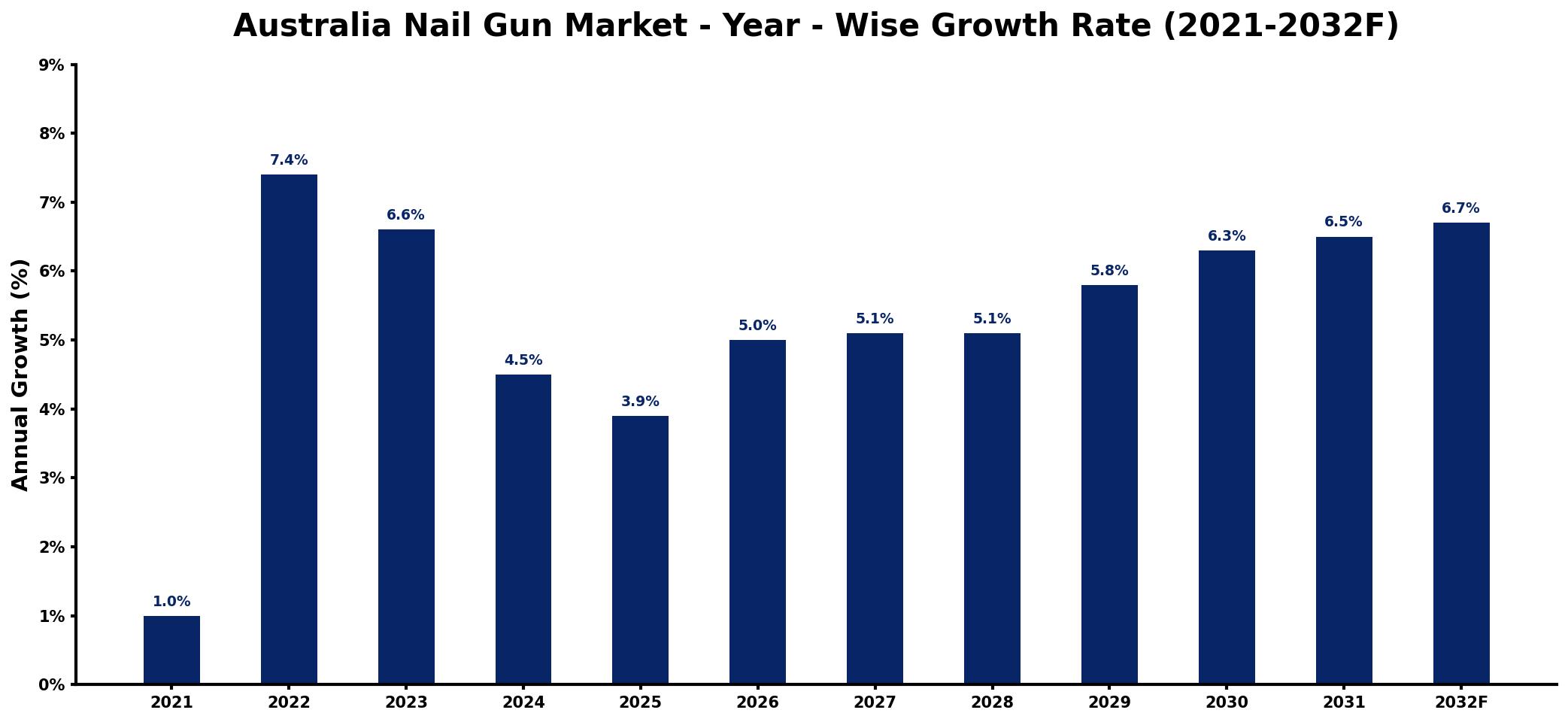
The table below presents the year‑wise growth rates along with the key drivers influencing the market
| Year | Growth Rate | Major Drivers |
| 2021 | 1.0% | Rising construction sector investments |
| 2022 | 7.4% | Increased DIY home improvement projects |
| 2023 | 6.6% | Growing demand from renovation markets |
| 2024 | 4.5% | Expansion of commercial construction activities |
| 2025 | 3.9% | Surge in infrastructure development projects |
| 2026 | 5.0% | Higher adoption of automated tools |
| 2027 | 5.1% | Increased focus on energy efficiency |
| 2028 | 5.1% | Growing popularity of prefabricated structures |
| 2029 | 5.8% | Investments in residential housing projects |
| 2030 | 6.3% | Emergence of advanced building materials |
| 2031 | 6.5% | Strengthening of manufacturing capabilities |
| 2032 | 6.7% | Rising trends in sustainable construction |
Note: Market size estimations and growth projections presented in this report are based on 6Wresearch's proprietary forecasting methodology, utilizing the latest available industry data, government publications, and primary research inputs.
Australia Nail Gun Market Synopsis
The most significant force shaping the Australia Nail Gun Market today is the surge in construction activities. Driven by an expanding housing market and infrastructure projects, the demand for efficient fastening tools has increased, leading to heightened usage of nail guns in framing, roofing, and cabinetry work.
Moreover, the growing acceptance of both cordless and pneumatic nail guns has contributed to market dynamism. These innovations not only improve usability but also enhance safety features, thereby aligning with regulatory standards and addressing workplace safety concerns.
Australia Nail Gun Market Key Takeaways
- The growing construction and woodworking industries are primary demand drivers for nail guns in Australia.
- Technological advancements, including improved battery life and safety features, are reshaping the market landscape.
- Investment opportunities exist in developing lightweight and eco-friendly nail gun models.
- Distribution channel expansion and partnerships with contractors can significantly enhance market reach.
- Government initiatives support local manufacturers and maintain safety standards, ensuring market competitiveness.
Evaluation of Restraints in Australia Nail Gun Market
Despite its promising growth, the Australia Nail Gun Market faces notable challenges. Intense competition from low-cost imports puts pressure on domestic manufacturers, potentially impacting their market share. Additionally, fluctuating raw material prices create uncertainty, complicating the pricing strategies of local manufacturers. Limited domestic production capacity further constrains growth, as many businesses rely on imported products to meet demand.
Australia Nail Gun Market Trends
Current trends in the Australia Nail Gun Market indicate a significant shift towards battery-operated models, reflecting the industrys move towards cordless solutions. These models offer superior portability and convenience, appealing to a broad range of end-users. Furthermore, there is an increasing emphasis on integrating smart technologies, such as safety sensors and battery monitoring systems, which enhance user experience and safety.
Australia Nail Gun Market Opportunities
The market presents ample investment opportunities, particularly in innovation-driven niches. Companies can capitalize on the demand for lightweight, high-performance nail guns that cater to the growing emphasis on ergonomics in tool design. Additionally, introducing sustainable, eco-friendly models can meet the evolving preferences of environmentally conscious consumers. Strengthening distribution networks through partnerships with major hardware retailers also represents a strategic avenue for market penetration.
Government Initiatives in the Australia Nail Gun Market
The Australian government plays a pivotal role in shaping the nail gun market through various initiatives. Regulatory frameworks, such as the Australian Consumer Law, establish crucial safety and quality standards for power tools. Additionally, low import tariffs on nail guns promote competitive pricing within the market. The government also provides support for local manufacturers via small business grants and tax incentives for investments in advanced manufacturing technologies, fostering innovation and growth.
Future Insights of the Australia Nail Gun Market
Looking ahead, the Australia Nail Gun Market is poised for sustained growth from 2026 to 2032. As construction projects continue to proliferate, the demand for efficient and reliable fastening tools will remain robust. Moreover, ongoing technological innovations, such as improved safety features and battery efficiency, will likely become critical differentiators in the market. The emphasis on safety, combined with government support for local manufacturing, will ensure a competitive environment that encourages further advancements.
Australia Nail Gun Market Latest Developments (2025 - 2026)
Recent developments in the Australia Nail Gun Market indicate a shift towards enhanced safety features and smarter designs. Manufacturers are increasingly incorporating technology that monitors usage and battery life, creating a safer user experience. Furthermore, there is a noticeable trend towards more eco-friendly production methods, aligning with global sustainability goals. Partnerships between manufacturers and construction companies are also on the rise, aimed at improving market accessibility and product education.
Australia Nail Gun Market - Key Attractiveness of the Report
- 10 Years of Market Numbers
- Historical Data Starting from 2022 to 2025
- Base Year: 2025
- Forecast Data until 2032
- Key Performance Indicators Impacting the Market
- Major Upcoming Developments and Projects
Key Highlights of the Report:
- Australia Nail Gun Market Outlook
- Market Size of Australia Nail Gun Market, 2025
- Forecast of Australia Nail Gun Market, 2032
- Historical Data and Forecast of Australia Nail Gun Revenues & Volume for the Period 2022-2032F
- Australia Nail Gun Market Trend Evolution
- Australia Nail Gun Market Drivers and Challenges
- Australia Nail Gun Price Trends
- Australia Nail Gun Porter's Five Forces
- Australia Nail Gun Industry Life Cycle
- Historical Data and Forecast of Australia Nail Gun Market Revenues & Volume By Product Type for the Period 2022-2032F
- Historical Data and Forecast of Australia Nail Gun Market Revenues & Volume By Pneumatic Nail Gun for the Period 2022-2032F
- Historical Data and Forecast of Australia Nail Gun Market Revenues & Volume By Combustion Powered Nail Gun for the Period 2022-2032F
- Historical Data and Forecast of Australia Nail Gun Market Revenues & Volume By Electric Nail Gun for the Period 2022-2032F
- Historical Data and Forecast of Australia Nail Gun Market Revenues & Volume By others for the Period 2022-2032F
- Historical Data and Forecast of Australia Nail Gun Market Revenues & Volume By Application for the Period 2022-2032F
- Historical Data and Forecast of Australia Nail Gun Market Revenues & Volume By Construction Engineering for the Period 2022-2032F
- Historical Data and Forecast of Australia Nail Gun Market Revenues & Volume By Residential Decoration for the Period 2022-2032F
- Australia Nail Gun Import Export Trade Statistics
- Market Opportunity Assessment By Product Type
- Market Opportunity Assessment By Application
- Australia Nail Gun Top Companies Market Share
- Australia Nail Gun Competitive Benchmarking By Technical and Operational Parameters
- Australia Nail Gun Company Profiles
- Australia Nail Gun Key Strategic Recommendations






































