Australia Network Slicing Market Size, Share & Growth Rate
The Australia Network Slicing Market was estimated at USD 189 Million in 2025 and is projected to reach USD 221 Million by 2032, growing at a CAGR of 2.3% from 2026 to 2032. This growth is primarily driven by the increasing demand for tailored connectivity solutions across various industries, as organizations recognize the value of dedicated virtual networks. Moreover, advancements in 5G technology are pivotal, enabling telecom operators to efficiently deliver these customized services while improving operational efficiency.
Australia Network Slicing Market Year-wise Growth Rate and Key Drivers
This graph highlights how the Australia Network Slicing Market has steadily grown over the years, supported by major growth factors.
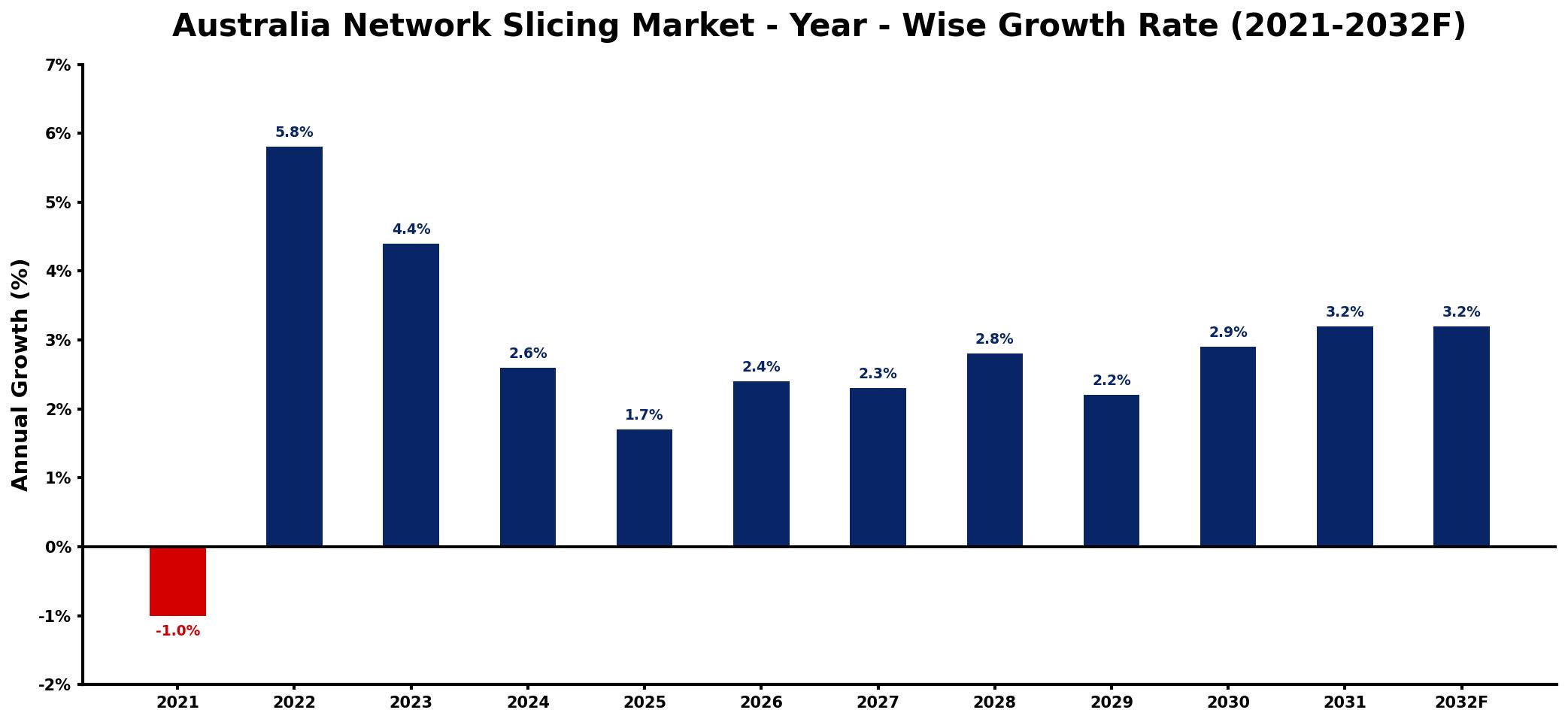
The table below presents the year‑wise growth rates along with the key drivers influencing the market
| Year | Growth Rate | Major Drivers |
| 2021 | -1.0% | decreased investment in technology infrastructure |
| 2022 | 5.8% | rising demand for mobile connectivity |
| 2023 | 4.4% | growth in IoT applications adoption |
| 2024 | 2.6% | increased enterprise digital transformation initiatives |
| 2025 | 1.7% | expanding need for cloud services |
| 2026 | 2.4% | surge in 5G technology deployments |
| 2027 | 2.3% | growing interest in customized solutions |
| 2028 | 2.8% | enhanced focus on user experience |
| 2029 | 2.2% | rising investments in smart cities |
| 2030 | 2.9% | increased collaboration among telecom providers |
| 2031 | 3.2% | expansion of edge computing capabilities |
| 2032 | 3.2% | growing demand for cybersecurity solutions |
Note: Market size estimations and growth projections presented in this report are based on 6Wresearch's proprietary forecasting methodology, utilizing the latest available industry data, government publications, and primary research inputs.
Australia Network Slicing Market Synopsis
In Australia, the shift towards 5G adoption is not merely a technological upgrade but a fundamental transformation in how networks operate. The ability to create dedicated virtual networks, or slices, has garnered interest from sectors like healthcare and gaming, which require robust, reliable, and secure connectivity to support their critical applications.
Additionally, as IoT applications proliferate, the necessity for network slicing becomes increasingly apparent. Businesses are seeking efficient solutions that can cater to their unique connectivity requirements, which further underscores the need for tailored network services in a competitive market landscape.
Australia Network Slicing Market Key Takeaways
- The rise of 5G technology is a primary catalyst for network slicing adoption across various sectors.
- Customized virtual networks are essential for industries with specific connectivity demands, such as healthcare and IoT.
- Investment in network efficiency and security solutions is critical for sustaining growth in the market.
- Government initiatives support the development of network slicing technologies, fostering innovation.
- Partnerships between telecom operators and technology providers can significantly enhance market positioning.
Evaluation of Restraints in Australia Network Slicing Market
Despite the promising outlook for the Australia Network Slicing Market, several restraints are currently hindering its full potential. The high costs associated with the implementation of network slicing technologies can deter companies from making necessary investments. Additionally, the lack of adequate infrastructure to support advanced 5G networks poses a challenge for operators looking to roll out these services. Regulatory constraints and heightened concerns regarding data security and network reliability also create an environment of caution, further impacting market performance. Addressing these barriers will be crucial for the market to realize its forecasted growth.
Australia Network Slicing Market Trends
One of the notable trends influencing the Australia Network Slicing Market is the integration of artificial intelligence (AI) into network management. By leveraging AI, operators can optimize network performance and enhance service delivery through predictive analytics. Furthermore, as businesses increasingly embrace digital transformation, the demand for flexible and scalable network solutions continues to rise, reshaping how telecom services are approached.
Another trend is the growing emphasis on sustainability within the telecommunications industry. Operators are exploring energy-efficient solutions and practices in their network slicing strategies, ensuring that their services align with environmental goals while also meeting consumer demand for greener technology.
Australia Network Slicing Market Opportunities
The Australia Network Slicing Market presents promising investment opportunities, particularly in the areas of research and development for slicing algorithms and virtualization techniques. Companies that focus on enhancing network efficiency through innovation can capture significant market share. Additionally, collaborations with cloud service providers and telecom operators will be crucial for establishing a competitive advantage. As more industries recognize the value of secure and customizable network solutions, the potential for market growth is vast, creating a fertile environment for new entrants and established players alike.
Government Initiatives in the Australia Network Slicing Market
The Australian government plays an active role in the development of network slicing technologies, regulated under the Telecommunications Act. Financial support programs aim to foster innovation in the telecom sector, encouraging operators to explore network slicing capabilities. Moreover, low import tariffs on telecom equipment create a conducive environment for businesses looking to upgrade their infrastructure. Compliance with data privacy and network security regulations is also emphasized, ensuring that the evolution of the network slicing market aligns with national standards and consumer trust.
Future Insights of the Australia Network Slicing Market
Looking ahead to 2026-2032, the Australia Network Slicing Market is poised for significant advancements as 5G technology matures. The evolution of network slicing capabilities will likely lead to more sophisticated and efficient services, meeting the diverse needs of a wide range of industries. As businesses increasingly prioritize tailored connectivity solutions, the demand for secure and efficient network services will shape the future of telecommunications. The successful navigation of existing challenges, along with proactive government support, will be crucial in propelling market growth during this period.
Australia Network Slicing Market Latest Developments (2025 - 2026)
Recent developments in the Australia Network Slicing Market have demonstrated a trend towards enhanced collaborations among telecom operators and technology providers, focusing on the deployment of next-generation slicing solutions. Initiatives to improve interoperability and standardization of network slicing technologies are gaining traction, reflecting a collective effort to drive market growth. Furthermore, discussions surrounding regulatory frameworks are expected to evolve, with an emphasis on ensuring data security and privacy while supporting innovation in network slicing.
Australia Network Slicing Market - Key Attractiveness of the Report
- 10 Years of Market Numbers
- Historical Data Starting from 2022 to 2025
- Base Year: 2025
- Forecast Data until 2032
- Key Performance Indicators Impacting the Market
- Major Upcoming Developments and Projects
Key Highlights of the Report:
- Australia Network Slicing Market Outlook
- Market Size of Australia Network Slicing Market, 2025
- Forecast of Australia Network Slicing Market, 2032
- Historical Data and Forecast of Australia Network Slicing Revenues & Volume for the Period 2022-2032F
- Australia Network Slicing Market Trend Evolution
- Australia Network Slicing Market Drivers and Challenges
- Australia Network Slicing Price Trends
- Australia Network Slicing Porter's Five Forces
- Australia Network Slicing Industry Life Cycle
- Historical Data and Forecast of Australia Network Slicing Market Revenues & Volume By Component for the Period 2022-2032F
- Historical Data and Forecast of Australia Network Slicing Market Revenues & Volume By Solution for the Period 2022-2032F
- Historical Data and Forecast of Australia Network Slicing Market Revenues & Volume By Services (Professional & Managed) for the Period 2022-2032F
- Historical Data and Forecast of Australia Network Slicing Market Revenues & Volume By End User for the Period 2022-2032F
- Historical Data and Forecast of Australia Network Slicing Market Revenues & Volume By Telecom Operators for the Period 2022-2032F
- Historical Data and Forecast of Australia Network Slicing Market Revenues & Volume By Enterprises for the Period 2022-2032F
- Historical Data and Forecast of Australia Network Slicing Market Revenues & Volume By Application for the Period 2022-2032F
- Historical Data and Forecast of Australia Network Slicing Market Revenues & Volume By Manufacturing for the Period 2022-2032F
- Historical Data and Forecast of Australia Network Slicing Market Revenues & Volume By Government for the Period 2022-2032F
- Historical Data and Forecast of Australia Network Slicing Market Revenues & Volume By Automotive for the Period 2022-2032F
- Historical Data and Forecast of Australia Network Slicing Market Revenues & Volume By Media and Entertainment for the Period 2022-2032F
- Australia Network Slicing Import Export Trade Statistics
- Market Opportunity Assessment By Component
- Market Opportunity Assessment By End User
- Market Opportunity Assessment By Application
- Australia Network Slicing Top Companies Market Share
- Australia Network Slicing Competitive Benchmarking By Technical and Operational Parameters
- Australia Network Slicing Company Profiles
- Australia Network Slicing Key Strategic Recommendations






































