Australia Nicotine Replacement Therapy Market Size, Share & Growth Rate
The Australia Nicotine Replacement Therapy Market was estimated at USD 221 Million in 2025 and is projected to reach USD 259 Million by 2032, growing at a CAGR of 2.3% from 2026 to 2032. The increasing public awareness regarding the health hazards of smoking, coupled with government initiatives to promote smoking cessation, are significant factors contributing to this positive trajectory. Furthermore, the accessibility of various NRT products, including patches and gums, enhances their adoption among consumers striving for a smoke-free lifestyle.
Australia Nicotine Replacement Therapy Market Year-wise Growth Rate and Key Drivers
This graph highlights how the Australia Nicotine Replacement Therapy Market has steadily grown over the years, supported by major growth factors.
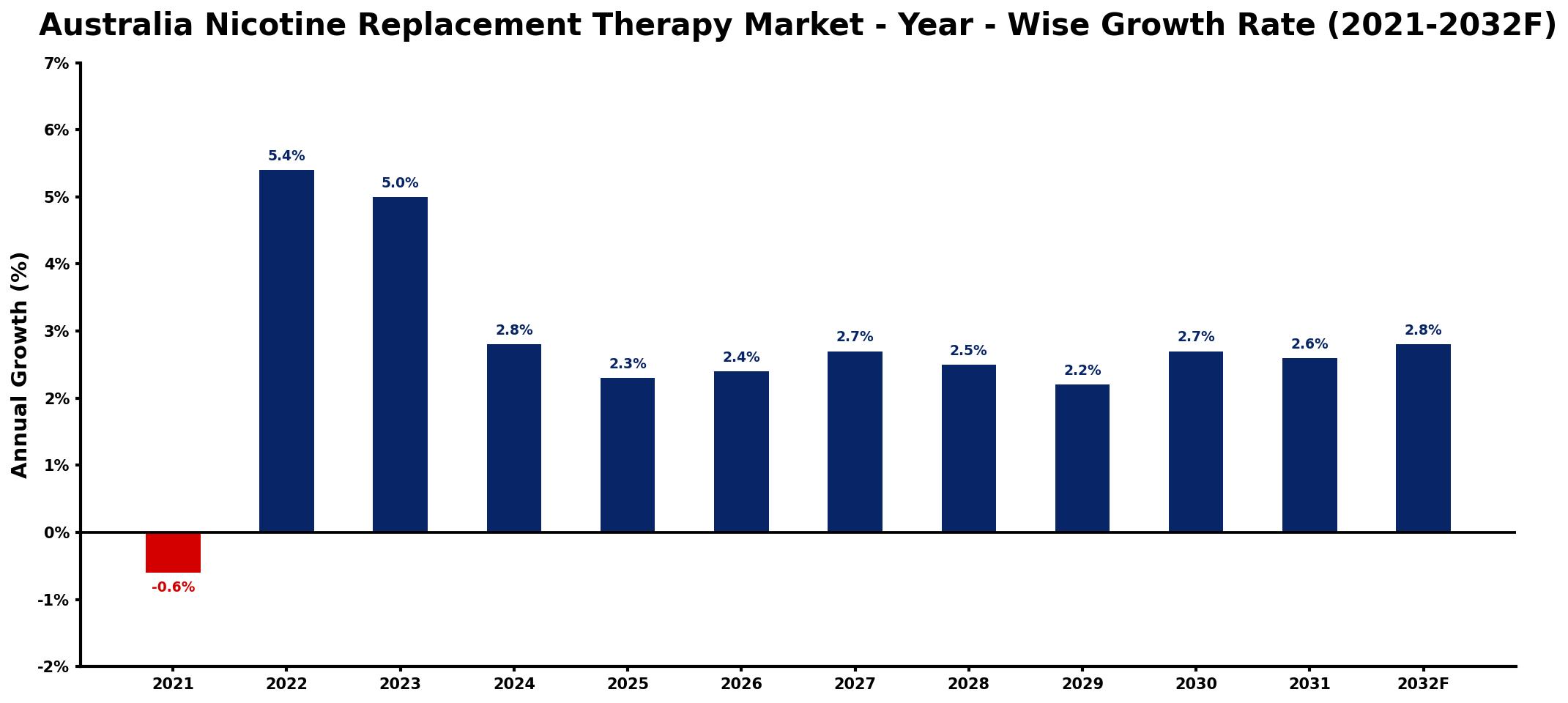
The table below presents the year‑wise growth rates along with the key drivers influencing the market
| Year | Growth Rate | Major Drivers |
| 2021 | -0.6% | Market interest has diminished significantly |
| 2022 | 5.4% | Rising awareness of health benefits |
| 2023 | 5.0% | Increased accessibility through retail channels |
| 2024 | 2.8% | Growing online sales platforms emergence |
| 2025 | 2.3% | More favorable regulatory environment established |
| 2026 | 2.4% | Innovative product offerings expanding rapidly |
| 2027 | 2.7% | Surge in consumer health consciousness |
| 2028 | 2.5% | Enhanced marketing strategies driving sales |
| 2029 | 2.2% | Collaborations with healthcare providers increasing |
| 2030 | 2.7% | strengthening underlying market demand |
| 2031 | 2.6% | Broader demographic targeting strategies evolving |
| 2032 | 2.8% | Technological advancements in product delivery |
Note: Market size estimations and growth projections presented in this report are based on 6Wresearch's proprietary forecasting methodology, utilizing the latest available industry data, government publications, and primary research inputs.
Australia Nicotine Replacement Therapy Market Synopsis
In Australia, the demand for nicotine replacement therapy (NRT) products is on the rise, driven by a growing number of smokers seeking effective cessation methods. The availability of various forms of NRT, such as patches, gums, and lozenges in pharmacies and supermarkets, caters to diverse consumer preferences and needs. This accessibility plays a crucial role in encouraging smokers to make the transition away from tobacco.
Furthermore, stringent regulations regarding tobacco consumption and robust public health campaigns enhance market growth. These initiatives not only raise awareness about the dangers of smoking but also emphasize the importance of quitting, thereby propelling the uptake of nicotine replacement products.
Australia Nicotine Replacement Therapy Market Key Takeaways
- The Australia Nicotine Replacement Therapy Market is set for steady growth due to increasing public health awareness.
- Government regulations and health campaigns play a pivotal role in supporting market expansion.
- Availability and innovation in NRT products enhance their acceptance among consumers.
- Challenges arise from shifting consumer preferences toward alternative cessation methods like vaping.
- Investment opportunities lie in developing new NRT products and enhancing e-commerce distribution channels.
Evaluation of Restraints in Australia Nicotine Replacement Therapy Market
Despite the favorable market conditions, several restraints are impacting the growth of the nicotine replacement therapy market in Australia. Regulatory challenges remain a prominent barrier, as stringent controls on therapeutic goods can limit product availability and innovation. Additionally, consumers are increasingly gravitating towards alternative cessation methods, particularly vaping, which could divert attention and spending away from traditional NRT products. Moreover, skepticism regarding the efficacy and cost-effectiveness of NRT continues to pose challenges for widespread acceptance, affecting overall market dynamics.
Australia Nicotine Replacement Therapy Market Trends
Emerging trends are reshaping the nicotine replacement therapy landscape in Australia. There is a noticeable increase in consumer interest in personalized cessation plans, leading to a rise in demand for tailored NRT solutions that address individual needs. Additionally, the integration of digital health technologies, such as mobile apps that track smoking cessation progress, is gaining traction. This technological advancement not only provides users with real-time feedback but also enhances the overall quitting experience, making it more engaging and effective.
Australia Nicotine Replacement Therapy Market Opportunities
The nicotine replacement therapy market in Australia presents substantial investment opportunities. There is significant potential for the development of innovative NRT products that can cater to specific demographics, such as young adults and pregnant women. Additionally, investments in e-commerce distribution channels can facilitate greater accessibility to NRT, allowing consumers to purchase products more conveniently. Government-backed health initiatives aimed at smoking cessation further create a favorable environment for market growth, inviting investors to explore avenues for collaboration in public health programs.
Government Initiatives in the Australia Nicotine Replacement Therapy Market
The Australian government has implemented various initiatives to promote smoking cessation, notably through the regulation of nicotine replacement therapy products. The Therapeutic Goods Administration (TGA) oversees the approval process for NRT, ensuring adherence to safety and efficacy standards. Recent reforms target unapproved vaping devices, aiming to enhance public health, particularly among youth. These comprehensive policies and initiatives reflect the government's commitment to reducing tobacco consumption, fostering a supportive environment for the growth of the nicotine replacement therapy market.
Future Insights of the Australia Nicotine Replacement Therapy Market
Looking ahead to 2026-2032, the Australia Nicotine Replacement Therapy Market is poised for steady expansion, driven by persistent public health campaigns and evolving consumer preferences. As innovation continues to shape NRT offerings, we can expect the introduction of more diverse and effective products. The government's ongoing commitment to tobacco control, paired with increasing healthcare awareness, will likely enhance the market landscape, establishing a robust framework for NRT as a preferred method for quitting smoking.
Australia Nicotine Replacement Therapy Market Latest Developments (2025 - 2026)
Recent developments in the nicotine replacement therapy sector reflect an evolving industry focusing on consumer needs and regulatory compliance. Companies are increasingly investing in research to enhance product formulations and efficacy. Additionally, the rise of digital platforms for product distribution is reshaping the market, allowing for greater consumer engagement. Policymakers are actively refining existing regulations to address emerging concerns related to new smoking cessation alternatives, ensuring that public health remains a top priority.
Australia Nicotine Replacement Therapy Market - Key Attractiveness of the Report
- 10 Years of Market Numbers
- Historical Data Starting from 2022 to 2025
- Base Year: 2025
- Forecast Data until 2032
- Key Performance Indicators Impacting the Market
- Major Upcoming Developments and Projects
Key Highlights of the Report:
- Australia Nicotine Replacement Therapy Market Outlook
- Market Size of Australia Nicotine Replacement Therapy Market, 2025
- Forecast of Australia Nicotine Replacement Therapy Market, 2032
- Historical Data and Forecast of Australia Nicotine Replacement Therapy Revenues & Volume for the Period 2022-2032F
- Australia Nicotine Replacement Therapy Market Trend Evolution
- Australia Nicotine Replacement Therapy Market Drivers and Challenges
- Australia Nicotine Replacement Therapy Price Trends
- Australia Nicotine Replacement Therapy Porter's Five Forces
- Australia Nicotine Replacement Therapy Industry Life Cycle
- Historical Data and Forecast of Australia Nicotine Replacement Therapy Market Revenues & Volume By Product for the Period 2022-2032F
- Historical Data and Forecast of Australia Nicotine Replacement Therapy Market Revenues & Volume By Nicotine Replacement Therapy for the Period 2022-2032F
- Historical Data and Forecast of Australia Nicotine Replacement Therapy Market Revenues & Volume By E-cigarettes for the Period 2022-2032F
- Historical Data and Forecast of Australia Nicotine Replacement Therapy Market Revenues & Volume By Heat-not-burn Tobacco Products for the Period 2022-2032F
- Historical Data and Forecast of Australia Nicotine Replacement Therapy Market Revenues & Volume By Distribution Channel for the Period 2022-2032F
- Historical Data and Forecast of Australia Nicotine Replacement Therapy Market Revenues & Volume By Offline for the Period 2022-2032F
- Historical Data and Forecast of Australia Nicotine Replacement Therapy Market Revenues & Volume By Online for the Period 2022-2032F
- Australia Nicotine Replacement Therapy Import Export Trade Statistics
- Market Opportunity Assessment By Product
- Market Opportunity Assessment By Distribution Channel
- Australia Nicotine Replacement Therapy Top Companies Market Share
- Australia Nicotine Replacement Therapy Competitive Benchmarking By Technical and Operational Parameters
- Australia Nicotine Replacement Therapy Company Profiles
- Australia Nicotine Replacement Therapy Key Strategic Recommendations






































