Australia Nuclear Imaging Market Size, Share & Growth Rate
The Australia Nuclear Imaging Market was estimated at USD 107 Million in 2025 and is projected to reach USD 126 Million by 2032, growing at a CAGR of 2.4% from 2026 to 2032. This growth trajectory is primarily driven by the increasing demand for early disease diagnosis, particularly in oncology, cardiology, and neurology. Enhanced accuracy and effectiveness offered by advanced PET and SPECT imaging technologies are further propelling market expansion.
Australia Nuclear Imaging Market Year-wise Growth Rate and Key Drivers
This graph highlights how the Australia Nuclear Imaging Market has steadily grown over the years, supported by major growth factors.
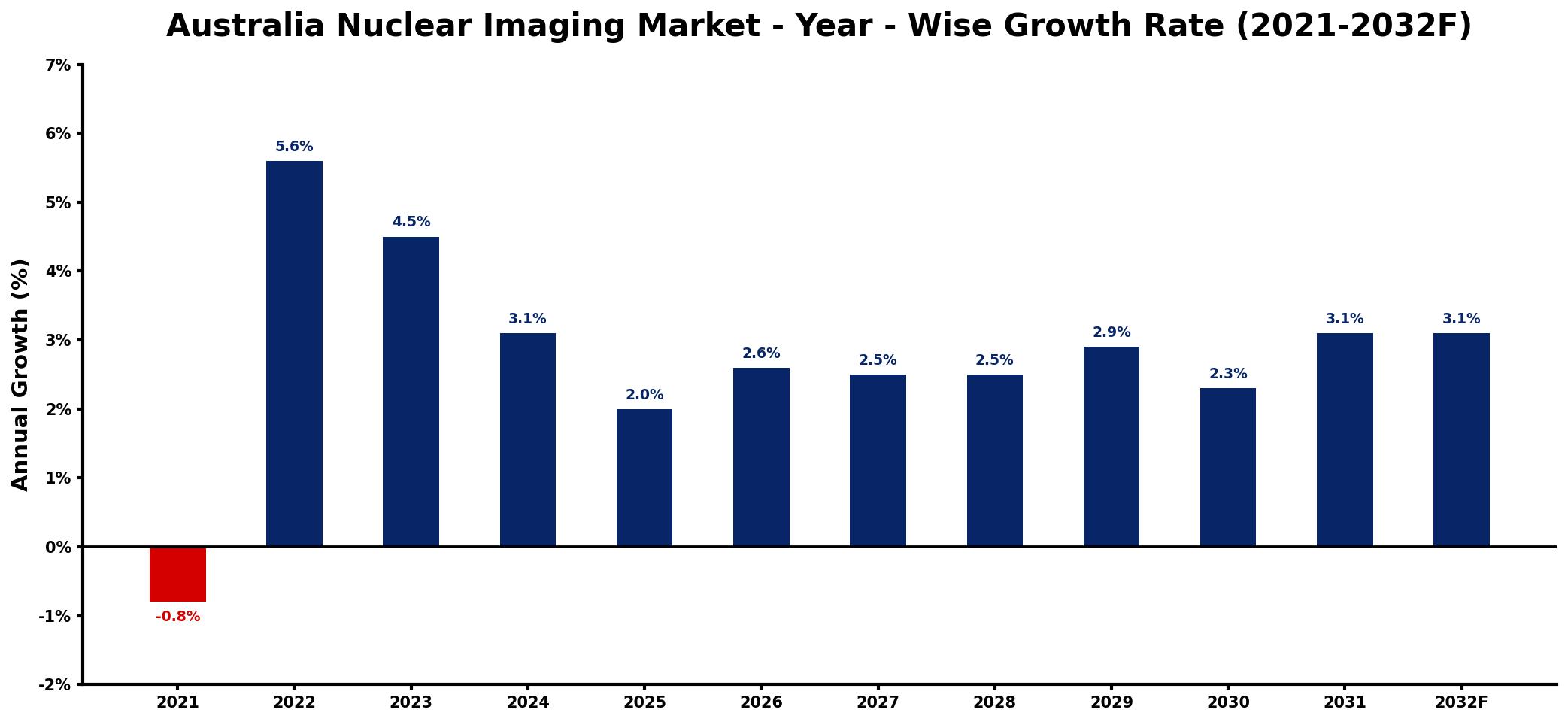
The table below presents the year‑wise growth rates along with the key drivers influencing the market
| Year | Growth Rate | Major Drivers |
| 2021 | -0.8% | Investment in healthcare technology declines |
| 2022 | 5.6% | Growing demand for advanced diagnostics |
| 2023 | 4.5% | Increased funding for research initiatives |
| 2024 | 3.1% | Expansion of healthcare facilities nationwide |
| 2025 | 2.0% | Rising prevalence of chronic diseases |
| 2026 | 2.6% | Technological advancements in detection methods |
| 2027 | 2.5% | Increased public awareness campaigns |
| 2028 | 2.5% | Emergence of innovative treatment options |
| 2029 | 2.9% | Strengthened partnerships with healthcare providers |
| 2030 | 2.3% | Focus on preventive healthcare strategies |
| 2031 | 3.1% | Higher government healthcare expenditures |
| 2032 | 3.1% | Growing interest in personalized medicine |
Note: Market size estimations and growth projections presented in this report are based on 6Wresearch's proprietary forecasting methodology, utilizing the latest available industry data, government publications, and primary research inputs.
Australia Nuclear Imaging Market Synopsis
The demand for nuclear imaging in Australia is on the rise, largely due to a growing emphasis on proactive healthcare solutions. Innovations in hybrid imaging systems are significantly improving diagnostic capabilities, leading to better patient outcomes in critical areas such as cancer and cardiovascular health.
Governmental support for nuclear medicine research plays a vital role in this sector, fostering an environment conducive to technological advancements. As healthcare providers adopt these innovations, the ability to accurately diagnose complex conditions continues to enhance, solidifying the market's foundation.
Australia Nuclear Imaging Market Key Takeaways
- The market is witnessing significant growth driven by advancements in imaging technologies.
- Government initiatives bolster research and development in nuclear medicine.
- High costs associated with equipment and radiopharmaceuticals pose challenges.
- Technological innovation, particularly in hybrid systems, enhances diagnostic accuracy.
- Investment opportunities exist for AI-integrated diagnostic tools within the sector.
Evaluation of Restraints in Australia Nuclear Imaging Market
Despite its growth, the Australia Nuclear Imaging Market faces notable constraints, primarily due to the high costs linked to radiopharmaceuticals and advanced imaging equipment. These expenses can be a barrier for healthcare providers aiming to incorporate the latest technologies into their practices. Additionally, strict regulatory frameworks regarding radiation safety and waste management further contribute to compliance costs. The competition from alternative imaging methods such as MRI and CT scans also presents a challenge, as these alternatives continue to gain traction in clinical settings.
Australia Nuclear Imaging Market Trends
Several trends are shaping the landscape of the nuclear imaging market in Australia. The integration of artificial intelligence in diagnostic procedures is enhancing operational efficiency and accuracy. Furthermore, the shift towards personalized medicine is increasing the utilization of PET and SPECT technologies, allowing for tailored treatment plans based on individual patient data. There is also a marked increase in multi-modality imaging approaches that combine nuclear imaging with other imaging modalities to provide comprehensive diagnostic insights.
Australia Nuclear Imaging Market Opportunities
As the nuclear imaging market continues to expand, notable growth opportunities lie in the development of innovative radiopharmaceuticals and AI-enhanced diagnostic solutions. Companies focusing on improving the efficiency and safety of PET and SPECT imaging systems are well-positioned to thrive. Additionally, increased government funding for cancer and neurological research further opens avenues for investment, creating a fertile ground for new entrants and established players aiming to enhance their market presence.
Government Initiatives in the Australia Nuclear Imaging Market
The Australian government plays a pivotal role in regulating the nuclear imaging market through stringent healthcare regulations and radiation safety policies. Compliance with the Australian Radiation Protection and Nuclear Safety Agency (ARPANSA) standards ensures that nuclear imaging technologies are utilized safely in medical diagnostics. Furthermore, government investment in medical imaging infrastructure seeks to enhance the capabilities of healthcare facilities across the nation, thus improving overall patient care.
Future Insights of the Australia Nuclear Imaging Market
Looking ahead to 2026-2032, the Australia Nuclear Imaging Market is set to undergo transformative changes driven by ongoing technological advancements and increasing healthcare investments. The growing acceptance of nuclear imaging in clinical practices, supported by robust research initiatives, will likely stimulate demand. The convergence of AI with nuclear imaging technology is expected to redefine diagnostic practices, ultimately leading to improved patient outcomes and a more efficient healthcare system.
Australia Nuclear Imaging Market Latest Developments (2025 - 2026)
In the recent months, the nuclear imaging sector has seen significant movement towards enhancing diagnostic accuracy through technological advancements. Research institutions are collaborating with healthcare providers to explore novel applications of PET and SPECT technologies in real-world scenarios. Additionally, there is an ongoing focus on regulatory adaptations to accommodate new imaging modalities while ensuring patient safety and compliance with established standards.
Australia Nuclear Imaging Market - Key Attractiveness of the Report
- 10 Years of Market Numbers
- Historical Data Starting from 2022 to 2025
- Base Year: 2025
- Forecast Data until 2032
- Key Performance Indicators Impacting the Market
- Major Upcoming Developments and Projects
Key Highlights of the Report:
- Australia Nuclear Imaging Market Outlook
- Market Size of Australia Nuclear Imaging Market, 2025
- Forecast of Australia Nuclear Imaging Market, 2032
- Historical Data and Forecast of Australia Nuclear Imaging Revenues & Volume for the Period 2022-2032F
- Australia Nuclear Imaging Market Trend Evolution
- Australia Nuclear Imaging Market Drivers and Challenges
- Australia Nuclear Imaging Price Trends
- Australia Nuclear Imaging Porter's Five Forces
- Australia Nuclear Imaging Industry Life Cycle
- Historical Data and Forecast of Australia Nuclear Imaging Market Revenues & Volume By Product for the Period 2022-2032F
- Historical Data and Forecast of Australia Nuclear Imaging Market Revenues & Volume By Single Photon-Emission Computed Tomography (SPECT) for the Period 2022-2032F
- Historical Data and Forecast of Australia Nuclear Imaging Market Revenues & Volume By Hybrid Pet for the Period 2022-2032F
- Historical Data and Forecast of Australia Nuclear Imaging Market Revenues & Volume By Planar Scintigraphy for the Period 2022-2032F
- Historical Data and Forecast of Australia Nuclear Imaging Market Revenues & Volume By Application for the Period 2022-2032F
- Historical Data and Forecast of Australia Nuclear Imaging Market Revenues & Volume By Oncology for the Period 2022-2032F
- Historical Data and Forecast of Australia Nuclear Imaging Market Revenues & Volume By Cardiology for the Period 2022-2032F
- Historical Data and Forecast of Australia Nuclear Imaging Market Revenues & Volume By Neurology for the Period 2022-2032F
- Historical Data and Forecast of Australia Nuclear Imaging Market Revenues & Volume By Others for the Period 2022-2032F
- Historical Data and Forecast of Australia Nuclear Imaging Market Revenues & Volume By Portability for the Period 2022-2032F
- Historical Data and Forecast of Australia Nuclear Imaging Market Revenues & Volume By Pocket-Sized/Handheld Device for the Period 2022-2032F
- Historical Data and Forecast of Australia Nuclear Imaging Market Revenues & Volume By Fixed for the Period 2022-2032F
- Historical Data and Forecast of Australia Nuclear Imaging Market Revenues & Volume By End user for the Period 2022-2032F
- Historical Data and Forecast of Australia Nuclear Imaging Market Revenues & Volume By Hospitals for the Period 2022-2032F
- Historical Data and Forecast of Australia Nuclear Imaging Market Revenues & Volume By Imaging Centers for the Period 2022-2032F
- Historical Data and Forecast of Australia Nuclear Imaging Market Revenues & Volume By Academic and Research Centers for the Period 2022-2032F
- Historical Data and Forecast of Australia Nuclear Imaging Market Revenues & Volume By Others for the Period 2022-2032F
- Australia Nuclear Imaging Import Export Trade Statistics
- Market Opportunity Assessment By Product
- Market Opportunity Assessment By Application
- Market Opportunity Assessment By Portability
- Market Opportunity Assessment By End user
- Australia Nuclear Imaging Top Companies Market Share
- Australia Nuclear Imaging Competitive Benchmarking By Technical and Operational Parameters
- Australia Nuclear Imaging Company Profiles
- Australia Nuclear Imaging Key Strategic Recommendations






































