Australia Nylon Market: Import Trend Analysis
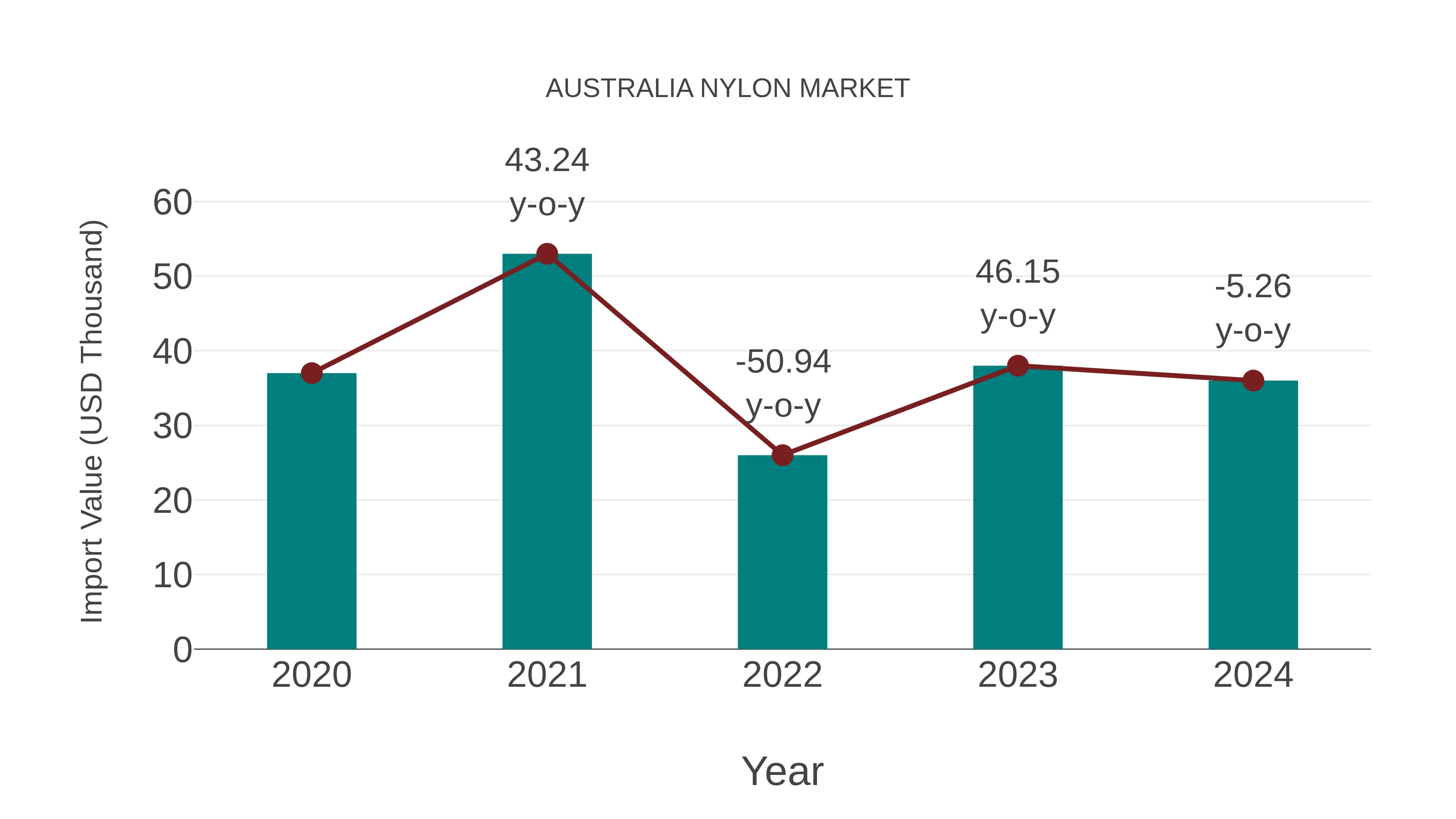
In the Australia nylon market, the import trend exhibited a decline, with a growth rate of -5.26% from 2023 to 2024. The compound annual growth rate (CAGR) for imports between 2020 and 2024 stood at -0.68%. This negative momentum can be attributed to shifting demand patterns or changes in trade policies impacting market stability.
Australia Nylon Market Synopsis
The Australian nylon market is influenced by growing demand in various sectors, including textiles, automotive, and industrial applications. With its durability, lightweight properties, and resistance to wear, nylon is widely used in the production of fabrics, engineering plastics, and consumer goods. The market is shaped by both domestic manufacturing and imports, with sustainability concerns driving interest in recycled nylon products. The expansion of end-user industries and technological advancements in polymer processing contribute to steady market growth.
Drivers of the market
Australias nylon market benefits from increasing demand in apparel, automotive components, and industrial applications. The materials versatility and resistance to wear and tear make it a preferred choice for various end uses. The rise of sustainable and bio-based nylon production is also influencing market trends, with manufacturers adopting greener production processes.
Challenges of the market
Australias nylon market is impacted by supply chain disruptions and competition from recycled or bio-based nylon alternatives. The fashion industrys shift toward sustainability is also affecting demand for conventional nylon. Fluctuations in crude oil prices further contribute to raw material cost variations.
Investment opportunities in the Market
The Australian nylon market presents strong investment potential due to its widespread applications in textiles, automotive components, and industrial uses. With the growing demand for durable, lightweight, and high-performance materials, investors can explore opportunities in domestic nylon production, recycling, and innovation in sustainable nylon alternatives. The increasing need for eco-friendly and biodegradable synthetic materials further enhances the sector`s appeal.
Government Policy of the market
The nylon market is governed by industrial regulations and environmental policies. The government enforces chemical safety laws to regulate the production and use of nylon-based products. Recycling initiatives encourage the reuse of nylon materials to reduce plastic waste. Import controls ensure that foreign nylon products meet national safety and quality standards.
Key Highlights of the Report:
- Australia Nylon Market Outlook
- Market Size of Australia Nylon Market, 2024
- Forecast of Australia Nylon Market, 2031
- Historical Data and Forecast of Australia Nylon Revenues & Volume for the Period 2018 - 2031
- Australia Nylon Market Trend Evolution
- Australia Nylon Market Drivers and Challenges
- Australia Nylon Price Trends
- Australia Nylon Porter's Five Forces
- Australia Nylon Industry Life Cycle
- Historical Data and Forecast of Australia Nylon Market Revenues & Volume By Product for the Period 2018 - 2031
- Historical Data and Forecast of Australia Nylon Market Revenues & Volume By Nylon 6 for the Period 2018 - 2031
- Historical Data and Forecast of Australia Nylon Market Revenues & Volume By Nylon 66 for the Period 2018 - 2031
- Historical Data and Forecast of Australia Nylon Market Revenues & Volume By Application for the Period 2018 - 2031
- Historical Data and Forecast of Australia Nylon Market Revenues & Volume By Automobile for the Period 2018 - 2031
- Historical Data and Forecast of Australia Nylon Market Revenues & Volume By Electrical & Electronics for the Period 2018 - 2031
- Historical Data and Forecast of Australia Nylon Market Revenues & Volume By Engineering Plastics for the Period 2018 - 2031
- Historical Data and Forecast of Australia Nylon Market Revenues & Volume By Textiles for the Period 2018 - 2031
- Historical Data and Forecast of Australia Nylon Market Revenues & Volume By Others for the Period 2018 - 2031
- Australia Nylon Import Export Trade Statistics
- Market Opportunity Assessment By Product
- Market Opportunity Assessment By Application
- Australia Nylon Top Companies Market Share
- Australia Nylon Competitive Benchmarking By Technical and Operational Parameters
- Australia Nylon Company Profiles
- Australia Nylon Key Strategic Recommendations






































