Australia Packaging Trays Market Summary
The australia packaging trays market was estimated at USD 224 Million in 2025 and is projected to reach USD 263 Million by 2032, growing at a CAGR of 2.8% from 2026 to 2032.
Australia Packaging Trays Market Year-wise Growth Rate and Key Drivers
This graph highlights how the Australia Packaging Trays Market has steadily grown over the past five years, supported by major growth factors.
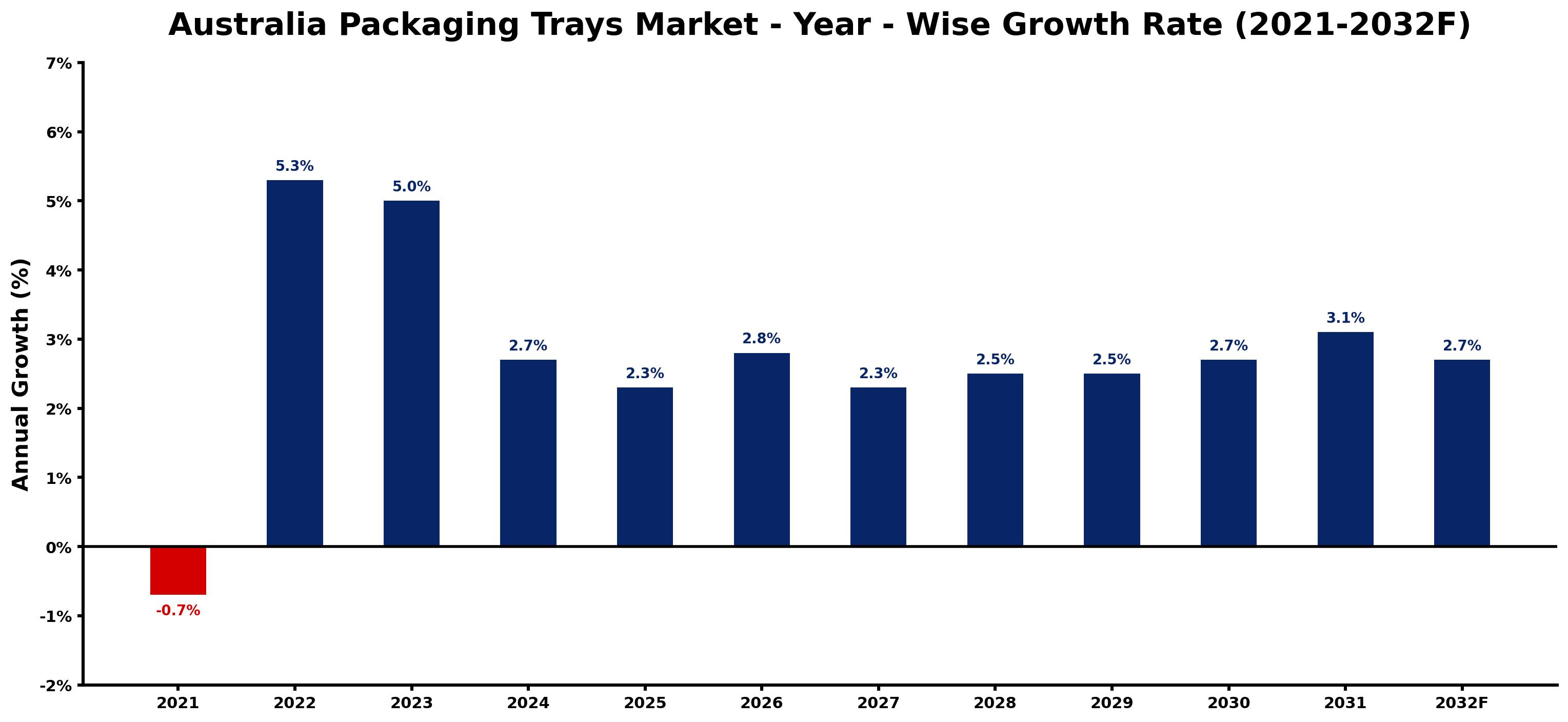
The table below presents the year wise growth rates along with the key drivers influencing the market
| Year | Growth Rate | Major Drivers |
| 2021 | -0.7% | Supply chain disruptions hindered manufacturers' ability to meet demand, resulting in decreased sales across the sector. |
| 2022 | 5.3% | Increased e-commerce activity shifted demand to efficient, sustainable packaging designs. |
| 2023 | 5.0% | Consumer preference for eco-friendly materials influenced packaging tray innovations and choices. |
| 2024 | 2.7% | Manufacturers focused on lightweight materials to reduce shipping costs and environmental impact. |
| 2025 | 2.3% | Technological advancements in production enhanced efficiency, lowering overall operational expenses. |
| 2026 | 2.8% | Retailers prioritized personalized packaging options to appeal to niche customer segments. |
| 2027 | 2.3% | Corporate sustainability goals led to larger investments in biodegradable packaging materials. |
| 2028 | 2.5% | Emerging food delivery services triggered significant demand for durable, insulated packaging trays. |
| 2029 | 2.5% | Collaboration between manufacturers and retailers fostered innovative designs tailored for specific products. |
| 2030 | 2.7% | Market players increasingly integrated automation technologies, streamlining packaging processes and reducing waste. |
| 2031 | 3.1% | Rising consumer awareness about environmental issues created a shift towards minimalistic packaging. |
| 2032 | 2.7% | Global supply chain disruptions led to localized production strategies, enhancing market resilience. |
Note - Market size estimations and growth projections presented in this report are based on 6Wresearch's advanced forecasting approach, validated with industry datasets as of June 2026.
Australia Packaging Trays Market Synopsis
The Australia Packaging Trays Market is projected to reach 2.8% and witness significant growth during the forecast period (2026-2032). This growth trajectory is primarily driven by the increasing demand for ready-to-eat food products and a notable shift towards convenience foods across the country. Coupled with heightened export and import activities, these factors are significantly contributing to the expansion of the Australia Packaging Trays Market. Furthermore, the rapidly growing e-commerce sector and surging demand from the dairy industry are additional catalysts propelling market growth.
Australia Packaging Trays Market Growth Drivers
Several critical factors are influencing the growth of the Australia Packaging Trays Market. One of the foremost drivers is the rising consumer preference for ready-to-eat food products, which necessitates effective packaging solutions. As consumers increasingly seek convenience in their food choices, the demand for packaging trays that enhance shelf life while maintaining food quality is on the rise. Moreover, the expansion of the e-commerce sector is leading to an uptick in packaging needs, particularly for safe and efficient transport of goods.
- The growing trend of meal delivery services is creating a sustained demand for packaging trays designed for easy handling and presentation.
- Increased export and import activities within Australia are necessitating reliable packaging solutions to ensure that products reach international markets in optimal condition.
- The dairy sector is experiencing significant growth, with packaging trays playing a pivotal role in the protection and preservation of dairy products during storage and transportation.
- Sustainability trends are encouraging companies to adopt eco-friendly packaging solutions, further influencing the demand for innovative packaging trays.
- Investment in food processing and packaging technologies is enhancing production efficiencies and driving the market forward.
Australia Packaging Trays Market Trends and Opportunities
The Australia Packaging Trays Market is witnessing several key trends that are shaping its future. As sustainability becomes a more significant focus, manufacturers are increasingly investing in biodegradable and recyclable packaging materials. This not only addresses environmental concerns but also aligns with consumer preferences for sustainable products. Additionally, advancements in packaging technologies are facilitating innovations in design and functionality, leading to the development of smart packaging trays that can enhance user experience.
- The integration of smart technology in packaging trays is emerging as a trend, enabling features like temperature control and freshness indicators.
- Collaborations between packaging companies and food producers are becoming more common, driving efficiency and innovation in product offerings.
- Customizable packaging solutions are gaining traction, allowing producers to create packaging trays tailored to specific product requirements.
- The trend towards minimalistic packaging is reflecting consumer desires for simplicity and functionality in design.
- Growth in online grocery shopping is creating significant opportunities for packaging trays that support efficient logistics and product safety during transit.
Australia Packaging Trays Market Challenges and Restraints
Despite the positive growth prospects, the Australia Packaging Trays Market faces several challenges that could impede its expansion. Fluctuations in raw material prices can affect production costs, potentially leading to increased prices for consumers. Furthermore, regulatory pressures regarding packaging waste and sustainability are becoming more stringent, necessitating compliance from manufacturers. The market also contends with competition from alternative packaging solutions that may offer similar benefits.
- Rising costs of eco-friendly materials may limit the adoption of sustainable packaging solutions among smaller businesses.
- Challenges in supply chain logistics can disrupt the availability of packaging materials, impacting production schedules.
- Rapid technological advancements can pose a barrier for companies that may struggle to keep pace with evolving market demands.
- Consumer skepticism towards the efficacy of new packaging innovations may hinder broader acceptance in the market.
- The ongoing impact of the COVID-19 pandemic continues to create uncertainty within the supply chain and consumer behavior.
Australia Packaging Trays Market Government Investment and Initiatives
The Australian government has been proactive in supporting the packaging industry through various initiatives aimed at enhancing its sustainability and technological capabilities. Investment in research and development programs is facilitating innovations in packaging solutions that meet environmental standards. Public spending on infrastructure related to recycling and waste management is further improving the industry's capacity to handle packaging waste effectively. Additionally, government incentives for companies adopting green practices are encouraging the transition towards more sustainable packaging options.
Australia Packaging Trays Market Latest Developments (May 2025 - June 2026)
Recent developments within the Australia Packaging Trays Market have focused on addressing sustainability and advancing technology. Companies are increasingly adopting practices that prioritize eco-friendly materials while streamlining production processes to reduce environmental footprints. The introduction of innovative packaging designs that enhance product visibility and usability is becoming more prevalent. Moreover, partnerships between stakeholders in the supply chain are resulting in improved efficiencies, lowering costs while maintaining quality standards. The growing emphasis on online retail has also spurred enhancements in packaging to better cater to e-commerce logistics.
Australia Packaging Trays Market - Key Attractiveness of the Report
- 10 Years of Market Numbers
- Historical Data Starting from 2022 to 2025
- Base Year: 2025
- Forecast Data until 2032
- Key Performance Indicators Impacting the Market
- Major Upcoming Developments and Projects
Key Highlights of the Report:
- Australia Packaging Trays Market Outlook
- Market Size of Australia Packaging Trays Market, 2025
- Forecast of Australia Packaging Trays Market, 2032F
- Historical Data and Forecast of Australia Packaging Trays Revenues & Volume for the Period 2022-2032F
- Australia Packaging Trays Market Trend Evolution
- Australia Packaging Trays Market Drivers and Challenges
- Australia Packaging Trays Price Trends
- Australia Packaging Trays Porter's Five Forces
- Australia Packaging Trays Industry Life Cycle
- Historical Data and Forecast of Australia Packaging Trays Market Revenues & Volume By Material Types for the Period 2022-2032F
- Historical Data and Forecast of Australia Packaging Trays Market Revenues & Volume By PET for the Period 2022-2032F
- Historical Data and Forecast of Australia Packaging Trays Market Revenues & Volume By PVC for the Period 2022-2032F
- Historical Data and Forecast of Australia Packaging Trays Market Revenues & Volume By Polypropylene for the Period 2022-2032F
- Historical Data and Forecast of Australia Packaging Trays Market Revenues & Volume By Others for the Period 2022-2032F
- Historical Data and Forecast of Australia Packaging Trays Market Revenues & Volume By Forms for the Period 2022-2032F
- Historical Data and Forecast of Australia Packaging Trays Market Revenues & Volume By Flexible for the Period 2022-2032F
- Historical Data and Forecast of Australia Packaging Trays Market Revenues & Volume By Semi-Flexible for the Period 2022-2032F
- Historical Data and Forecast of Australia Packaging Trays Market Revenues & Volume By End-users for the Period 2022-2032F
- Historical Data and Forecast of Australia Packaging Trays Market Revenues & Volume By Industrial for the Period 2022-2032F
- Historical Data and Forecast of Australia Packaging Trays Market Revenues & Volume By Food & Beverages for the Period 2022-2032F
- Historical Data and Forecast of Australia Packaging Trays Market Revenues & Volume By Retail for the Period 2022-2032F
- Historical Data and Forecast of Australia Packaging Trays Market Revenues & Volume By Cosmetic & Personal Care for the Period 2022-2032F
- Historical Data and Forecast of Australia Packaging Trays Market Revenues & Volume By Others for the Period 2022-2032F
- Australia Packaging Trays Import Export Trade Statistics
- Market Opportunity Assessment By Material Types
- Market Opportunity Assessment By Forms
- Market Opportunity Assessment By End-users
- Australia Packaging Trays Top Companies Market Share
- Australia Packaging Trays Competitive Benchmarking By Technical and Operational Parameters
- Australia Packaging Trays Company Profiles
- Australia Packaging Trays Key Strategic Recommendations






































