Australia Paint Protection Films Market: Import Trend Analysis
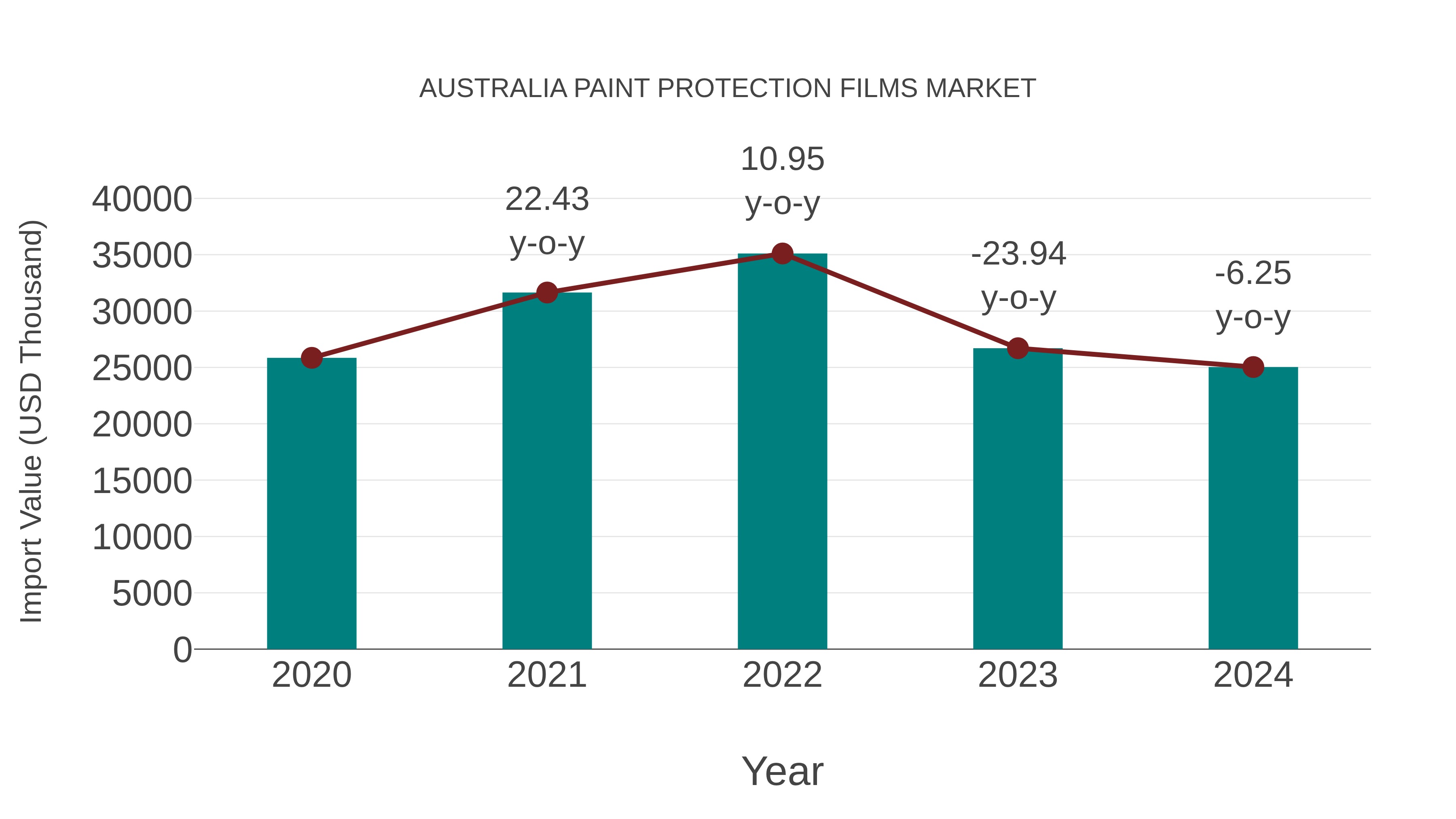
Australia`s import trend for paint protection films experienced a decline, with a growth rate of -6.25% from 2023 to 2024 and a compound annual growth rate (CAGR) of -0.8% from 2020 to 2024. This downturn could be attributed to shifting consumer preferences towards alternative automotive protection solutions or changes in trade policies affecting import dynamics.
Australia Paint Protection Films Market Overview
Paint protection films are widely used in the automotive sector to protect vehicle surfaces from scratches, UV rays, and environmental damage. In Australia, the market is growing due to the increasing demand for luxury vehicles and the rising popularity of do-it-yourself (DIY) protection kits. Advances in self-healing and hydrophobic coatings are also driving market innovation.
Drivers of the market
The paint protection films market in Australia is expanding due to rising demand for scratch-resistant and durable protective coatings in the automotive and electronics industries. Increasing adoption of self-healing and UV-resistant films for enhancing product longevity and aesthetics is driving market growth. Enhanced development of transparent and customizable protection films is supporting market expansion.
Challenges of the market
The paint protection films market in Australia faces challenges from high production costs and technical difficulties in achieving consistent film thickness and clarity. Dependence on imported raw materials increases market vulnerability. Competition from ceramic coatings and wax-based protection systems restricts market growth.
Investment opportunities in the Market
The Australia Paint Protection Films Market presents promising growth potential due to increasing demand for automotive and electronic surface protection. Investment opportunities include developing self-healing and UV-resistant films, improving adhesive properties, and expanding into aerospace and industrial applications.
Government Policy of the market
Paint protection films used in automotive and construction sectors are regulated under the AICIS. Importers and manufacturers must register the chemical composition and comply with product safety standards under the ACCC. Workplace safety guidelines during installation and handling are enforced under the Work Health and Safety Act 2011. Waste disposal and environmental safety are managed under the Environmental Protection Act 1997.
Key Highlights of the Report:
- Australia Paint Protection Films Market Outlook
- Market Size of Australia Paint Protection Films Market, 2025
- Forecast of Australia Paint Protection Films Market, 2032
- Historical Data and Forecast of Australia Paint Protection Films Revenues & Volume for the Period 2022-2032F
- Australia Paint Protection Films Market Trend Evolution
- Australia Paint Protection Films Market Drivers and Challenges
- Australia Paint Protection Films Price Trends
- Australia Paint Protection Films Porter's Five Forces
- Australia Paint Protection Films Industry Life Cycle
- Historical Data and Forecast of Australia Paint Protection Films Market Revenues & Volume By Material for the Period 2022-2032F
- Historical Data and Forecast of Australia Paint Protection Films Market Revenues & Volume By Thermoplastic Polyurethane for the Period 2022-2032F
- Historical Data and Forecast of Australia Paint Protection Films Market Revenues & Volume By Polyvinyl Chloride for the Period 2022-2032F
- Historical Data and Forecast of Australia Paint Protection Films Market Revenues & Volume By End Use Industry for the Period 2022-2032F
- Historical Data and Forecast of Australia Paint Protection Films Market Revenues & Volume By Automotive for the Period 2022-2032F
- Historical Data and Forecast of Australia Paint Protection Films Market Revenues & Volume By Electronics for the Period 2022-2032F
- Historical Data and Forecast of Australia Paint Protection Films Market Revenues & Volume By Construction for the Period 2022-2032F
- Australia Paint Protection Films Import Export Trade Statistics
- Market Opportunity Assessment By Material
- Market Opportunity Assessment By End Use Industry
- Australia Paint Protection Films Top Companies Market Share
- Australia Paint Protection Films Competitive Benchmarking By Technical and Operational Parameters
- Australia Paint Protection Films Company Profiles
- Australia Paint Protection Films Key Strategic Recommendations






































