Australia Payment as a Service Market Size & Growth Rate (2026-2032)
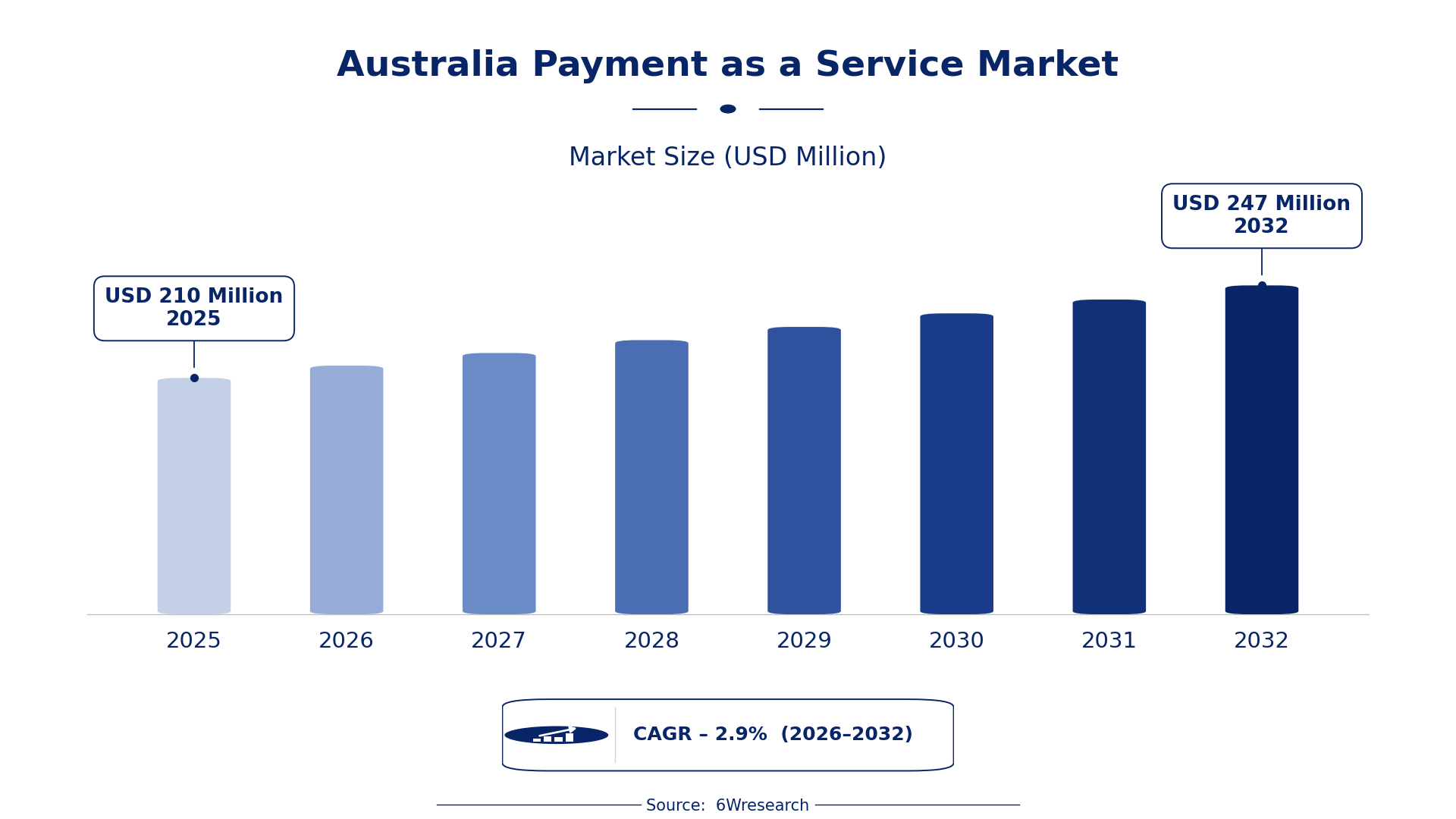
The Australia Payment as a Service Market was estimated at USD 210 Million in 2025 and is projected to reach USD 247 Million by 2032, growing at a CAGR of 2.9% from 2026 to 2032.
Australia Payment as a Service Market Synopsis
The primary force driving the Australia Payment as a Service Market is the rapid adoption of fintech innovations, which are reshaping how businesses and consumers engage in transactions. This shift towards digital payments is not just a trend; it's a fundamental change in consumer behavior, pushing companies to seek scalable, secure solutions.
As mobile wallets and contactless payments gain traction, businesses are compelled to integrate advanced payment solutions. Regulatory frameworks are evolving in tandem, ensuring that these digital transactions are secure and compliant with the latest standards. This creates a fertile ground for growth in the sector.
Australia Payment as a Service Market Year-wise Growth Rate and Key Drivers
This graph illustrates the annual growth rates of the Australia Payment as a Service Market from 2021 to 2032, highlighting a steady upward trajectory and projected expansion over the forecast period.
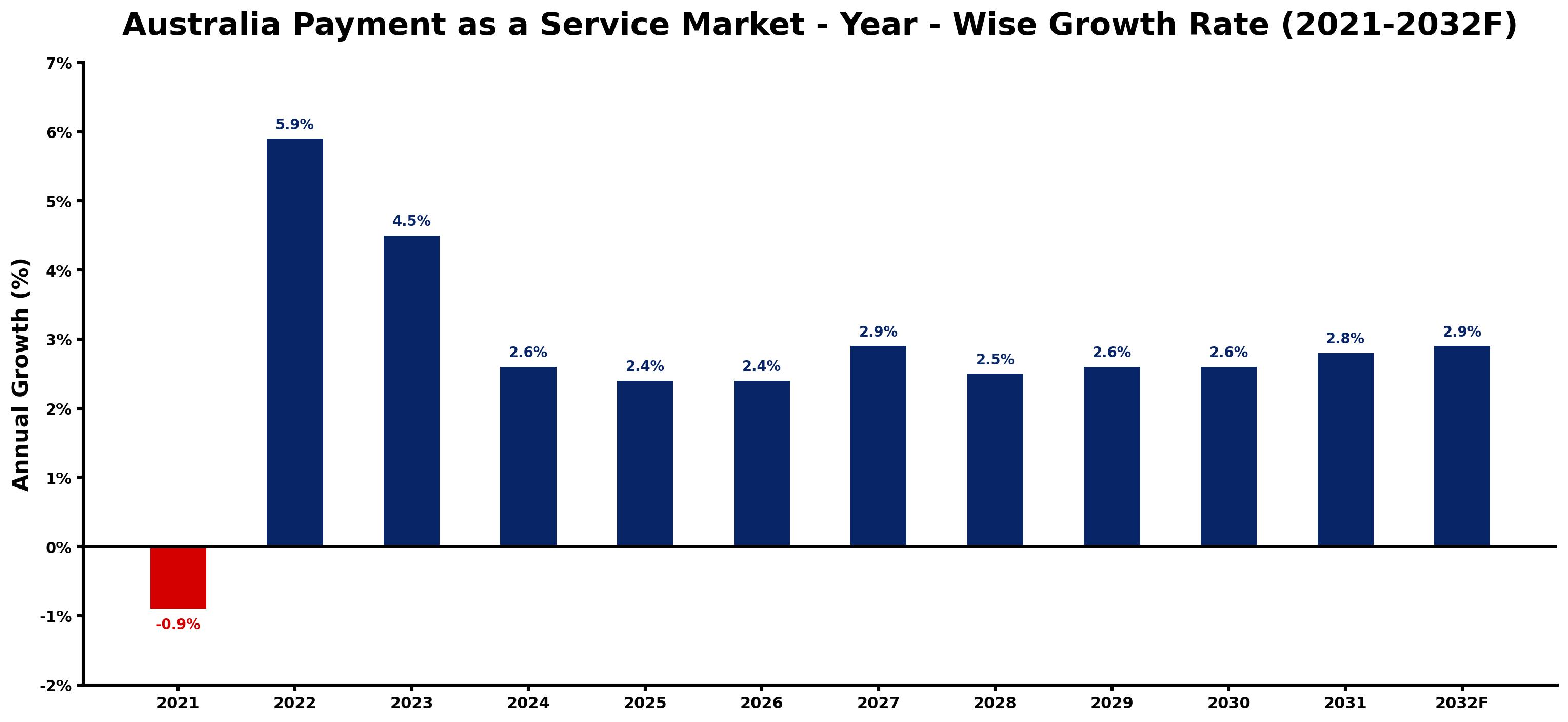
The table below presents the year‑wise growth rates along with the key drivers influencing the market
| Year | Growth Rate | Major Drivers |
| 2021 | -0.9% | RBA's low interest rates reduced transaction fees. |
| 2022 | 5.9% | Increased adoption of digital wallets among Australians. |
| 2023 | 4.5% | Launch of new fintech regulations by ASIC stimulating innovation. |
| 2024 | 2.6% | Growth in subscription-based services enhancing payment processing needs. |
| 2025 | 2.4% | Shift towards cashless transactions in urban areas. |
| 2026 | 2.4% | Regulatory support for real-time payment systems boosts market. |
| 2027 | 2.9% | Surge in online gaming demand driving payment flexibility. |
| 2028 | 2.5% | Increased cybersecurity measures enhancing consumer trust in payments. |
| 2029 | 2.6% | Growing popularity of peer-to-peer payment applications in Australia. |
| 2030 | 2.6% | Enhanced mobile banking features promoting transaction convenience. |
| 2031 | 2.8% | Emergence of integrated payment solutions for SMEs. |
| 2032 | 2.9% | Government incentives for digital payment adoption accelerate growth. |
Note: Market size estimations and growth projections presented in this report are based on 6Wresearch's proprietary forecasting methodology, utilizing the latest available industry data, government publications, and primary research inputs.
Australia Payment as a Service Market Key Takeaways
Below are some of the specific key takeaways from the market, including:
- Fintech innovations are the driving force behind market growth, enhancing transaction efficiency.
- Increasing consumer preference for mobile wallets is reshaping payment processing strategies.
- Regulatory support is crucial in mitigating security risks associated with digital payments.
- The rise of e-commerce is creating new opportunities for payment service providers.
- Challenges around fraud and compliance costs must be addressed for sustained market expansion.
Evaluation of Restraints in Australia Payment as a Service Market
Several restraints are currently hindering the growth of the Australia Payment as a Service Market. The escalating threats of payment fraud are a major concern, as businesses grapple with the need to protect sensitive transaction data. Additionally, the high costs associated with regulatory compliance can deter smaller players from entering the market. Customer trust remains a critical issue, especially as incidents of fraud can severely impact consumer confidence in digital payment systems. These challenges necessitate a concerted effort from stakeholders to bolster security and foster a more trustworthy payment environment.
Australia Payment as a Service Market Trends
Several trends are emerging in the Australia Payment as a Service Market. The rise in mobile payment adoption is driving companies to prioritize user-friendly interfaces and faster transaction processing. There's also a noticeable shift towards cloud-based payment systems, offering businesses scalability and flexibility. on top of that, real-time transaction processing is gaining traction, enabling companies to enhance customer experiences while improving operational efficiency. These trends highlight the ongoing evolution of payment solutions in response to consumer demands and technological advancements.
Australia Payment as a Service Market Opportunities
The Australia Payment as a Service Market is ripe with investment opportunities. With increasing demand for cloud-based payment systems, companies can capitalize on developing secure platforms that cater to both small and large enterprises. There's also potential for innovation in real-time transaction processing, which can significantly improve user experience. Expanding into retail and financial services offers further growth avenues, as these sectors increasingly shift towards digital solutions. Investors and companies that recognize these opportunities stand to gain a competitive edge.
Government Initiatives in the Australia Payment as a Service Market
The regulatory environment surrounding the Australia Payment as a Service Market is characterized by proactive government initiatives aimed at enhancing payment security and efficiency. These policies reflect a commitment to fostering innovation while ensuring consumer protection. By regulating payment service providers, the government is creating a foundation for a more secure digital payment ecosystem.
- A regulatory framework introduced in 2025 mandates enhanced security measures for payment service providers.
- A national digital infrastructure upgrade programme is currently underway to improve transaction processing speed.
- Ongoing assessments by the Reserve Bank of Australia (RBA) focus on ensuring compliance with anti-money laundering regulations.
- A planned initiative aims to provide funding for research into advanced fraud detection technologies by 2026.
Future Insights of the Australia Payment as a Service Market
Looking ahead to 2026-2032, the Australia Payment as a Service Market is expected to undergo transformative changes. As consumer expectations evolve, businesses will need to adopt cutting-edge technologies to stay competitive. The integration of artificial intelligence and machine learning in payment processing could streamline operations and enhance security. Additionally, as more businesses embrace digital transformation, the demand for customized payment solutions tailored to various sectors will rise. This shift will drive innovation and open up new avenues for growth within the market.
Australia Payment as a Service Market Latest Developments
Recent developments in the Australia Payment as a Service Market indicate a strong push towards innovation and security. Companies are increasingly investing in advanced technologies to enhance payment processing capabilities and ensure compliance with regulatory standards. The market is witnessing a flurry of activity as businesses seek to adopt solutions that meet the evolving needs of consumers.
- A leading regional operator launched a new secure payment gateway in early 2025, significantly improving transaction speed.
- In mid-2025, a major technology vendor began rolling out an AI-driven fraud detection system that enhances security measures.
- By late 2025, a collaborative initiative between fintech companies aimed to create a unified digital wallet solution is expected to be completed.
- A planned partnership between payment service providers and banks is set to expand digital payment access in rural areas by 2026.
Australia Payment as a Service Market - Key Attractiveness of the Report
- 10 Years of Market Numbers
- Historical Data Starting from 2022 to 2025
- Base Year: 2025
- Forecast Data until 2032
- Key Performance Indicators Impacting the Market
- Major Upcoming Developments and Projects
Key Highlights of the Report:
- Australia Payment as a Service Market Outlook
- Market Size of Australia Payment as a Service Market, 2025
- Forecast of Australia Payment as a Service Market, 2032
- Historical Data and Forecast of Australia Payment as a Service Revenues & Volume for the Period 2022-2032F
- Australia Payment as a Service Market Trend Evolution
- Australia Payment as a Service Market Drivers and Challenges
- Australia Payment as a Service Price Trends
- Australia Payment as a Service Porter's Five Forces
- Australia Payment as a Service Industry Life Cycle
- Historical Data and Forecast of Australia Payment as a Service Market Revenues & Volume By Component for the Period 2022-2032F
- Historical Data and Forecast of Australia Payment as a Service Market Revenues & Volume By Platform for the Period 2022-2032F
- Historical Data and Forecast of Australia Payment as a Service Market Revenues & Volume By Services for the Period 2022-2032F
- Historical Data and Forecast of Australia Payment as a Service Market Revenues & Volume By Service for the Period 2022-2032F
- Historical Data and Forecast of Australia Payment as a Service Market Revenues & Volume By Professional services for the Period 2022-2032F
- Historical Data and Forecast of Australia Payment as a Service Market Revenues & Volume By Managed services for the Period 2022-2032F
- Historical Data and Forecast of Australia Payment as a Service Market Revenues & Volume By Vertical for the Period 2022-2032F
- Historical Data and Forecast of Australia Payment as a Service Market Revenues & Volume By Retail for the Period 2022-2032F
- Historical Data and Forecast of Australia Payment as a Service Market Revenues & Volume By Hospitality for the Period 2022-2032F
- Historical Data and Forecast of Australia Payment as a Service Market Revenues & Volume By Media and entertainment for the Period 2022-2032F
- Historical Data and Forecast of Australia Payment as a Service Market Revenues & Volume By Healthcare for the Period 2022-2032F
- Historical Data and Forecast of Australia Payment as a Service Market Revenues & Volume By Banking, Financial Services, and Insurance (BFSI) for the Period 2022-2032F
- Historical Data and Forecast of Australia Payment as a Service Market Revenues & Volume By Others for the Period 2022-2032F
- Australia Payment as a Service Import Export Trade Statistics
- Market Opportunity Assessment By Component
- Market Opportunity Assessment By Service
- Market Opportunity Assessment By Vertical
- Australia Payment as a Service Top Companies Market Share
- Australia Payment as a Service Competitive Benchmarking By Technical and Operational Parameters
- Australia Payment as a Service Company Profiles
- Australia Payment as a Service Key Strategic Recommendations






































