Australia Perchloroethylene Market Size, Share & Growth Rate
The Australia Perchloroethylene Market was estimated at USD 226 Million in 2025 and is projected to reach USD 267 Million by 2032, growing at a CAGR of 2.4% from 2026 to 2032. This growth is primarily driven by the continued demand for perchloroethylene in traditional applications such as dry cleaning and metal degreasing. However, the market is also facing transformative pressures due to the rising adoption of eco-friendly solvents and stringent regulatory frameworks aimed at minimizing environmental impact.
Australia Perchloroethylene Market Year-wise Growth Rate and Key Drivers
This graph highlights how the Australia Perchloroethylene Market has steadily grown over the years, supported by major growth factors.
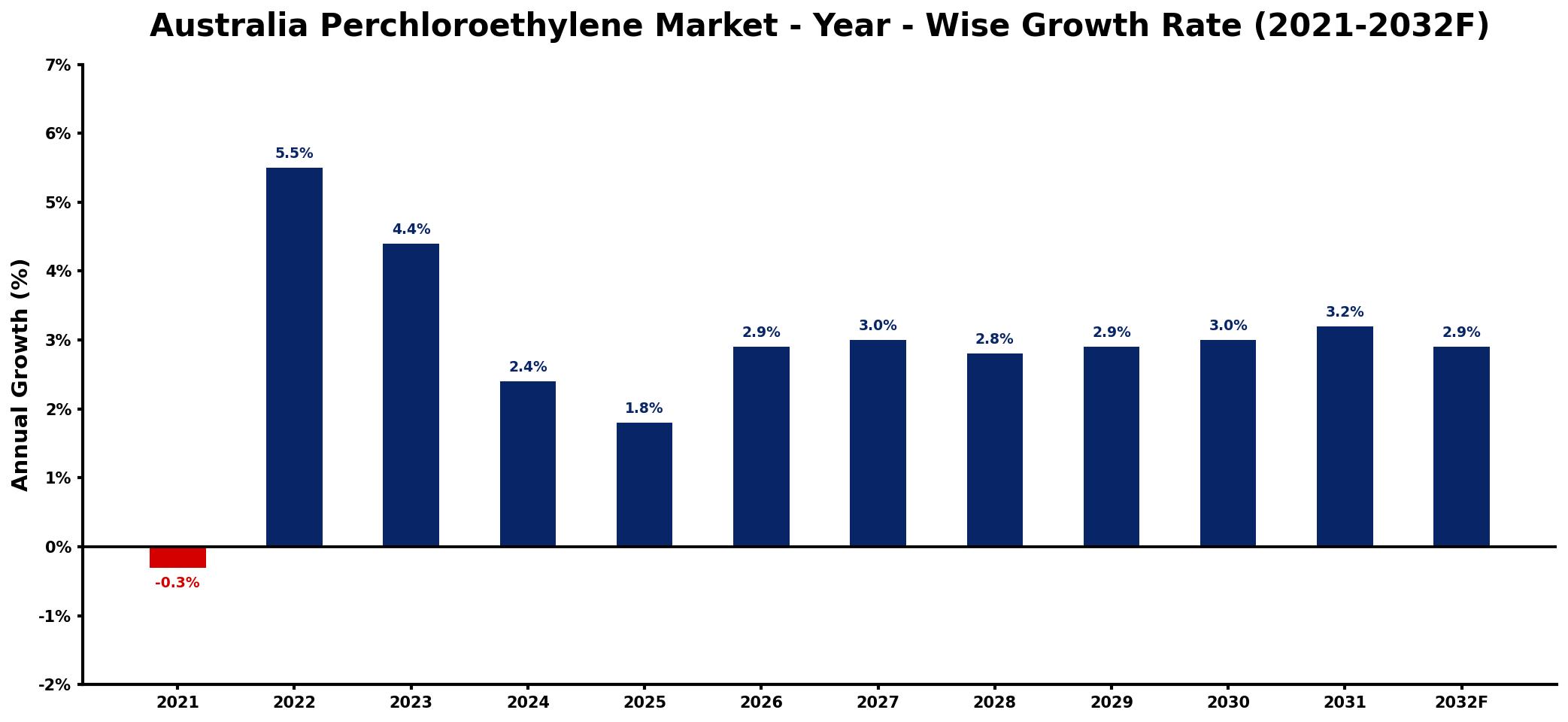
The table below presents the year‑wise growth rates along with the key drivers influencing the market
| Year | Growth Rate | Major Drivers |
| 2021 | -0.3% | Decrease in industrial cleaning demand |
| 2022 | 5.5% | Increased laundry service expansions |
| 2023 | 4.4% | Growth in dry cleaning sector |
| 2024 | 2.4% | Rising demand from automotive industry |
| 2025 | 1.8% | Investment in eco-friendly alternatives |
| 2026 | 2.9% | Boost in industrial solvent applications |
| 2027 | 3.0% | Expansion of textile manufacturing facilities |
| 2028 | 2.8% | increased overall sector activity |
| 2029 | 2.9% | Increase in regulatory compliance needs |
| 2030 | 3.0% | growing emerging market penetration |
| 2031 | 3.2% | strengthening underlying market demand |
| 2032 | 2.9% | rising end-use demand growth |
Note: Market size estimations and growth projections presented in this report are based on 6Wresearch's proprietary forecasting methodology, utilizing the latest available industry data, government publications, and primary research inputs.
Australia Perchloroethylene Market Synopsis
A significant force currently shaping the Australia Perchloroethylene Market is the increasing environmental scrutiny surrounding volatile organic compounds (VOCs). As awareness about health risks and ecological impacts grows, regulatory bodies are imposing stricter guidelines, ultimately reshaping industry practices and consumer preferences.
Simultaneously, the industrial landscape is witnessing a gradual shift towards sustainable alternatives. The demand for perchloroethylene remains robust; however, many sectors are increasingly experimenting with greener cleaning options, thus impacting traditional market dynamics.
Australia Perchloroethylene Market Key Takeaways
- The market is experiencing a compound annual growth rate (CAGR) of 2.4% from 2026 to 2032.
- Regulatory changes and environmental concerns are driving the adoption of alternative solvents.
- Investment in recycling technologies presents new growth avenues.
- Emerging research into non-toxic substitutes is gaining traction.
- The dry cleaning sector remains the largest end-user of perchloroethylene.
Evaluation of Restraints in Australia Perchloroethylene Market
Several significant restraints are currently impacting the Australia Perchloroethylene Market. One of the most pressing issues is the stringent regulatory landscape that governs the use of perchloroethylene due to its recognized health risks and environmental toxicity. This has catalyzed a search for safer alternatives, resulting in declining market share for traditional solvents. Furthermore, fluctuating raw material prices and restrictions on imports create instability within the supply chain, exacerbating challenges faced by manufacturers and end-users alike.
Australia Perchloroethylene Market Trends
One key trend shaping the Australia Perchloroethylene Market is the surge in demand for eco-friendly cleaning agents as businesses and consumers prioritize sustainability. This is leading to innovation in product formulations that comply with environmental regulations while still meeting performance requirements. Additionally, advancements in recycling technologies are making it feasible to reclaim and reuse perchloroethylene, thereby reducing waste and enhancing resource efficiency. These trends signal a transformative shift in the market landscape as it adapts to both consumer expectations and regulatory pressures.
Australia Perchloroethylene Market Opportunities
Investment opportunities abound within the Australia Perchloroethylene Market, particularly in the realm of developing environmentally friendly alternatives. Companies focusing on innovation in non-toxic solvents stand to benefit from increased consumer demand. Furthermore, there is a significant need for advancements in sustainable disposal methods and recycling technologies, offering a pathway for businesses to remain compliant with evolving regulations while maintaining their operational viability. Exploring niche applications and industrial solutions further enhances prospects for market participants.
Government Initiatives in the Australia Perchloroethylene Market
The Australian government has implemented robust regulatory measures governing the use of hazardous substances, including perchloroethylene. These regulations emphasize the importance of safe handling and disposal practices to mitigate health and environmental risks. Public spending is increasingly directed towards research and development initiatives aimed at finding viable alternatives to harmful chemicals. Such initiatives are further supported by government programs that promote sustainable practices across various industries, facilitating a transition towards greener solutions.
Future Insights of the Australia Perchloroethylene Market
Looking ahead to 2026-2032, the Australia Perchloroethylene Market is anticipated to navigate significant transitions driven by regulatory developments and shifting consumer preferences. The ongoing evolution towards sustainable practices will likely intensify competition among manufacturers, with an increasing focus on eco-friendly products. While perchloroethylene will continue to play a role in key applications such as dry cleaning and degreasing, the market will gradually adapt to new norms, ultimately shaping a more responsible industrial landscape.
Australia Perchloroethylene Market Latest Developments (2025 - 2026)
Recent developments in the Australia Perchloroethylene Market indicate a heightened focus on compliance with environmental regulations, as businesses seek to align their practices with government policies. Notably, there has been an uptick in research initiatives exploring non-toxic alternatives, reflecting industry responsiveness to market pressures. Additionally, industry stakeholders are actively investing in sustainable technologies that enable the efficient recycling of perchloroethylene, thereby minimizing ecological footprints and enhancing operational resilience.
Australia Perchloroethylene Market - Key Attractiveness of the Report
- 10 Years of Market Numbers
- Historical Data Starting from 2022 to 2025
- Base Year: 2025
- Forecast Data until 2032
- Key Performance Indicators Impacting the Market
- Major Upcoming Developments and Projects
Key Highlights of the Report:
- Australia Perchloroethylene Market Outlook
- Market Size of Australia Perchloroethylene Market, 2025
- Forecast of Australia Perchloroethylene Market, 2032
- Historical Data and Forecast of Australia Perchloroethylene Revenues & Volume for the Period 2022-2032F
- Australia Perchloroethylene Market Trend Evolution
- Australia Perchloroethylene Market Drivers and Challenges
- Australia Perchloroethylene Price Trends
- Australia Perchloroethylene Porter's Five Forces
- Australia Perchloroethylene Industry Life Cycle
- Historical Data and Forecast of Australia Perchloroethylene Market Revenues & Volume By Type for the Period 2022-2032F
- Historical Data and Forecast of Australia Perchloroethylene Market Revenues & Volume By Ethylene Oxychlorination for the Period 2022-2032F
- Historical Data and Forecast of Australia Perchloroethylene Market Revenues & Volume By Acetylene Method for the Period 2022-2032F
- Historical Data and Forecast of Australia Perchloroethylene Market Revenues & Volume By Ethylene Direct Chlorination for the Period 2022-2032F
- Historical Data and Forecast of Australia Perchloroethylene Market Revenues & Volume By End-use for the Period 2022-2032F
- Historical Data and Forecast of Australia Perchloroethylene Market Revenues & Volume By Dry Cleaning Agent for the Period 2022-2032F
- Historical Data and Forecast of Australia Perchloroethylene Market Revenues & Volume By Solvent for the Period 2022-2032F
- Historical Data and Forecast of Australia Perchloroethylene Market Revenues & Volume By Others for the Period 2022-2032F
- Australia Perchloroethylene Import Export Trade Statistics
- Market Opportunity Assessment By Type
- Market Opportunity Assessment By End-use
- Australia Perchloroethylene Top Companies Market Share
- Australia Perchloroethylene Competitive Benchmarking By Technical and Operational Parameters
- Australia Perchloroethylene Company Profiles
- Australia Perchloroethylene Key Strategic Recommendations






































