Australia Pharmaceutical Glass Vials and Ampoules Market Size, Share & Growth Rate
The Australia Pharmaceutical Glass Vials and Ampoules Market was estimated at USD 227 Million in 2025 and is projected to reach USD 267 Million by 2032, growing at a CAGR of 2.3% from 2026 to 2032. This growth trajectory is primarily driven by the expanding pharmaceutical and biotechnology sectors, coupled with a rising demand for high-quality injectable drugs. The increasing focus on stringent regulatory requirements ensures that manufacturers are investing in premium glass packaging solutions to maintain drug stability and sterility.
Australia Pharmaceutical Glass Vials and Ampoules Market Year-wise Growth Rate and Key Drivers
This graph highlights how the Australia Pharmaceutical Glass Vials and Ampoules Market has steadily grown over the years, supported by major growth factors.
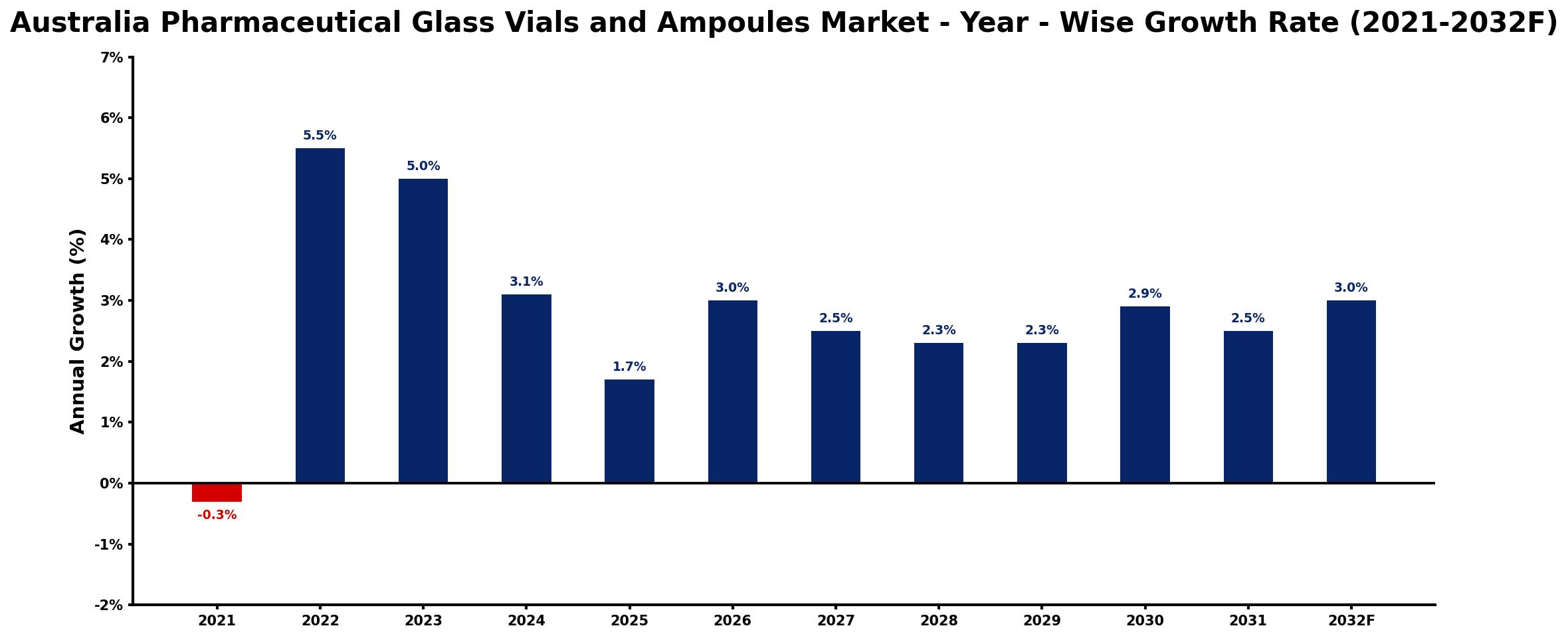
The table below presents the year‑wise growth rates along with the key drivers influencing the market
| Year | Growth Rate | Major Drivers |
| 2021 | -0.3% | decreased production capacity observed |
| 2022 | 5.5% | rising healthcare investments noted |
| 2023 | 5.0% | increased export opportunities identified |
| 2024 | 3.1% | growing demand from biotech sector |
| 2025 | 1.7% | expansion of global supply chains |
| 2026 | 3.0% | advancements in technology adoption |
| 2027 | 2.5% | increased focus on sustainability practices |
| 2028 | 2.3% | higher R&D spending reported |
| 2029 | 2.3% | emerging markets showing potential |
| 2030 | 2.9% | growing trend in personalized medicine |
| 2031 | 2.5% | surge in contract manufacturing agreements |
| 2032 | 3.0% | expansion into digital health solutions |
Note: Market size estimations and growth projections presented in this report are based on 6Wresearch's proprietary forecasting methodology, utilizing the latest available industry data, government publications, and primary research inputs.
Australia Pharmaceutical Glass Vials and Ampoules Market Synopsis
The primary force shaping the Australia Pharmaceutical Glass Vials and Ampoules Market is the surge in vaccine production post-COVID-19, which has heightened the need for reliable packaging that guarantees product integrity. Furthermore, the growing prevalence of chronic diseases continues to boost the demand for injectable therapeutics, reinforcing the critical role that glass packaging plays in the healthcare supply chain.
As pharmaceutical companies prioritize high-quality materials, advancements in lightweight borosilicate glass technology are further defining market dynamics. These innovations not only enhance the safety of pharmaceutical products but also align with sustainability initiatives aimed at reducing environmental impact through the recycling of glass containers.
Australia Pharmaceutical Glass Vials and Ampoules Market Key Takeaways
- The market is projected to grow steadily, fueled by increasing demand for injectable drugs and stringent packaging regulations.
- Investments in high-quality, break-resistant glass technologies are becoming a focus area for manufacturers.
- There is a significant opportunity for sustainable packaging solutions, responding to environmental concerns.
- Government policies ensure compliance with rigorous safety standards, supporting market integrity.
- The surge in vaccine production has catalyzed growth in the packaging segment.
Evaluation of Restraints in Australia Pharmaceutical Glass Vials and Ampoules Market
Despite the promising growth, the Australia Pharmaceutical Glass Vials and Ampoules Market is not without its challenges. Stringent regulatory requirements imposed by the Therapeutic Goods Administration (TGA) create a complex compliance landscape that manufacturers must navigate. Additionally, the rising demand for contamination-free glass vials leads to increased production costs. Supply chain disruptions, particularly in raw materials, further complicate the operational landscape, adding to the uncertainty for manufacturers aiming to meet market demands.
Australia Pharmaceutical Glass Vials and Ampoules Market Trends
Several trends are currently shaping the Australia Pharmaceutical Glass Vials and Ampoules Market. The shift towards high-quality borosilicate glass is notable, as this material offers enhanced durability and chemical resistance, critical for preserving drug efficacy. Furthermore, the industry's embrace of lightweight vial technologies is driving innovation and cost efficiency. Sustainability is also at the forefront, with more manufacturers exploring eco-friendly production methods and encouraging recycling initiatives to minimize environmental impact.
Australia Pharmaceutical Glass Vials and Ampoules Market Opportunities
The market is ripe with opportunities for growth, particularly in the domain of producing sterile and break-resistant pharmaceutical glass packaging. There is a burgeoning need for partnerships between glass manufacturers and pharmaceutical companies to ensure consistent and reliable supply chains. Additionally, investing in advanced glass forming technologies could enhance production efficiency, allowing for greater responsiveness to market demands, especially as vaccine production continues to rise.
Government Initiatives in the Australia Pharmaceutical Glass Vials and Ampoules Market
The Australian government plays a pivotal role in regulating the pharmaceutical glass vials and ampoules market through the Therapeutic Goods Administration (TGA). The TGA enforces strict guidelines that govern the safety and quality of medical packaging materials, ensuring compliance with high standards of glass purity, sterility, and resistance to contamination. Furthermore, government initiatives aimed at promoting sustainability in packaging are encouraging manufacturers to adopt environmentally friendly practices.
Future Insights of the Australia Pharmaceutical Glass Vials and Ampoules Market
Looking ahead to 2026-2032, the Australia Pharmaceutical Glass Vials and Ampoules Market is anticipated to experience steady growth driven by ongoing advancements in pharmaceutical technology and an increasing emphasis on safe and reliable drug delivery systems. The focus on sustainability will likely shape production methodologies, while strategic partnerships within the supply chain may enhance market resilience against disruptions. Overall, the convergence of health needs and innovative packaging solutions positions the market for a promising future.
Australia Pharmaceutical Glass Vials and Ampoules Market Latest Developments (2025 - 2026)
Recent developments in the Australian pharmaceutical glass vials and ampoules market indicate a strong focus on innovation, particularly in glass-forming technologies that enhance the properties of vials and ampoules. Manufacturers are increasingly collaborating with pharmaceutical companies to ensure product consistency and meet growing demands. Sustainability initiatives are also being prioritized, with various stakeholders exploring methods to reduce the environmental footprint of glass packaging.
Australia Pharmaceutical Glass Vials and Ampoules Market - Key Attractiveness of the Report
- 10 Years of Market Numbers
- Historical Data Starting from 2022 to 2025
- Base Year: 2025
- Forecast Data until 2032
- Key Performance Indicators Impacting the Market
- Major Upcoming Developments and Projects
Key Highlights of the Report:
- Australia Pharmaceutical Glass Vials and Ampoules Market Outlook
- Market Size of Australia Pharmaceutical Glass Vials and Ampoules Market, 2025
- Forecast of Australia Pharmaceutical Glass Vials and Ampoules Market, 2032
- Historical Data and Forecast of Australia Pharmaceutical Glass Vials and Ampoules Revenues & Volume for the Period 2022-2032F
- Australia Pharmaceutical Glass Vials and Ampoules Market Trend Evolution
- Australia Pharmaceutical Glass Vials and Ampoules Market Drivers and Challenges
- Australia Pharmaceutical Glass Vials and Ampoules Price Trends
- Australia Pharmaceutical Glass Vials and Ampoules Porter's Five Forces
- Australia Pharmaceutical Glass Vials and Ampoules Industry Life Cycle
- Historical Data and Forecast of Australia Pharmaceutical Glass Vials and Ampoules Market Revenues & Volume By Type for the Period 2022-2032F
- Historical Data and Forecast of Australia Pharmaceutical Glass Vials and Ampoules Market Revenues & Volume By 2ml for the Period 2022-2032F
- Historical Data and Forecast of Australia Pharmaceutical Glass Vials and Ampoules Market Revenues & Volume By 3ml to 5ml for the Period 2022-2032F
- Historical Data and Forecast of Australia Pharmaceutical Glass Vials and Ampoules Market Revenues & Volume By 6ml to 8ml for the Period 2022-2032F
- Historical Data and Forecast of Australia Pharmaceutical Glass Vials and Ampoules Market Revenues & Volume By 8ml or more for the Period 2022-2032F
- Historical Data and Forecast of Australia Pharmaceutical Glass Vials and Ampoules Market Revenues & Volume By Application for the Period 2022-2032F
- Historical Data and Forecast of Australia Pharmaceutical Glass Vials and Ampoules Market Revenues & Volume By Pharmaceutical for the Period 2022-2032F
- Historical Data and Forecast of Australia Pharmaceutical Glass Vials and Ampoules Market Revenues & Volume By Chemical Reagent for the Period 2022-2032F
- Australia Pharmaceutical Glass Vials and Ampoules Import Export Trade Statistics
- Market Opportunity Assessment By Type
- Market Opportunity Assessment By Application
- Australia Pharmaceutical Glass Vials and Ampoules Top Companies Market Share
- Australia Pharmaceutical Glass Vials and Ampoules Competitive Benchmarking By Technical and Operational Parameters
- Australia Pharmaceutical Glass Vials and Ampoules Company Profiles
- Australia Pharmaceutical Glass Vials and Ampoules Key Strategic Recommendations






































